
The best piano bench hinge is one that matches the bench’s existing lid, frame and mounting arrangement. For a conventional short-hinge replacement, start with the Schaff Piano Supply pair sold by Howard Piano Industries as S-575A. For a continuous hinge, consider the National Hardware N148-221 if you need a cut-to-length option, or the Sugatsune LSD-30-600 if a 600 mm stainless hinge fits.
These are specification-based picks for different repair needs. A hinge provides the pivot connection; a lid stay or support controls or supports the open lid. None of the three product listings establishes a soft-close or hold-open function.
Best piano bench hinges at a glance
| Exact choice | Best reason to choose it | Dimensions to match | Key limit |
|---|---|---|---|
| Schaff/Howard S-575A, one pair | Replacing a matching pair of short bench hinges | Retailer lists 1-9/16-inch width and 1-23/32-inch total length; unequal leaves | Hole spacing and a no-mortise fit are not established |
| National Hardware N148-221, one hinge | A narrow continuous hinge that can be cut to length | 30 inches long × 1-1/16 inches nominal open width | Nickel-finished steel; requires a compatible continuous-hinge mounting surface |
| Sugatsune LSD-30-600, one hinge | A fixed 600 mm length in satin stainless steel | 600 × 30 mm; 20 mounting holes | Screws are required and sold separately |
1. Schaff S-575A pair: best for matching an existing short hinge
Choose this if: your bench already uses two small hinges with unequal leaves. Howard Piano Industries lists this Schaff Piano Supply pair specifically for a piano bench or vertical piano lid, under retailer SKU S-575A.
Why it makes the list: the unequal leaves provide a specific geometry to compare with the old hardware. Howard gives a 1-9/16-inch width and 1-23/32-inch total length, with leaf measurements of 29/32 inch and 9/16 inch taken from the inside of the hinge. The finish is brass plated, not solid brass.
What to check: the listing does not supply a screw-hole-spacing drawing or establish that the hinges will fit without mortising. Compare the old hinge, its recess and its holes before ordering. The listing also does not establish screw inclusion or a lid-weight capacity, so confirm those details if they affect the repair.
View the S-575A pair at Howard Piano Industries.
2. National Hardware N148-221: best for a cut-to-length continuous hinge
Choose this if: your bench has room for a narrow continuous hinge, and a 30-inch starting length suits the job. This pick is the nickel-finish N148-221, not a different width or finish from the same product family.
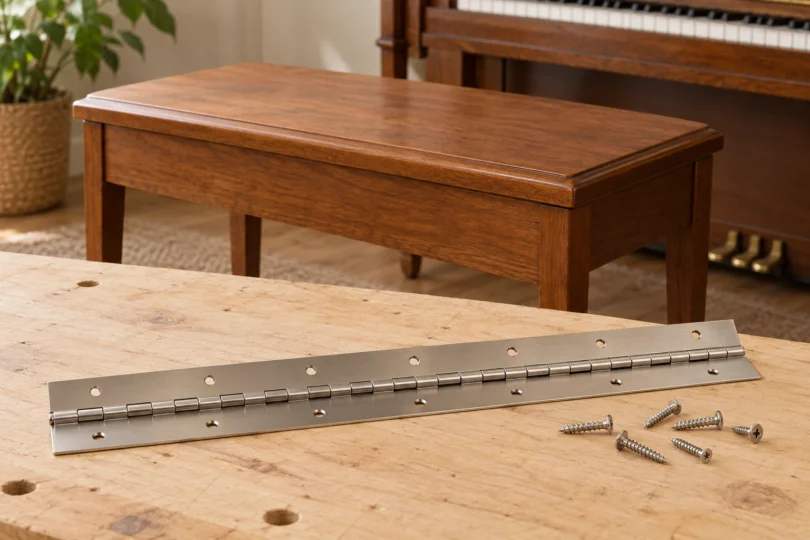
Why it makes the list: National specifies a cold-rolled steel body and steel pin, surface mounting, and permission to cut the hinge to the desired length. The nominal open width is 1-1/16 inches. A manufacturer drawing identifies N148-221 and provides the dimensions and hole layout for checking the available mounting surface.
What to check: a continuous hinge is not automatically a drop-in replacement for two short hinges. Check the bench’s rear rail, lid clearance and screw positions. The drawing specifies #5 × 3/4-inch flat-head wood screws; confirm that the mounting material can accept that length. National’s “friction type pin” description concerns pin retention, not a promise that the lid will stay open.
View National Hardware N148-221.
3. Sugatsune LSD-30-600: best for a 600 mm stainless replacement
Choose this if: a continuous hinge measuring 600 × 30 mm matches the bench and you prefer satin-finish 304 stainless steel. The exact model is LSD-30-600, sold individually.
Why it makes the list: the manufacturer’s catalog documents 20 mounting holes and a 1.2 mm leaf thickness for this size. Its double-folded construction and crimped end knuckles are identified in the product documentation, giving you more to check than a generic “heavy-duty piano hinge” label.
What to check: the product page calls for 2.5 mm or #3 screws, which are not included. Compare the drawing’s hole positions with sound wood in the lid and frame. Buy the length you need; do not assume the crimped-end design can be shortened like the National hinge. The similarly named LSN range is a weld-on design, so it is not an interchangeable screw-mounted choice.
What to check before buying
- Hinge type: match a short hinge pair or a continuous hinge to the existing mounting arrangement. Changing the type may require modifying the bench.
- Leaf shape and thickness: compare both leaves, any recesses and the position of the hinge barrel. Overall length alone does not establish fit.
- Hole positions and fasteners: check spacing, screw-head style and screw length against the available wood. Damaged or enlarged holes need attention before a replacement hinge can be securely fitted.
- Lid movement: make sure the chosen arrangement allows the lid to close and open without binding against the frame, upholstery or nearby piano.
Do you need a hinge or a lid support?
If the pivot hardware is broken, a matching hinge may be the right replacement. If the lid falls while you reach for music, replacing an ordinary hinge alone does not establish a safe hold-open solution. Look for a separately specified support or a combined mechanism designed for the particular lid and mounting arrangement.
Sugatsune’s lid-support guidance uses lid size and weight to determine torque requirements, and also calls for checking mounting configuration and hinge compatibility. A generic “supports 40 pounds” claim leaves out important fit information.
Likewise, an opening stop, a hold-open stay and a soft-close damper serve different purposes. Do not treat those labels as interchangeable, or assume a replacement marked “piano hinge” includes any of them.
Does a hinge rating tell you how much weight the bench can hold?
No. The seating capacity of the complete bench depends on its structure and condition. None of the three listings provides a bench-occupancy rating. A replacement hinge does not establish that a damaged seat, frame, joint or leg is safe to use. For a repair that changes how the lid or bench carries weight, have a qualified repairer assess the construction.