

The best police badge holder is the one that fits your actual badge, fastener and approved carry method. Start with those three details before choosing leather, a neck chain or a particular brand. A holder described as universal may still be unsuitable for an oversized star, a curved badge or an unusual attachment.
For a reversible badge-and-ID carrier, compare the Aker 597. For a leather star-badge belt carrier, look at the Aker 592. For a round synthetic clip-on holder with a published diameter, the Safariland 7350-01 is a useful alternative. The comparisons below use manufacturer specifications and identifiable retail variants; we have not performed retention, comfort or long-term wear tests.
This guide concerns holders for credentials you are authorized to carry. Check your agency or employer’s display and equipment requirements first. A holder is an accessory, and the products discussed here do not establish anyone’s identity or authority.
A short list by carry style
| Holder | Carry format | Useful verified detail | Check before buying |
|---|---|---|---|
| Aker 597, A597-BP | Reversible neck badge and ID holder | Cowhide construction; beaded chain included | Your badge and ID dimensions; suitability of neck carry |
| Aker 592, A592-BP | Leather clip-on star-badge holder | Fits belts up to 1.75 inches wide | Badge outline, fastener and belt thickness |
| Safariland 7350-01-2 | Round synthetic clip-on holder | 3-inch diameter; belt clip accepts up to 1.75 inches | Badge footprint and attachment clearance |
Aker 597: badge and ID in one neck carrier
The Aker Model 597 is a reversible cowhide badge-and-ID holder designed for neck carry. Aker includes a beaded chain and states that the badge itself is not included. The verified black, plain-finish retail version is A597-BP.
This format makes sense when you need to carry both an issued badge and an identification card without adding a second holder. The reversible arrangement lets you present the appropriate side. It may be less convenient if your work requires the badge and the full ID to remain visible at the same time.
Aker describes broad badge compatibility, but the retail description is narrower and mentions common oval and round styles. Treat neither phrase as a substitute for checking the outline and mounting hardware. Ask the seller for the usable ID-window dimensions if your credential is larger than a standard card. A supplied metal chain should not be assumed to have a breakaway feature unless that is explicitly specified.
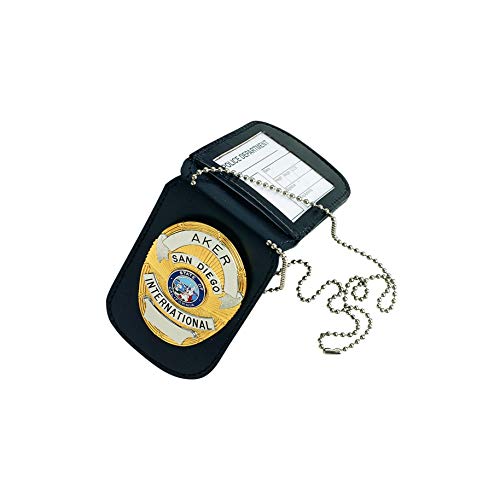
Aker Leather 597 Neck Badge & ID Holder, Black Reversible Design | Chain, Fits Most Standard Oval and Round Cutout Badges and ID Cards, Leather Construction Uniform or Undercover Wear
As an Amazon Associate we earn from qualifying purchases.
Aker 592: a leather belt option for a star badge
The Aker Model 592 uses cowhide and solid brass snaps, with a black clip accepting belts up to 1.75 inches wide. It is designed for a star badge. The linked black, plain version is A592-BP; the badge is not included.
Choose this shape when your badge matches its intended mounting area and you want a dedicated leather carrier rather than a combined wallet. The belt-width specification gives you a concrete starting point, but also check belt thickness and whether the clip can engage fully.
The number and proportions of a star’s points matter. Do not choose the holder merely because a product photograph contains a star that looks similar. Compare the widest point-to-point measurement, total height and position of the attachment. If a tip projects beyond the backing or prevents the holder from closing properly, ask about a different holder instead of forcing the fit.

Safariland 7350-01: a round synthetic alternative
The Safariland 7350-01 is a 3-inch-diameter round holder designed to carry a star badge. Safariland specifies a leather-look synthetic body and a metal belt clip for belts up to 1.75 inches wide. The verified black, plain retail listing is 7350-01-2, corresponding to manufacturer SKU 1100881.
This is worth comparing if you prefer synthetic material or want a circular backing with a stated overall dimension. The 3-inch figure describes the holder, so do not assume every badge up to that size will fit. You still need room for the badge’s shape and rear hardware.
Some retail specification fields are generic or inconsistent, including material descriptions. Use Safariland’s product description for the construction and dimensions, and confirm the complete model number rather than substituting another 7350-series shape. The oval and teardrop versions are different selections.

Measure the badge before you measure the holder
Place the badge face upward on a flat surface where it will not scratch. Record the widest and tallest points. A curved badge also needs depth clearance; two badges with identical front outlines can sit differently because one has a pronounced curve or a taller rear fitting.
Then record how it attaches. A pin, screw post or other fastener needs a compatible passage and enough room behind the backing. Note the orientation and spacing without modifying the issued badge. A front-facing product photograph rarely shows enough detail to settle this part of the purchase.
For an existing holder that fits well, measure the usable mounting area and compare its construction with the replacement. Overall wallet dimensions are less useful than the recess dimensions, opening position and closed thickness. Photographing the empty holder beside a ruler can help you ask a precise fit question without sharing an image of sensitive credentials.
Understand recessed cutouts and universal holders
A recessed holder has an opening shaped for a particular badge outline. This can keep the badge seated neatly, but it depends on choosing the correct cutout. Similar agency names, badge ranks or product photographs do not establish an exact match.
Perfect Fit provides a badge-cut finder for its products. If you choose a custom-cut holder, identify the badge model and the holder maker’s cutout number before ordering. A badge manufacturer’s model number and a holder manufacturer’s cutout code are separate references; keep both in your order notes.
A universal holder generally offers broader shape compatibility, but ask what that means for the specific design. It may use a flat backing rather than a shaped recess. Check whether the badge can sit straight, whether the fastener can close completely and whether any edge presses against the ID window or outer fold.
If the seller supplies a printable sizing template, print it at the stated scale and verify a reference measurement with a ruler. A browser or printer that automatically shrinks a page can turn a promising fit into the wrong purchase. Do not trim a holder or alter a badge simply to make an uncertain combination work.
Choose belt, neck or wallet carry for the actual task
A belt holder keeps the badge separate from cards and cash. Check how it behaves with the belt and clothing you actually wear, including whether a jacket blocks the required display. A clip’s stated maximum belt width is an upper limit to verify, not a promise that every belt below it will hold equally well.
Neck carry brings the badge and possibly an ID window together, but chain length, clothing and snag exposure affect suitability. Follow workplace requirements for neck-worn items. If a breakaway attachment is required, choose a documented compatible solution rather than assuming any included chain meets that requirement.
A badge wallet can be practical when protected storage matters more than continuous display. Consider whether its fold can close without pressing the badge into the credential. A thick stack of bank cards or receipts may create a problem that the empty product photographs cannot show.
Check the credential window separately
Measure the complete ID, including any laminate border. Compare that with both the pocket size and the visible window. A card can slide into a pocket while its photograph, expiry date or other required information remains obscured by the frame.
Decide whether the card must stay inside the holder to be read, tapped or scanned. If your workplace uses an access system, check compatibility with its reader and any shielding in the holder. An RFID-blocking claim is not automatically a benefit for a credential you need to present repeatedly.
Ask whether the window is replaceable if it becomes scratched. When the badge holder and ID sleeve are integrated, a damaged window may otherwise mean replacing a larger accessory. Avoid adding improvised layers that interfere with the intended closure or make the credential difficult to inspect.
Inspection and care after delivery
Before putting the holder into regular use, inspect the stitching, clip, closure and backing. Confirm that the badge mounts as intended and that the rear fastener is fully secured. Try the empty carrier on the intended belt first, then check the complete setup in a safe setting.
Do not treat this check as a substitute for agency inspection or an equipment standard. If the holder slips, rotates excessively, fails to close or leaves a sharp edge exposed, resolve the fit issue before relying on it.
Follow the maker’s cleaning instructions for the actual material. Leather-look synthetic and cowhide can require different care. Keep liquids away from credentials and the inside of clear windows, and allow a damp holder to dry naturally unless its instructions say otherwise.
Quick buying checklist
- Authorized carry method and required display format confirmed
- Badge width, height, curvature and attachment recorded
- Exact model or custom cutout identified
- Belt width and thickness checked, or neck attachment approved
- ID fits and remains readable
- Return terms checked, especially for a custom-cut product
Choose the carry format first, then the exact fit. The Aker 597, Aker 592 and Safariland 7350-01 solve different carrying problems, so the strongest choice depends on your credentials and daily use rather than a universal ranking.
Image note: Existing category illustration retained from the original article.