
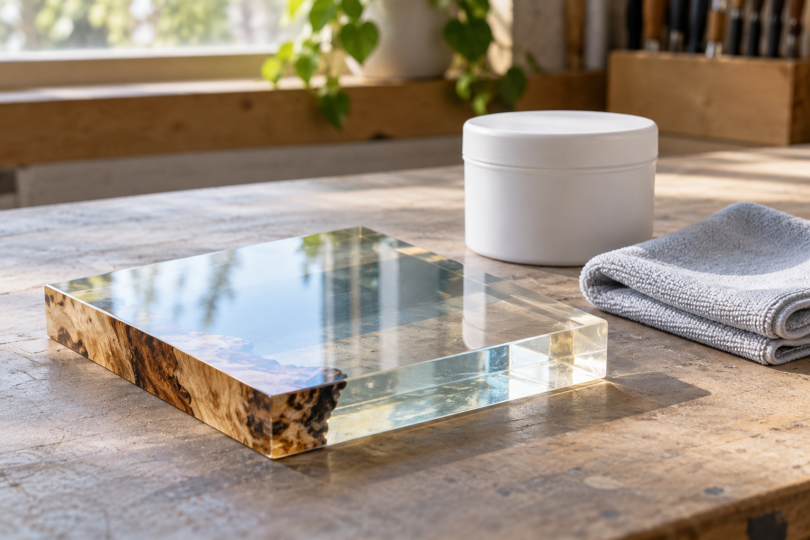

For a cured GlassCast project that has been sanded ready for polishing, NW1 is our starting choice. TOPFINISH 2 suits the later finishing stage, EPODEX POLISH offers a separate P3000 preparation route, and TotalBoat owners have a manufacturer-recommended TotalBuff and TotalShine pairing.
Choose the compound for your resin system and the finish you have now. These recommendations compare manufacturer instructions and documented uses; they are not hands-on test results.
Only polish fully cured resin. Check your resin maker’s instructions before starting, and do not treat a generic number of days as a cure guarantee for every formulation and working condition.
Our choices at a glance
| Choice | Best fit | Main tradeoff |
|---|---|---|
| GlassCast NW1, 100g | First compound after the maker’s 1200-grit preparation | Needs proper sanding first |
| GlassCast TOPFINISH 2, 100g | Fine finishing after cutting, or very light use scratches | Does not replace a cutting compound |
| EPODEX POLISH, 200ml | Fully cured resin prepared to P3000 | Its preparation instructions differ from NW1’s |
| TotalBoat TotalBuff quart + TotalShine pint | Following TotalBoat’s TableTop Epoxy polishing recommendation | Two separate products; this is not a universal epoxy compatibility claim |
1. GlassCast NW1: our first pick for the cutting stage on GlassCast resin
NW1 is a coarse cutting compound that GlassCast specifically recommends for its epoxy surface and casting resins. The selected 100g pack is one of three manufacturer-listed sizes; 500g and 1kg are the larger alternatives.
Its clearest use case is a GlassCast tabletop, casting or edge that has already been flattened and sanded through the prescribed progression to a smooth 1200-grit finish. GlassCast permits hand and machine application, so a small job does not automatically require buying a powered polisher.
The benefit is a clearly documented first polishing stage. The limitation is the preparation: buying a stronger compound is not a substitute for removing the previous sanding scratches.
Check GlassCast NW1 and choose the 100g pack.
2. GlassCast TOPFINISH 2: best for an additional finishing stage
TOPFINISH 2 is the finer companion to a cutting compound such as NW1. We would choose the 100g pack for someone who already has the cutting stage covered and wants to add a finishing product.
GlassCast says the surface should already be smooth and glossy before using it. It also describes use on very fine scratches from normal wear, but explicitly distinguishes those from sanding marks left by incomplete preparation.
That makes TOPFINISH 2 a useful optional second purchase, rather than the first bottle for a dull, freshly sanded slab. Both hand and powered application are supported; an extra stage still means extra work and another product to buy.
Check TOPFINISH 2 and choose the 100g pack.
3. EPODEX POLISH: best for the EPODEX P3000 preparation route
The current EPODEX product page identifies a 200ml polishing paste for epoxy resin, although its URL retains “100ml.” Use the current product title and selected package when ordering.
EPODEX describes this polish for polyurethane and epoxy surfaces and touch-ups. Its instructions call for sanding through the grits to P3000, removing dust and residue, applying a small amount with a soft cloth or pad, then buffing and removing the residue.
This is our alternative for someone following EPODEX’s own preparation sequence. Compared with NW1’s GlassCast instructions, it calls for a finer sanding endpoint; do not mix the two recipes and assume they are interchangeable.
Check EPODEX POLISH, currently described as 200ml.
4. TotalBoat TotalBuff and TotalShine: best for TotalBoat TableTop Epoxy
TotalBoat’s support guidance explicitly recommends TotalBuff and TotalShine for polishing cured TotalBoat TableTop Epoxy. The current product pages list TotalBuff in a quart and TotalShine in a 16-fluid-ounce pint; this selection is two separate products.
Choose this pairing if you want to follow that resin manufacturer’s named system. TotalBuff is the cutting product and TotalShine is the finer finishing compound; TotalShine’s page also states that it contains no wax or silicone.
The important boundary is substrate approval. The retail product descriptions mainly discuss boat gelcoat, while the separate support article supplies the specific TableTop Epoxy recommendation. We would not extend that recommendation to an unidentified casting resin or substitute the gelcoat sanding recipe for epoxy instructions.
Check TotalBuff, quart and TotalShine, pint, then follow TotalBoat’s TableTop Epoxy guidance.
What to check before you buy
- Identify the stage. A cutting compound and a fine finishing polish solve different preparation problems; TOPFINISH 2 is explicitly a finishing product.
- Follow one compatible process. NW1’s GlassCast route starts polishing after 1200-grit preparation, whereas EPODEX specifies P3000. Those are product-specific instructions, not a universal minimum grit.
- Plan to control heat and residue. GlassCast advises stopping to let the resin and pad cool fully if the resin feels hot, and removing NW1 residue before the TOPFINISH 2 stage.
- Read the actual safety data. Check the selected compound’s SDS, the resin instructions and your tool manual before work. Protective equipment and exposure controls must match the products and task.
Frequently asked questions
Can I polish resin before applying another layer?
EPODEX explicitly says not to polish between resin layers. If another coat is planned, follow that coating system’s surface-preparation instructions instead of this gloss-finishing shortlist.
Why does the surface still look hazy?
Check the preparation and amount of compound before buying another polish. GlassCast advises checking that earlier scratches are removed before moving on; EPODEX warns that too much polish can leave a milky appearance.
Can I polish by hand?
GlassCast supports hand application for both NW1 and TOPFINISH 2, and EPODEX gives a cloth-or-pad application method. Match the method to the product’s instructions and the size of the job.
