


The best powdered drink mix depends on what you want the drink to do. True Lemon Original Lemonade is a convenient choice for a lightly sweetened bottle of water. Crystal Light Lemonade pitcher packets suit a household that wants to make a larger batch with no sugar. Gatorade Thirst Quencher powder serves a different purpose: a carbohydrate-and-electrolyte sports drink.
Those differences matter more than a long list of flavors. A packet for a water bottle, a packet for a two-quart pitcher and a scoop of sports-drink powder are not interchangeable. This guide compares their published specifications and preparation directions; it does not claim a taste-test winner.
Choose the format before choosing a flavor
| Drink mix | Useful for | Package in the product link | Main tradeoff |
|---|---|---|---|
| True Lemon Original Lemonade | Portable, lightly sweetened lemonade | 30 stick packets | Contains stevia and a small amount of sugar |
| Crystal Light Lemonade | Shared pitchers and refrigerator batches | Six pitcher packets, 3.2 ounces total | Contains aspartame, acesulfame potassium and soy |
| Gatorade Thirst Quencher, Frost Glacier Freeze | Preparing a conventional sports drink | One 76.5-ounce canister | Requires careful measuring; not a zero-sugar flavoring |
True Lemon Original Lemonade: for a water bottle
True Citrus lists Original Lemonade as caffeine-free, with 10 calories and 1 gram of sugar per stick. It combines lemon ingredients with stevia and cane sugar. The suggested preparation is one stick in 16 ounces of water, making this the easiest format here to keep in a work bag or beside a refillable bottle.
Choose it if you want sweetness without a full-sugar lemonade. Stevia is still a sweetener, and personal taste varies, so try a small supply before buying a case. This is Original Lemonade, not the brand’s unsweetened crystallized lemon seasoning and not an Energy variety.
The linked pack contains 30 sticks. True Citrus notes that its ingredient formulation and packaging are changing, so check the box you receive rather than relying on older claims about sodium or vitamin content.
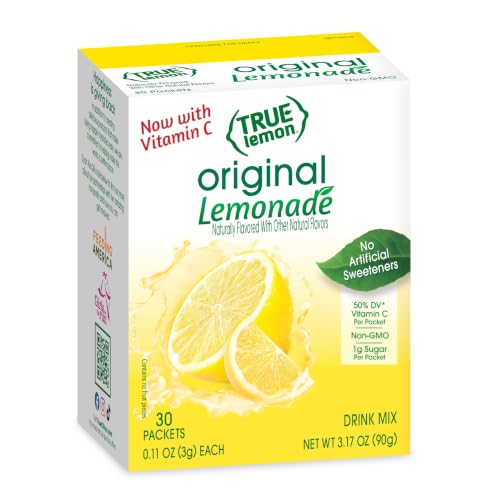
True Lemon Original Lemonade Powdered Drink Mix Packets, 30 ct | Non-GMO, gluten free, low calorie water enhancer, no artificial sweeteners, 50% Daily Vitamin C
As an Amazon Associate we earn from qualifying purchases.
Crystal Light Lemonade: for a pitcher
Kraft Heinz’s six-packet Lemonade mix makes a two-quart pitcher from each packet. Its listed nutrition is 5 calories and zero grams of sugar per labeled serving. One packet makes multiple servings, so the calorie number does not describe the whole pitcher.
This is a useful arrangement when several people share a drink or you want a batch ready in the refrigerator. The ingredients include aspartame and acesulfame potassium, and the manufacturer declares soy. Check those details if you avoid a particular sweetener or allergen.
The brand directs users to keep the prepared drink covered in the refrigerator and not to store it in a metal container. Use the entire pitcher packet with the stated water volume; estimating a tiny fraction of the dry powder is less convenient than buying bottle-sized sticks.

Gatorade Thirst Quencher powder: for a sports-drink format
Gatorade Thirst Quencher Frost Glacier Freeze is the conventional carbohydrate-and-electrolyte option in this comparison. PepsiCo’s information for the 76.5-ounce canister lists about 94 servings and zero caffeine. That serving count is a nutrition-label count, not 94 full-size bottles.
A canister makes sense when you repeatedly prepare the same drink and have room to measure it. It is less convenient than individual sticks for someone mixing a drink at a desk or while traveling. Keep the supplied scoop dry and follow the container’s directions for the exact amount of water and powder.
Do not assume that adding extra powder makes a better hydration drink. It changes the concentration of the carbohydrates and electrolytes as well as the flavor. If you want a zero-sugar product, check a separately labeled formula rather than expecting ordinary Thirst Quencher to fill that role.

How to read the numbers fairly
Compare the amount you will actually drink. The FDA explains that Nutrition Facts usually describes one serving, while a package can contain several. A bottle holding two servings contributes twice the listed amounts if you finish it. Adding more water changes concentration, but it does not remove sugar or calories from the powder already added.
Write down three things when comparing labels: powder per serving, water per serving and servings in your bottle. Then compare calories, added sugar and sodium on that same basis. This avoids treating a small glass of one drink as equivalent to a large bottle of another.
For value, divide the total purchase cost by the amount of correctly prepared drink. Packet count alone can be misleading: six pitcher packets can make more beverage than a larger number of single-bottle sticks. Include shipping and avoid a large multipack until you know you like the flavor.
Flavoring, sports drinks and energy drinks
A low-calorie flavoring can make water more appealing, but extra vitamins or the word “hydration” do not by themselves establish a need for a product. CDC’s drinking-water guidance recommends water as a regular choice and notes that sugary drinks, including sports drinks, add calories. An everyday desk drink and a drink selected for a demanding training session need not be the same.
Energy powders are another category. Look for the actual caffeine amount and serving directions, particularly in variety packs containing both caffeinated and caffeine-free flavors. Do not assume every product sold under one brand has the same formula. If you have been told to restrict sodium, sugar, fluids or caffeine, use your clinician’s advice when selecting a mix.
People with phenylketonuria need particular care with aspartame. The FDA advises people with PKU to avoid or restrict it. That is a specific dietary issue, not a reason to label all low-calorie sweeteners unsafe.
A practical first purchase
Start with one flavor in the format you will use most. A portable packet is worth paying for if measuring a canister is impractical; a pitcher pack is wasteful if most of the prepared drink goes untouched. Read the mixing directions before choosing a bottle or container, then use clean drinking water and follow the package’s storage instructions.
Keep unopened powder dry and reseal a canister promptly. Check the ingredient label again when reordering, since a familiar front label can outlast a formula change. For most buyers, a modest first order and a clear purpose produce a better result than a bulk assortment bought solely because it has the largest packet count.
Image note: Examples from the product category; pictured models and variants may differ from the options discussed.


