
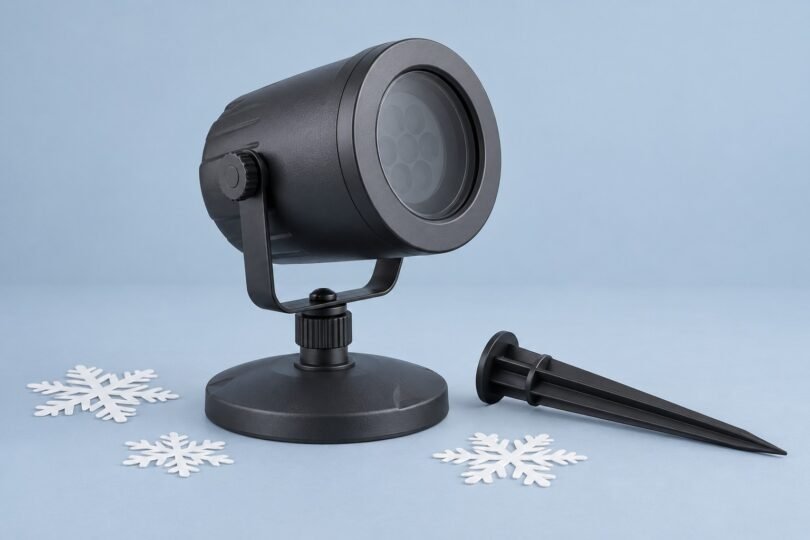

For recognizable white snowflakes on a house or garage, start with an LED image projector that explicitly lists a snowflake effect. Then check the projector and power adapter separately for outdoor suitability, measure the distance to your wall, and compare the controls you will actually use. A large advertised coverage area is not enough to establish that the picture will look good in your yard.
The LOFTEK binocular snowflake projector is a focused option to compare for white winter effects. AGPTEK’s no-slide 2-in-1 projector is more relevant if you also want colorful backgrounds and other holiday images. These are specification-based choices using manufacturer documentation, not results from hands-on brightness or weather testing.
Choose the effect before choosing the projector
- Snowflake images: distinct decorative shapes, often rotating across the surface. Check whether you can slow or stop their movement.
- Snowfall spots: moving white dots that suggest falling snow. These may suit the atmosphere you want, but they do not necessarily form detailed snowflakes.
- Pattern-and-wave projectors: image effects paired with a colored ripple background. Confirm that the background can be switched off if you want a simple white display.
- Laser star fields: a separate category. Do not assume a listing with “laser,” “LED” and “snow” in its title produces the same effect as an LED snowflake projector.
Some devices combine different light sources. Read the manual’s light-source description rather than relying on the shopping category or the appearance of a product photo. This guide favors documented LED image projection for its snowflake purpose; it does not recommend stage lasers or indoor galaxy projectors for outdoor decoration.
LOFTEK binocular snowflake projector: a white winter display
The linked LOFTEK listing identifies a Cool White projector, ASIN B09BF6HF47, manufacturer part number 03-22-US-508-010202. Its package description contains one projector, rather than two separate units: “binocular” refers to the dual-lens design. The listing describes large snowflakes, small snowflakes and snow spots.

LOFTEK 03-22-US-508-010202 LED snowflake projector, Cool White, one projector
As an Amazon Associate we earn from qualifying purchases.
The LOFTEK manual specifies an IP65 projector and IP44 power adapter, a 5-meter cord, and an operating range of -20°C to 50°C (-4°F to 122°F). It includes a ground stake and mounting plate. The remote offers fast, slow and stopped rotation, separate flashing control, and 2-, 4- or 6-hour timer buttons. The documented automatic cycle is six hours on and eighteen hours off.
For initial placement, the manual suggests roughly 10–15 feet from the surface, followed by adjustment. Its specification table gives a broader 3–10-meter projection range; neither figure guarantees a sharp whole-house display. Important limitations: the remote is not waterproof, the light must stay out of standing water, only the supplied adapter should be used, and the manual says not to use dimmers.
AGPTEK no-slide 2-in-1: for multiple holiday patterns
The AGPTEK no-slide 2-in-1 projector combines an image head with a water-wave head. The manufacturer lists a snowflake among its Christmas and Halloween designs and says the two effects can operate together or separately. This is worth comparing if you want to change themes throughout the year; it is less targeted than a dedicated white snowflake light.
The product page and its linked instructions specify an IP65 lamp and IP44 power supply. The operating range is 5°F to 113°F (-15°C to 45°C). The package lists one projector with a stake, base, adapter and remote; the cord is approximately 16.4 feet. Timer controls are 4, 6 and 8 hours.
Use the exact no-slide product page when comparing offers. AGPTEK has other similarly named projectors, including the SY-818, and their instructions should not be treated as interchangeable. For this version, the English instructions suggest 16.4–26.3 feet from the projection surface in dark conditions. Check the supplied documentation and regional plug before ordering.
Outdoor suitability means checking the whole setup
IP ratings describe enclosure protection. The two digits address solid-object or dust ingress and water ingress, respectively. In the IP rating explanation from Zebra, water level 4 concerns splashes and level 5 concerns water jets. An IP65 lamp with an IP44 adapter does not become an entirely IP65 system. Neither of those ratings is an immersion rating.
Look for separate instructions covering the lamp, transformer, cord connections and remote. Keep the adapter and connections positioned and protected as the manufacturer requires, away from puddles and accumulating snow. A weather-resistant lamp body does not make an indoor extension cord or an exposed plug connection suitable for rain. Do not improvise a sealed plastic-bag enclosure around powered equipment.
“Outdoor” may also come with a shelter requirement. For example, Airam’s snowflake projector 9478594 is specifically described for indoor use or outdoors under a roof. That is a useful reminder to read the actual placement restrictions. An IP number also does not replace a model’s temperature limits: check your expected overnight low, not just the temperature when you install it.
Distance, wall texture and competing light
Measure the available placement distance before shopping. A projector intended to sit several meters from a wall may be awkward on a narrow porch. Start within the exact manual’s suggested range, then assess the image after dark with the porch and street lighting in their normal state.
Think of coverage as a compromise rather than a score. Spreading the effect across a larger area can make individual details harder to see. A smooth, pale garage door is a more straightforward trial surface than a façade broken up by dark brick, windows, shrubs and deep trim. These are practical placement considerations, not measured performance claims for the models above.
Try a small, clearly defined target first. Check from the viewing position people will actually use, then adjust distance and angle within the instructions. Avoid assuming that buying a second light will solve a poor first placement: overlapping patterns may simply make the scene busier. Choose a return policy that lets you assess the effect in your own conditions.
Mounting and controls that make everyday use easier
A ground stake suits an appropriate patch of soil; a base needs a stable, permitted surface. Verify what the package includes and how the manual allows it to be secured. Do not force a plastic stake into frozen ground, leave a loose unit where wind can redirect it, or position the cord across a walking route. Higher mounting is not automatically better, especially when it makes maintenance or safe aiming difficult.
Decide whether you want steady shapes, gentle movement or flashing before buying. Look for an explicit stop-rotation setting rather than assuming “speed control” includes it. A timer can reduce nightly adjustments, but check whether it repeats daily and what happens after power is interrupted. Do not assume a remote-controlled light will remember its settings when an external timer cuts power.
Set it up without creating a hazard
- Inspect before connecting. Do not use a cracked housing, damaged lens, frayed cord or damaged adapter. Use the manufacturer’s supplied power equipment and instructions.
- Use appropriate outdoor power. The CPSC’s holiday-light guidance recommends outdoor-rated products and cords, recognized safety-testing labels, and GFCI-protected circuits. Have a qualified electrician address unsuitable outlets rather than modifying plugs or wiring.
- Contain the display on a solid surface. Aim away from people’s eyes, traffic, neighboring windows and the sky. Check the entire moving pattern, not just its center, and recheck if the mount shifts.
- Keep lasers out of this plan. The FDA explains the eye and driver hazards of laser beams. The FAA warns specifically about holiday laser displays reaching aircraft. Never aim a light at an aircraft; if a display spills beyond its safe target, switch it off and correct the setup.
- Switch off before bed or leaving home. Follow CPSC guidance even if a longer timer setting is available. Keep remotes, small batteries and sharp stakes away from children.
The practical buying decision
Compare the LOFTEK when white snowflake movement is the main goal, and the exact AGPTEK no-slide version when varied holiday imagery matters more. Before buying either, confirm the selected model, light color, one-projector package, local plug, adapter rating and operating limits. A clear picture on your chosen wall, safely contained and easy to control, matters more than an exaggerated coverage claim or a long list of unrelated decorations.


