
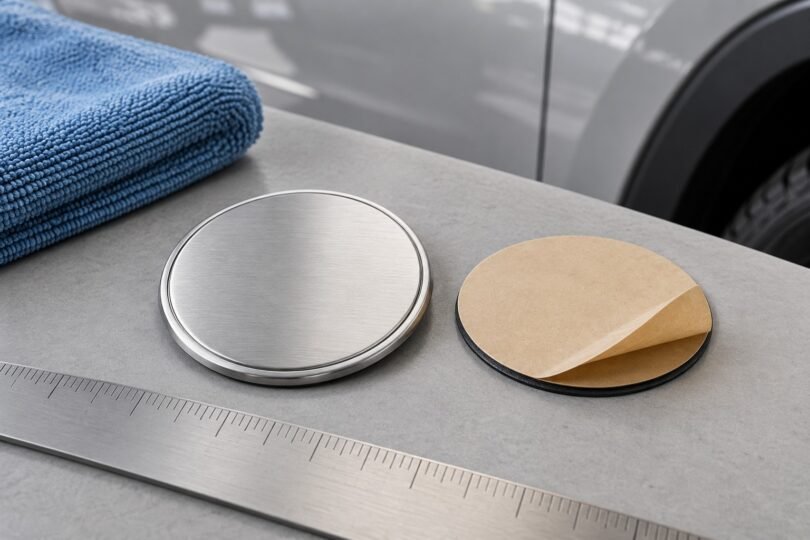

To replace a Trail Rated Jeep badge, start with the vehicle’s VIN and the correct Mopar part number. Matching a round emblem by its color or diameter alone can leave you with the wrong finish, backing or application.
The badge also has a meaning beyond its appearance: Jeep uses Trail Rated to identify vehicles that have passed its off-road capability testing. Buying and attaching a replacement emblem does not certify a vehicle, add four-wheel drive or change its capabilities.
What does Jeep’s Trail Rated badge mean?
Jeep’s Trail Rated explanation identifies five testing categories:
- Traction: putting available grip to work across challenging terrain.
- Water fording: vehicle provisions and limits for traveling through water.
- Maneuverability: steering and negotiating obstacles or tight spaces.
- Articulation: suspension movement that helps maintain tire contact on uneven ground.
- Ground clearance: space and approach, breakover and departure geometry for clearing obstacles.
The emblem is not a universal water-depth or obstacle-clearance specification. Use the owner’s manual for the exact vehicle, and account for its condition and equipment. Jeep specifically warns against attempting water crossings without knowing the depth and checking the vehicle’s stated limit.
Choose the kind of badge you actually want
A replacement for a factory Trail Rated emblem
For a missing, damaged or faded factory badge, use the Mopar catalog or a Jeep parts department to identify the replacement. Supply the VIN, model year, model, trim and the badge’s location. Keep a photo of the original and any readable part number, but do not assume that a previous owner fitted the correct emblem.
A genuine-part listing should identify the manufacturer and a complete part number. Ask the seller to confirm any superseded number and whether the new part preserves the appearance you want. If you are restoring a factory finish, ask specifically about the background, lettering, outer ring and surface finish.
An overlay or a decorative emblem
An overlay changes the appearance of an existing badge. A complete replacement takes its place. Confirm which the listing supplies before removing anything: an overlay may depend on an intact original emblem and an exact face shape.
Novelty badges such as “Duck Rated” or “Beach Rated” are decoration. They should not be treated as proof of Jeep’s testing, a replacement for vehicle records or an off-road equipment upgrade. Likewise, a seller describing an item as “for Jeep” does not by itself establish that Mopar made it.
A Badge of Honor trail award
Jeep’s Badge of Honor program is separate: it recognizes participating trail experiences through its app and community. If you want an award associated with a trail you completed, use that program’s current process. A Trail Rated replacement medallion serves a different purpose.
Why a Mopar part number matters
The official Mopar nameplate catalog for a 2023 Wrangler configuration shows several Trail Rated medallions at the same diagram reference. The description alone does not tell you which version to order.
- Mopar 5043160AA is identified as a Trail Rated front-fender medallion for right or left placement.
- Mopar 68309634AC carries the same basic Trail Rated, right-or-left description.
- Mopar 68292505AB is another Trail Rated front-fender medallion; its listing says it replaces 68292505AA.
These are catalog examples, not universal-fit recommendations. The product pages reviewed did not provide populated year/model fitment tables. Confirm the current part for your VIN with the supplying dealer before purchase. Do not treat an entry under one catalog configuration as proof that every listed part is interchangeable.
“Right or left” describes an application position. It does not establish that a listing contains two badges. Confirm the number supplied, whether adhesive or mounting components are included, and whether any installation materials must be ordered separately.
Check these details before placing an order
- Vehicle and part match: record the VIN, exact part number and any dealer-confirmed replacement number.
- Purpose: confirm full replacement, overlay or decorative decal.
- Dimensions and shape: compare width, height, thickness and the rear profile with the original mounting area. A matching diameter alone is not enough.
- Finish: check the actual selected version rather than relying on the first gallery photo.
- Attachment: ask whether it uses pre-applied tape, separate adhesive, locating features or another mounting arrangement.
- Package: establish the badge count and included backing or hardware in writing.
- Returns: read the supplying seller’s conditions before peeling the liner, installing the part or ordering a special-order finish.
Keep the order confirmation and part-number label until the replacement has been checked. If the delivered part differs from the description or the confirmed fit, resolve that with the seller before installation.
Plan removal and installation around the actual part
Before removing the original, photograph its position and measure from nearby fixed panel edges. Preserve those references so the replacement does not end up tilted or placed differently from the other side. Check for previous repainting, damaged clear coat, a wrap or paint-protection film that could change the removal and bonding approach.
Use the instructions for the confirmed badge and attachment material. 3M’s automotive attachment guidance distinguishes tape products and repair procedures for different trim applications. “Double-sided tape” is a category, not a complete installation specification.
For the products covered by its automotive attachment-tape repair procedure, 3M warns against applying new tape over old tape or residue, touching the exposed adhesive, or leaving it exposed before installation. It also specifies application conditions and pressure. Those instructions do not establish a universal cure time or confirm the adhesive on an unidentified badge.
Ask the installer or supplier which cleaners, preparation steps, temperature range and waiting period apply to your paint and adhesive. Avoid improvised metal-prying, aggressive scraping or heating based on a generic online tip. If the old badge resists removal, the paint is compromised or the mounting method is uncertain, have a body shop or experienced detailer assess it.
Common questions
Will any round Trail Rated badge fit any Jeep?
No universal fit should be assumed. The official catalog contains multiple part numbers with similar descriptions. Check the exact application, appearance, backing and quantity for the vehicle you are repairing.
Can I tell whether a used Jeep is Trail Rated just by the badge?
A visible emblem can be added or replaced. Confirm the vehicle’s original configuration through its records and a Jeep dealer rather than treating the badge alone as proof.
How can I check who made a badge?
Check what the seller actually represents: a genuine Mopar part, an overlay, or a separately branded decorative item. Ask for the manufacturer and exact part number. A familiar design or logo in a photograph is not enough to verify the seller’s claim.
Does the badge affect off-road performance?
The replacement emblem is a cosmetic part. It does not change tires, suspension, driveline, clearance or vehicle operating limits. Choose it for correct fit and appearance, and use the vehicle’s documentation to understand its capabilities.
What is the best replacement to buy?
For a factory-style repair, the most useful choice is the current Mopar part confirmed for your VIN and desired finish, supplied with the correct attachment and quantity. For a cosmetic change, choose a clearly described overlay or decorative item after checking its fit and installation requirements.


