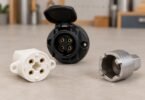

A replacement Triboro light socket needs to match the fixture, lamp base, mounting arrangement and electrical requirements. The name stamped on an old socket is a useful clue, but it is not enough to identify a safe replacement. Start with the fixture’s label and the complete part number before choosing a new lampholder.
The most important check: a socket marked 660W does not make the light fixture suitable for a 660-watt bulb. Follow the fixture’s lamp limit and the replacement component’s instructions.
What does “Triboro” on a light socket mean?
Triboro made sockets used inside other companies’ light fixtures. The Henry Ford’s collection includes a ceiling fixture made by Puritan Lighting Company with sockets attributed to Triboro. Its catalog records a 660W, 250V marking on the socket brackets and a separate instruction on the canopy limiting the lamps to 60 watts or less. That is a particularly clear example of why the two ratings must not be confused. See the museum’s fixture record and inscriptions.
That record establishes the origin of one documented fixture, not the identity of every Triboro socket. A general search for the brand can turn up different mounting styles and lamp families. Without an exact part number, measurements and the fixture information, there is no single replacement this guide can responsibly call a match.
Identify the socket before shopping
Have a qualified lamp-repair shop or electrician identify any component that cannot be inspected safely. For a cord-connected lamp, unplug it before handling it. For a hardwired fixture, have power isolated and verified off before inspection or service; the wall switch alone is not a safe isolation method.
- Record the complete fixture label. Note the manufacturer, model, permitted bulb type and maximum lamp wattage. Photograph the label and any readable socket markings without disturbing wiring.
- Identify the lamp base. Medium screw, candelabra screw and fluorescent bi-pin holders are different products. Match the exact base designation in the fixture and lamp documentation. SATCO, for example, identifies its 80-1120 medium screw holder as E26, while Leviton’s 13357 is a medium bi-pin fluorescent holder. The word “medium” by itself is insufficient. SATCO E26 example; Leviton bi-pin example.
- Match the mounting hardware. Compare the bracket, screw spacing, socket height, body diameter, lamp-pipe thread, retaining ring and shade support as applicable. Similar-looking porcelain bodies can have different attachment methods.
- Match the electrical construction. Confirm voltage and wattage ratings, lead-wire specification or terminal type, insulation requirements and any switching function. A keyless holder has no integral on/off switch; it is not a substitute for a switched or three-way socket merely because a bulb fits.
- Check the complete installation. The enclosure, shade clearance, insulation, wire condition and dry, damp or wet-location requirements all matter. A component’s material or screw fit does not establish suitability for an outdoor or enclosed fixture.
Documented lampholders worth comparing
These are specific modern components with manufacturer documentation. They are starting points for identifying a matching part with a repair professional, not confirmed Triboro cross-references.
| Component | Documented construction | Key compatibility question |
|---|---|---|
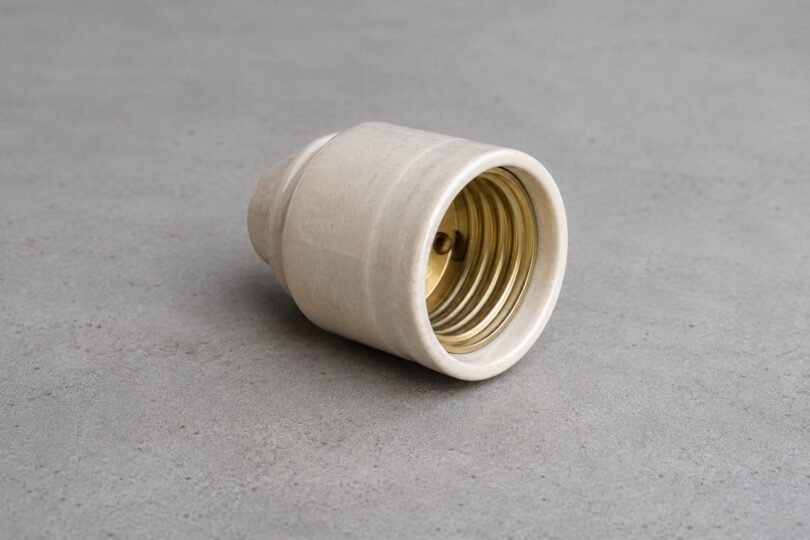
| Legrand Pass & Seymour 8052CC10 | White porcelain, medium-base, bracket-mounted lampholder. Legrand technical support gives a component rating of 660W at 250V. | Does the exact bracket and socket position match the fixture’s required replacement? Do not treat its component rating as the permitted bulb wattage. |
| Leviton 10045 | White glazed porcelain, medium-base, single-circuit keyless holder with two screw terminals and a 1/8-27 cap mount; rated 660W, 250V. | Does the fixture require this pipe/cap mounting arrangement, terminal access and single-circuit construction? |
| SATCO 80-1120 | White porcelain E26 keyless surface-mount holder with two bushings and screw terminals; rated 660W, 250V. SATCO specifies that the surface-mount cap is not included. | Are the bushing layout, dimensions and required mounting parts correct for the assembly? |
For the specific Legrand model in the table, this listing is for one white, bracket-mounted 8052CC10 lampholder. Confirm the fixture match before ordering.

Legrand Pass and Seymour 8052CC10 White Bracket-Mounted Lampholder, 1 Count
As an Amazon Associate we earn from qualifying purchases.
A higher published component rating is not a reason to select one of these over a correctly specified original part. Choose the construction the fixture requires. Where a maker does not publish a needed dimension, temperature limit or mounting detail, obtain that information before ordering.
Wattage, voltage and temperature answer different questions
Wattage: obey the fixture’s maximum lamp rating as well as the limits of its components. The CPSC Guide to Home Wiring Hazards identifies excessive bulb wattage as a cause of overheating and directs users to check the wattage called for on the fixture. If that label is missing, have the fixture assessed rather than borrowing a wattage from another lamp.
Voltage: the holder’s marked voltage is not an instruction to fit a bulb of that voltage. Match the bulb to the fixture and supply specified by the manufacturer. A mechanically compatible screw base does not prove electrical compatibility.
Temperature: a stated wire-insulation temperature applies to that wire under its specification. It does not certify the shade, socket body, surrounding wiring or entire fixture for the same temperature. Ask for the exact component documentation if the application involves significant heat. “Porcelain” and “heat resistant” are not complete installation specifications.
LED lamps: check actual input wattage, permitted enclosure use, dimmer compatibility and the fixture’s lamp restrictions. A replacement socket alone does not resolve those requirements.
Fluorescent sockets and LED conversions need separate checks
If the original is a fluorescent bi-pin holder, do not replace it with a screw socket or select a “tombstone” holder on appearance alone. Shunted holders connect contacts internally; non-shunted holders keep them separate. The required type depends on the lamp and circuit design. LEDVANCE explains the distinction.
For an LED tube conversion, have the installer follow the exact retrofit kit instructions, including compatible holders and any required fixture changes. This is not established by a tube fitting between the existing sockets. Leviton’s linked instructions for electronic-discharge lampholders specifically prohibit direct connection to the branch circuit and require power to be disconnected and verified off before wiring. Read the applicable Leviton instructions.
Check certification for the exact part
Leviton’s 10045 page identifies UL Listed file E3810; SATCO lists 80-1120 as cULus Listed. Those model-specific statements should not be transferred to a different seller’s look-alike socket. UL also distinguishes a Recognized Component from a Listed end product: a component is evaluated for use within a larger assembly under its applicable conditions. UL’s explanation of component recognition.
When repair-shop help is the better next step
Stop using a fixture with scorching, arcing, burning odors, a loose socket or damaged insulation. Replacing only the visible holder may leave the cause unresolved. The CPSC recommends qualified electrical attention for overheating and other wiring hazards.
Bring the shop the fixture model, photographs, bulb specification and every readable socket code. Ask it to confirm the mounting fit, ratings, insulation and condition of the rest of the fixture. If an approved compatible part cannot be established, discuss replacing the fixture. That is more useful than buying an adapter or a package of assorted sockets and hoping one fits.