
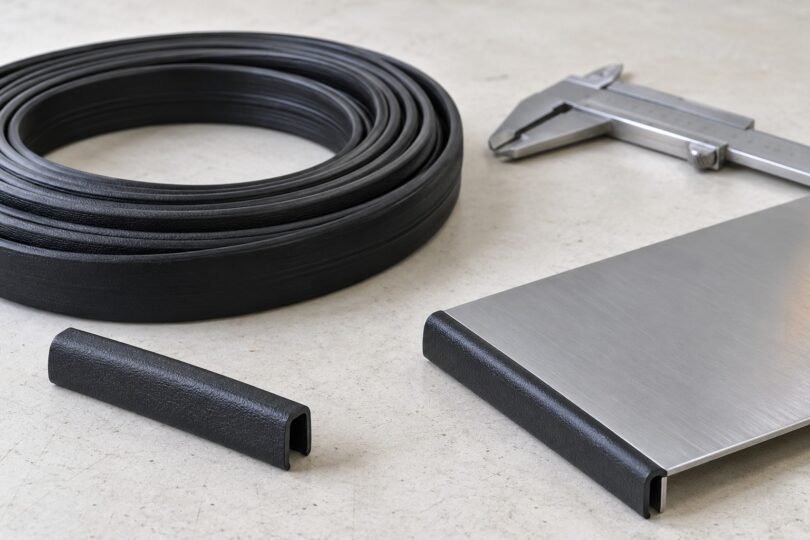

A U-channel sealing strip has to fit both the edge it grips and the job it performs. A plain U-shaped trim can cover a sharp panel edge without sealing a door gap. A shower-door sweep adds a water-deflecting profile, while a bulb seal needs controlled contact with a closing surface. Start with those differences before choosing a roll or length.
Edge trim, a shower sweep or a weatherseal?
Plain edge trim wraps around a panel or flange. Its job is to finish the edge and cover exposed material. A flexible carrier may use gripping tongues and metal clips to stay attached. The presence of a U-shaped channel does not establish a watertight joint.
A glass-door bottom seal grips the glass and adds fins or a deflector below or beside it. The glass thickness, clearance under the door and direction of the deflector all matter. A strip that grips correctly can still drag on the threshold or leave the wrong gap underneath.
A bulb or flap weatherseal adds a compressible sealing element to an attachment profile. Trim-Lok’s product descriptions distinguish its protective Edge Trim from Trim Seal with an attached sponge-rubber bulb and Flap Seal with an EPDM sponge-rubber flap. Choose the sealing element for the closed gap and contact direction, rather than treating any black U-channel as weatherstripping.
Trim-Lok 100B3X1/8-25: protective trim for a 1/8-inch edge
The Trim-Lok 100B3X1/8 profile is a useful starting point for a panel that actually measures 1/8 inch thick. The 100B3X1/8-25 retail configuration supplies a 25-foot length in black with a pebble texture. It has a single gripping tongue, a flexible PVC exterior and internal aluminum clips.
Keep the dimensions separate: 1/8 inch, about 3.18 mm, is the specified edge thickness; 9/16 inch, about 14.29 mm, is the nominal leg length. The manufacturer’s 100-series profile drawing also shows a 0.477-inch inner reach for the 100-1/8 section. The nominal leg length is therefore not an interchangeable measurement for the channel’s usable depth.

Trim-Lok 100B3X1/8-25 Edge Trim, 1/8-Inch Edge, 9/16-Inch Leg, Black Pebble, 25 Feet
As an Amazon Associate we earn from qualifying purchases.
The clips and tongue provide the push-on grip. This configuration is an edge protector without an attached bulb or flap. Use it where that is the desired result, such as finishing a suitable exposed panel edge. Do not buy it expecting to replace a compressed hatch gasket or correct an air leak around a closing door.
Prime-Line M 6258: a bottom seal for 3/8-inch shower glass
Prime-Line M 6258 is a more specific sealing application: a 36-inch clear-vinyl bottom seal for a frameless swinging shower door with 3/8-inch glass. The manufacturer’s catalog identifies a slip-on fit and one piece per inner pack. It is not the 1/4-inch or 1/2-inch glass version, and a two-pack listing is a different purchase configuration.
The M 6258 installation drawing marks the 3/8-inch glass channel, a 1/2-inch channel height and an 11/32-inch lower fin projection. Compare the complete cross-section with your existing seal and the space under the glass. Those profile dimensions serve different purposes; none should be read as a promise that the strip will seal an arbitrarily sized floor gap.
The usual installation is a slip-on fit without adhesive. There is an important qualification: Prime-Line’s instruction sheet says silicone sealant can be used at the bottom of the U-channel if the part slips. Follow that instruction for this model instead of assuming every push-on strip either requires glue or forbids it.
Measure the edge before measuring the roll
- Expose the actual mounting surface. If replacing a removable strip, examine the panel beneath it. Measure the finished edge, including any coating that will remain, rather than the outside of the old trim.
- Measure thickness at several points. A caliper is useful for distinguishing close sizes. Avoid squeezing a flexible material enough to distort it. Record the thickest and thinnest readings along the intended route.
- Check insertion space. Measure how far the channel can slide onto the edge before it meets a bend, screw, hinge or other obstruction. Compare that with the maker’s section drawing, not the overall height of a product photograph.
- Measure the working gap separately. For a sweep or compressible seal, measure the clearance where the sealing element will contact the opposite surface. Check along the whole opening, including its corners.
- Measure the full route. Follow curves with a flexible tape and account for joints and trimming. A 25-foot roll and a 36-inch rigid-looking sweep are different purchasing units.
Keep inch and metric measurements consistent. A listing may round 3/8 inch to 10 mm, but nearby nominal sizes should not be treated as universally interchangeable. Use the product’s intended panel thickness and fit guidance, and request a sample when a long run or uncertain edge would make a wrong size costly.
Material and retention details worth checking
The word “rubber” in a search result is not an adequate material specification. The Trim-Lok example above is PVC over metal clips; Prime-Line describes the M 6258 as clear vinyl. A separate product sold as EPDM, neoprene or silicone needs its own documentation. Do not transfer specifications between those materials or between different product families from one manufacturer.
Likewise, an adhesive-backed strip, a metal-reinforced push-on carrier and a plain flexible channel install differently. Check whether adhesive is already present, merely optional or required separately. If a seal will face cleaning chemicals, outdoor exposure, heat or contact with food, ask for the exact model’s suitability documentation. Generic material names do not prove chemical compatibility, flame performance or food-contact compliance.
Fit a short section before completing the installation
Prepare the surface using the relevant manufacturer’s instructions and inspect for damage that a new trim would only conceal. Try a short section where fit and movement can be checked. The channel should seat properly without being forced over an oversized edge. On a door, slowly check the entire swing and closing action before committing to the full length.
Trim-Lok’s metal-reinforced construction and a vinyl shower sweep should not automatically be cut with the same tool. Follow the supplier’s cutting guidance and leave a clean end. For M 6258, clean the glass after removing the old part and install the U-section as the instruction sheet shows. If the new seal still slips, catches or leaks, recheck the profile and clearance before adding more material.
The most useful shortlist is a measured one: plain trim for edge protection, the correct glass sweep for a shower door, or a purpose-designed bulb or flap for a closing gap. Match the complete part number, grip size, section dimensions and supplied length before ordering.


