
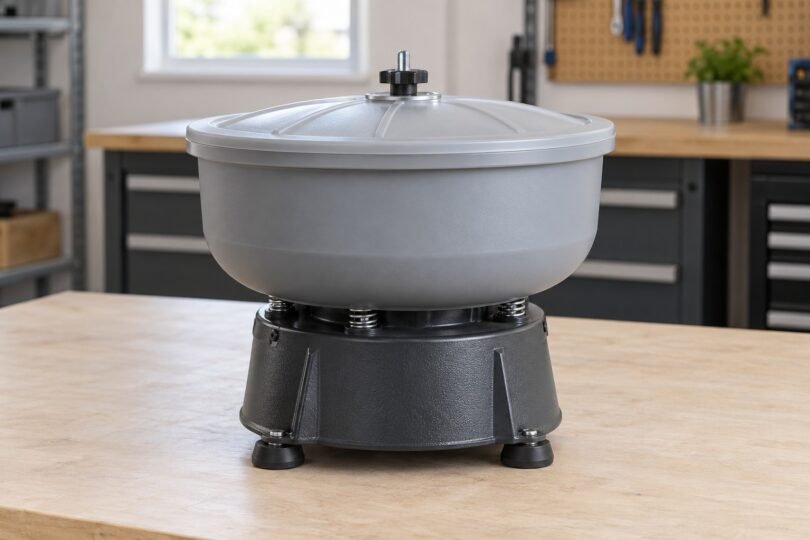

The best vibratory tumbler for your workshop depends on what you want to finish. A machine intended for dry brass cleaning can look remarkably similar to one built for wet rock polishing, yet their approved media and load limits can be very different. Start with the material, the desired surface finish, and the manufacturer’s instructions for the exact model.
For small metal or jewelry projects, the Raytech TV-5 is worth considering after confirming your media. For stones, look at a purpose-built lapidary configuration such as Raytech’s TV-10 Professional Rock Polishing Kit. For dry case cleaning, the Frankford Arsenal Quick-n-EZ and Lyman Pro 1200 are more narrowly focused choices. These recommendations compare documented specifications and restrictions; they are not hands-on test results.
Vibratory versus rotary tumblers
A rotary tumbler turns a barrel, lifting and dropping its contents as it revolves. A vibratory machine shakes its container so the material circulates inside. For stones, that difference matters: rotary action tends to round edges, while vibratory finishing is better suited to retaining an existing shape. Diamond Pacific’s tumbling documentation explains why vibratory machines suit preforms, carvings, and jewelry, while also noting that results and processing times vary with the material.
Neither mechanism guarantees a particular finish. A polishing machine cannot be selected by motor power or bowl size alone. A rough casting needing substantial deburring, a pre-shaped stone needing a final polish, and an empty brass case needing cleaning are different jobs. Likewise, a rotary media separator is an accessory for separating a finished batch, not a powered vibratory tumbler.
Four vibratory tumblers to compare
Raytech TV-5: a compact option for small finishing jobs
The Raytech TV-5 has an 8-inch bowl rated at approximately 0.05 cubic feet, three pints, or four pounds. Crucially, that four-pound working limit includes both media and workpieces. The standard machine includes a base, one bowl, and a lid. Choose the correct electrical version: 23001R is 115V, while 24106R is 230V.
Raytech lists light metal-finishing applications and polishing metal or plastic parts. That makes it a useful candidate for small workshop batches, provided the maker approves the specific combination of part and media. It is not permission to tumble every piece of jewelry or every alloy.
Important limitation: Raytech’s product page prohibits steel shot, its FAQ prohibits steel and ceramic in the TV-5, but the linked September 2024 manual allows up to four pounds of steel shot or ceramic in this model. Because those instructions conflict, obtain written confirmation for your exact unit before using either. Do not resolve the disagreement by choosing the most permissive statement.
Raytech TV-10 Professional Rock Polishing Kit: a rock-focused configuration
The TV-10 Professional Rock Polishing Kit, no-drain 115V version, is specifically presented for rock finishing. Raytech lists a 10-inch bowl, a heavy-duty drive and suspension, and included grits; rocks are not included. This is a different purchase from the with-drain TV-10 and from a spare bowl sold on its own.
The kit’s operating instructions state an approximately 0.10-cubic-foot, six-pint, or eight-pound working capacity, including grits and workpieces or rocks. The instructions describe a damp slurry rather than standing water and warn against letting the grit run too dry. Keep the shaft free of grit and water. These directions apply to this rock-polishing configuration, not to a dry-only case cleaner.
This is the more relevant starting point if stones are your main interest. Before ordering, ask which media, grit sequence, and bowl arrangement suit your stone type and starting condition. Buying a kit does not establish that every stone or filler material is compatible.
Frankford Arsenal Quick-n-EZ 855020: for dry case cleaning
The Quick-n-EZ 855020 is a vibratory brass-case cleaner. The maker quotes up to 600 9mm or 350 .223 empty cases; those are size-dependent capacity examples, not a general-purpose load rating in pounds. The Amazon variant below is the single 110V tumbler, not the larger cleaning kit with a separator and bucket.
The manufacturer’s assembly and usage instructions, hosted by Precision Reloading, specify dry corn-cob or walnut media and explicitly exclude liquid media and lapidary applications. Do not buy it as a lower-cost substitute for a wet rock tumbler. It makes sense when its dedicated dry-cleaning role is exactly what you need; it is a poor choice when you want one machine for unrelated craft processes.

Frankford Arsenal Quick-n-EZ 855020 Case Tumbler, 110V, single tumbler
As an Amazon Associate we earn from qualifying purchases.
Lyman Pro 1200 7631318: dry cleaning with a sifter lid
The Lyman Pro 1200’s distinguishing feature is its built-in sifter lid. The 115V model, part 7631318, holds a stated two pounds of media and up to 350 .38 Special cases. The media charge is not a two-pound combined payload. Lyman’s capacity chart lists the standard 1200 bowl as one gallon and 10 inches in diameter; the maker describes the Pro as having the same capacity.
Choose it for a dry-cleaning setup where the sifter lid is useful. Do not assume that the included bowl becomes a wet tumbler just because Lyman has offered liquid-system accessory bowls. Any conversion needs the specifically approved bowl, lid, and hardware. The card identifies one 115V Pro 1200, not a Turbo Twin or a 230V variant.

How to choose the right capacity and media
Separate volume, media charge, and total load. Gallons or pints describe bowl volume; pounds may describe media alone or the whole working load. A case count describes an example batch of particular-sized items. These figures are not interchangeable. Record the exact rating before comparing machines, and ask the manufacturer when a listing leaves the total allowable load unclear.
Specify the job before choosing an abrasive. Tell the supplier the material, dimensions, holes or recesses, and finish you need. For jewelry, include whether pieces have stones, coatings, or delicate features. A general metal-finishing claim does not prove compatibility with a finished ring. For rocks, identify the stone and its starting surface. Avoid universal grit recipes or promises that all batches finish in a fixed number of hours.
Budget for separation and maintenance. Consider how you will remove media from the parts, clean the bowl, and obtain replacements. Raytech’s instructions recommend reserving a bowl for final polishing to prevent contamination from embedded cutting grit. Check bowl, lid, fastener, and spare-part compatibility by exact model rather than assuming a similar-sized accessory will fit.
Dust, chemicals, and electrical safety
- Read the media’s safety data sheet. For example, Raytech’s Dri-Shine I SDS warns about airborne dust and combustible dust clouds. It calls for ventilation, minimizing dust accumulation, avoiding ignition sources, and washing after handling. Do not blow settled dust into the air with compressed air. Follow the actual product’s cleanup and protective-equipment requirements.
- Treat used case-cleaning media as contaminated. Frankford’s manual says media accumulates powder residue, dirt, polish, and lubricant. Hornady’s M-1 tumbler instructions warn of possible lead exposure and advise against eating, drinking, or using tobacco during use, followed by thorough handwashing. Do not treat a bright finish as proof that residue exposure has been eliminated.
- Keep the electrical setup dry and ventilated. Lyman’s Turbo Tumbler instructions warn against covering the machine with a box or blanket to reduce noise, blocking airflow, or using soft supporting materials. Follow the specified grounding and placement requirements.
- Use only approved compounds. A wet-capable bowl does not authorize arbitrary solvents or cleaner mixtures. Follow both the machine instructions and chemical label. Raytech warns against disposing of grit down a drain; check the appropriate disposal method for the used compound and contaminants.
- Keep case cleaning narrowly bounded. Never tumble live ammunition or primed cases. Frankford Arsenal also says not to operate its appliance unattended.
Questions to settle before buying
Can one tumbler polish rocks, jewelry, and metal parts?
Sometimes, with the correct machine and separately approved processes. Verify every intended use rather than transferring a media recommendation from another model. A dedicated dry case tumbler can explicitly prohibit rock polishing.
Does a larger bowl automatically make the machine better?
No. Choose around your normal batch and the manufacturer’s loading requirements. Extra volume has little value if your parts, media, or electrical supply are incompatible.
Which is the best starting point?
Choose by application first: a rock-specific configuration for stones, a documented small-parts finisher for workshop or jewelry work, or a dedicated dry cleaner for empty brass cases. Then compare the exact voltage, included equipment, replacement parts, and approved load. That is more useful than a single ranking across machines designed for different jobs.


