
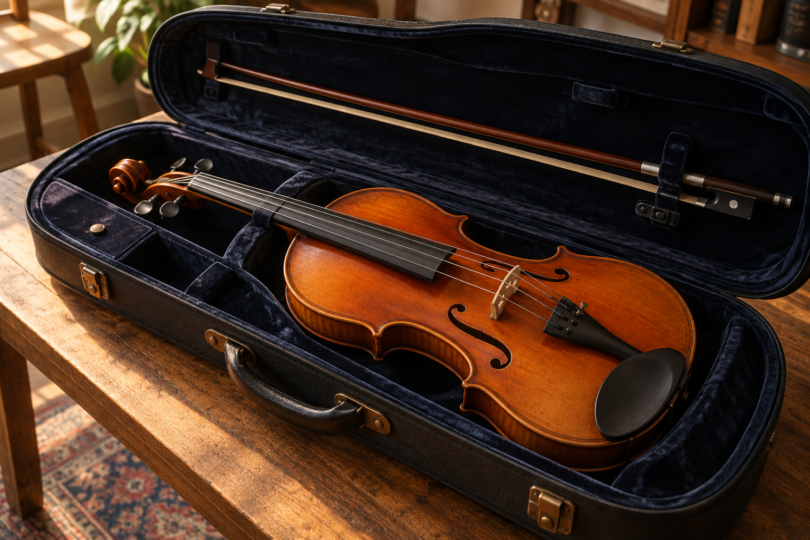

For a professional considering a contemporary acoustic violin, Scott Cao STV-1500, Scott Cao Signature Series and Andreas Eastman Master VL906 are three worthwhile starting points for an audition list. This comparison explains their documented construction and the questions to take to a luthier. Your final choice should be the individual instrument that supports your playing, repertoire and working conditions.
We compared manufacturer specifications and a current specialist-dealer listing; we have not played or tested these instruments. A model name cannot establish tonal balance, projection or response in your hands. As Johnson String Instrument explains, even examples of the same workshop model can have different voices. Read its guidance on auditioning individual instruments.
Three violins to put on your audition list
| Model or line | Documented distinction | Why consider it | Check before committing |
|---|---|---|---|
| Scott Cao STV-1500 | Morgan Hill build and setup | Compare a California workshop instrument | Exact copy, setup and delivery |
| Scott Cao Signature Series | Morgan Hill workshop line; Superior option | Explore a more individualized specification | Edition, maker and trial terms |
| Andreas Eastman Master VL906 | 4/4 Stradivari pattern; oil varnish | Audition a specified master-luthier model | Dealer setup and exact instrument |
Scott Cao STV-1500: a California workshop candidate
The STV-1500 is built, varnished and set up in Morgan Hill. Its catalog specification includes ten-year-aged Bosnian maple, Italian spruce and an Indian ebony fingerboard. Custom copies are available. See the STV-1500 catalog entry.
Put this on your list if you want to compare a contemporary workshop violin with instruments you already know. Ask to try more than one available example, using your regular bow. Pay particular attention to quiet attacks, string crossings and the response in passages you actually perform. These are audition priorities, not performance results we have established.
- Pros: A documented build and setup location, with scope to discuss the copy you want.
- Cons: A custom specification needs careful agreement; it cannot substitute for assessing the finished violin.
Scott Cao Signature Series: for a more detailed workshop brief
Signature Series violins are entirely built and varnished in Morgan Hill, using twenty-year-aged Bosnian maple and Italian spruce. The catalog distinguishes a Superior model supervised by Scott Cao. Clarify the edition before comparing offers. See the Signature Series catalog entry.
This line is worth discussing when the workshop’s approach to a particular historical copy matters to you. Ask which maker will build or has built the instrument, what documentation accompanies it, and which adjustments are included. Keep tone descriptions as questions to explore during a trial rather than accepting them as guarantees.
- Pros: Distinct editions give you specific construction and maker questions to discuss.
- Cons: The series name alone does not identify one violin or establish a tonal advantage over the other candidates.
Scott Cao’s catalog allows six to eight months for these orders, while its homepage separately advertises existing Signature inventory and posts shipping notices. Confirm the exact instrument and dispatch date with the seller. A catalog lead time is not a universal statement about dealer stock.
Andreas Eastman Master VL906: a defined full-size model
Eastman lists the VL906 as a master-luthier instrument in 4/4 size and a Stradivari pattern. The published specification includes Bosnian spruce and maple, oil varnish, an ebony fingerboard, boxwood fittings with light trim and a Despiau 2 Tree bridge. See Eastman’s VL906 specifications.
Consider it if you want a clearly specified model to compare through a specialist shop. The Violins and Such listing describes its VL906 for advanced orchestral or solo use and documents its own setup, including Dominant PRO strings and a fitted soundpost. That dealer configuration should be checked separately from Eastman’s standard specification. See that dealer’s VL906 configuration.
- Pros: Published size, pattern and component details make it easier to ask focused questions about the instrument offered.
- Cons: A dealer may change setup components, and the specification cannot tell you whether its sound will suit your professional work.
How to judge a violin for professional use
Set an audition routine before comparing instruments. Use familiar lyrical and articulated passages, test soft entrances and stronger playing, and listen across all four strings and positions. Have a trusted colleague listen from a distance when possible. Repeat the same material on each candidate so your impressions are easier to compare.
Try the instrument in a room relevant to your work if the trial agreement permits it. Consider comfort over a realistic session as well as the first impression. A recording can help you revisit what you heard, but it should supplement playing and listening rather than decide the purchase for you.
Arrange a luthier’s condition and setup check. Ask about cracks or previous repairs, neck and fingerboard condition, peg operation, bridge and soundpost fit, and any work included in the sale. Request clear identification and documentation of the exact instrument, especially when buying used or commissioning a particular copy.
Get the trial terms in writing: return deadline, shipping and insurance responsibilities, deposit or card authorization, permitted adjustments and charges if you keep the instrument. Trial programs differ; Shar’s published program, for example, includes fees and deferred billing. Its policy is an example of terms to check, not a promise that Shar stocks these three choices. Review Shar’s trial terms.
Compare the complete purchase cost for the exact instrument and setup, including any bow, case, adjustment work and delivery you need. A high specification or an aged-wood description does not establish resale value. Leave room in the budget for the practical equipment and maintenance your work requires.
Frequently asked questions
Which violin is best for every professional?
There is no winner we can establish for every player. Audition individual examples and judge their response, sound and comfort in the context of your own work.
Does a higher model number guarantee a better sound?
No such guarantee follows from these specifications. The construction details help you form a shortlist, but the decision requires playing and listening to the actual instrument.
Should I buy the same model a colleague uses?
It can be a useful lead, but try your own example. Individual workshop instruments can differ, and a violin that suits a colleague may respond differently to your bow and technique.
Are the bows and cases included?
Confirm the exact offer with the seller. This comparison does not assume an outfit or accessory bundle; ask for an itemized quote listing the instrument, bow, case and setup work you are paying for.
Can I order one immediately for an upcoming performance?
Confirm the seller has a specific instrument ready for trial or delivery and allow time to assess it. Check current shipping notices and the written return terms before relying on an arrival date.
Our recommendation
Build an audition list around the model or workshop line that matches your priorities, then compare individual examples with luthier support. The best professional purchase is one you can evaluate confidently, with clear condition, setup, documentation and trial terms. None of these model names removes that final step.

