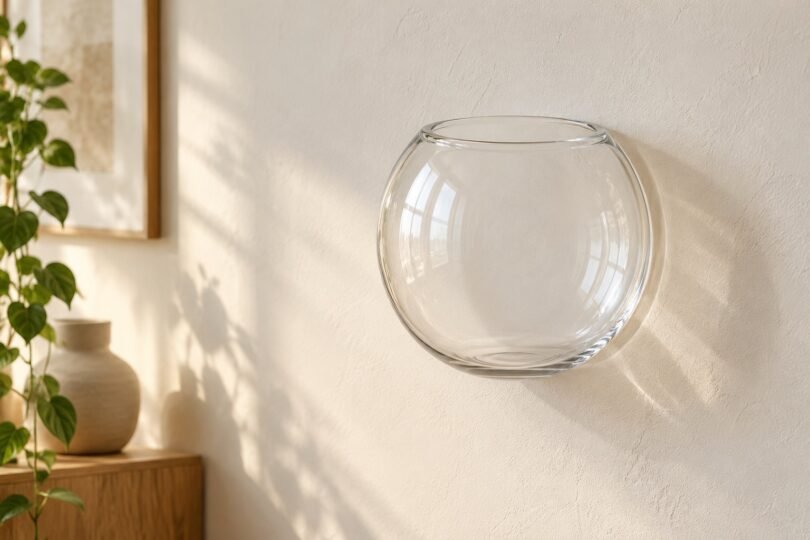

A wall mount fish bowl can look like a clever way to add life to a small room. For fish, though, a tiny decorative vessel is a poor starting point. The RSPCA warns against decorative bowls because limited space, filtration, oxygen exchange and temperature stability can compromise welfare.
Our recommendation: use a small wall vessel as empty decor or for suitable plants or faux greenery. If you want to keep fish, choose a properly equipped aquarium around the needs of the species, then find a suitable place for it. A photograph of a fish inside a product does not establish that it is a suitable home.
Choose the display you actually want
- Wall decoration: choose a purpose-made wall planter or an empty decorative vessel with clear mounting instructions.
- A living fish: plan a filtered aquarium with sufficient swimming space, appropriate temperature control and routine water testing.
- A genuinely wall-installed aquarium: treat it as a specialist installation. Obtain documentation for the exact tank, support system and wall construction before buying.
Why bettas and goldfish need more than a small bowl
Bettas are often pictured in small containers, but that is not a useful care standard. RSPCA Australia recommends ideally 20 liters or more, describing 10 liters as an absolute minimum. The minimum is not a shopping target: allow room for normal activity, cover and equipment. Its guidance specifically says small tanks and bowls do not meet these fish’s physical and mental needs.
The same guidance calls for a heated environment maintained at 24–26°C, suitable filtration with gentle flow, and a lid to prevent jumping. Bettas also need access to surface air, with an air space between the water and lid. A lamp above a bowl is not a substitute for proper temperature control. Merck also recommends a separate thermometer to check the water independently of the heater.
Goldfish are another unsuitable choice for tiny wall bowls. RSPCA Australia’s goldfish guide says traditional bowls should be avoided and emphasizes adult size, tank dimensions, fish numbers and effective filtration. Do not assume a compact aquarium is goldfish-ready merely because it exceeds one published volume threshold.
Two alternatives worth considering
For wall decor: Umbra Trigg small wall planters
Umbra Trigg is a decorative plant holder, not a fish tank. Umbra describes Trigg wall vessels for small plants, including faux greenery. This makes the design relevant if the goal is an attractive wall display without fish care.
The option below is the Small, White/Brass set of two, model 470753-524. Its two-pot identity is also listed by Home Depot. Check the selected size, finish and pack quantity before ordering; larger and differently colored Trigg listings are separate options. Follow the supplied installation instructions and choose plants appropriate to the container and room, or use faux stems.
Umbra Trigg Small Wall Planters, White/Brass, Set of 2
As an Amazon Associate we earn from qualifying purchases.
For a supported aquarium: Fluval Flex 2.0, 15 US gallons / 57 liters
The Fluval Flex 2.0 aquarium, item 15052, is a more practical starting point to evaluate for a suitable small-fish setup. It has integrated rear filtration, adjustable output nozzles, LED lighting and a cover. A heater is sold separately. Fluval also recommends its included spray bar for fish such as bettas that prefer gentler water movement.
This is a freestanding aquarium, not a wall-hung bowl. The Flex 2.0 manual requires a level, sturdy surface and the supplied anti-slip pad. Confirm the actual filter media bundle before ordering: the product page lists a BIOMAX insert, while the manual’s 15-gallon instructions say the media used to fill its baskets is not included. Budget for the remaining equipment and assess stocking separately.
Look beyond the advertised capacity
Compare the internal swimming area, not just the outside dimensions or a headline liter figure. Rear filter compartments, substrate, decorations and the space left below a lid all matter when planning the usable habitat. Ask whether the quoted volume describes the entire system or the display area; do not calculate a stocking allowance from exterior measurements alone.
Shape also matters. The RSPCA explains that the water surface is important for oxygen exchange and favors wider tanks over tall tanks with less surface area for their volume. It also notes that larger volumes provide more stable water conditions and temperatures. A shallow wall profile or impressive front diameter can conceal very little front-to-back space.
Before purchasing, check that you can reach every service point. Can you lift the cover, remove the filter, inspect the heater and siphon the substrate without climbing or moving a filled tank? A display that is awkward to maintain is a poor fit, however neatly it occupies a wall.
Plan the full load and safe access
Water weighs roughly 1 kilogram per liter, before the vessel, substrate and equipment are added. For perspective, 20 liters of water alone weighs about 20 kilograms. Merck Veterinary Manual’s placement guidance stresses strong, level, stable support and easy access for maintenance.
That arithmetic is not an anchor rating. Never choose fixings from the water weight alone or assume a decorative shelf can support an aquarium. For any wall-mounted vessel, follow the exact manufacturer’s instructions for the wall material, attachment points and permitted load. If the instructions do not establish that your proposed installation is suitable, obtain advice from the manufacturer and a qualified installer before filling it.
For powered aquarium equipment, plan accessible outlets and follow each appliance’s electrical instructions. The Fluval manual calls for a drip loop: the cable dips below the outlet so water cannot run along it into the socket. Leave enough access for safe servicing, and follow the equipment’s disconnection instructions before maintenance.
Cycle first, then keep checking the water
A newly filled tank is not ready simply because the water looks clear. Merck’s aquarium-fish guidance describes fishless cycling, in which the system is established without exposing fish to the ammonia and nitrite produced during startup. Use an appropriate fishless-cycling method and test ammonia, nitrite and nitrate regularly. Ammonia and nitrite should have returned to zero after cycling. Readiness depends on the test results and a functioning biological filter, not a guaranteed number of days.
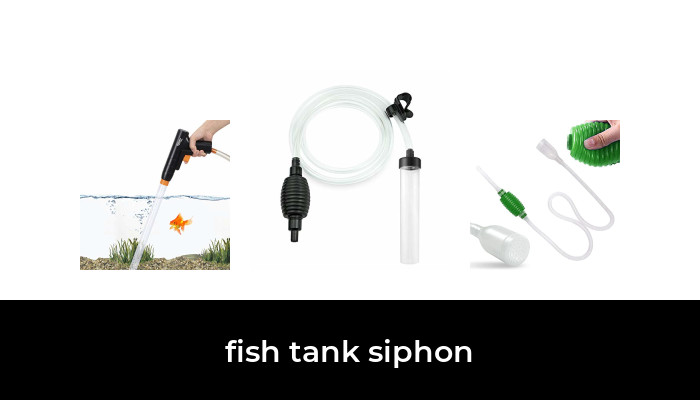
Include a test kit, thermometer, suitable heater when needed, siphon and dedicated bucket in the setup budget. Treat replacement tap water with an aquarium conditioner that neutralizes chlorine and chloramine, following its label; this is part of RSPCA Australia’s maintenance guidance.
Once stocked, keep a maintenance routine suited to the species and system. Merck’s maintenance checklist includes daily checks of the fish, temperature and equipment, removal of uneaten food, water testing and partial water changes. Replacing evaporated water alone does not perform the same job as removing and replacing some tank water.
Keep the buying decision simple: a small wall vessel can be appealing decor, while fish need a complete, maintainable habitat. Choose the animal’s home first and arrange the room around it.