
For an adult starting pyrography, the Razertip SE Kit is the most useful first comparison here because it combines an adjustable burner, an interchangeable-tip pen and a substantial instruction book. Choose the Colwood Detailer Standard Kit if you prefer its five-tip selection and choice of pen systems. Choose the Razertip SK Pyrography Starter Kit if you want four dedicated pens instead of changing individual tips in one handle.
These are three documented wire-tip systems for someone who expects to keep wood burning as a hobby. A short supervised class can be a better first purchase if you are still deciding whether you enjoy it. Our recommendations come from manufacturer specifications, not hands-on testing.
Research checked October 4, 2026. This guide covers the North American 120V versions. Confirm the exact kit, electrical rating and included accessories before ordering.
Three wood burning kits for adults compared
| Kit | Pen system | Control and power information | Main reason to consider it |
|---|---|---|---|
| Razertip SE Kit, KITSE | One BPH pen with six interchangeable tips | Adjustable 1–10 control; 10-amp output; 120V AC, 60Hz input | Instruction book and varied tip shapes in one starter package |
| Colwood Detailer Standard Kit, replaceable-tip selection | One RT handle with five replaceable tips | Variable solid-state controller; separate illuminated on/off switch; 120V unit | A focused writing, detail and shading set |
| Razertip SK Pyrography Starter Kit, KIT02-SK | Four fixed-tip pens; one pen connected at a time | Adjustable 1–10 control; 10-amp output; North American SK is 120V AC, 60Hz | Dedicated knife, round, ball and shading pens |
The amperage above is the maker’s burner output specification, not household current draw. It should not be ranked against an iron’s advertised wattage. Colwood’s explanation of woodburner controls also cautions against choosing a system by power claims alone.
What is actually included?
Razertip SE: a compact learning package
The SE package contains its power supply, BPH interchangeable-tip pen, removable pen cord, screwdriver, brass cleaning brush and the Razertip Pyro Studio Guide to Burning. The six tips are T8 burnishing, T9 writing, T14M medium knife, TH5MP medium spear shader, T99-012 1.2mm ball stylus and a blank tip.
Why it fits: the book gives a new hobbyist something more useful than a large assortment of unidentified attachments. Trade-off: several tip shapes share one handle, and the blank tip is not another ready-shaped drawing point. The contents list does not include practice wood.
Colwood Detailer: select the correct kit version
Colwood’s Standard Kit lists the Detailer unit, B large-point, C writing, D small-round, J tight-round and S shading tips, plus a tip box, cleaning cloth and honing paper. The replaceable-tip option adds the RT handle and EZ Tip Puller. The fixed-tip option is a different pen configuration; check the selection before checkout.
Why it fits: the assortment is easy to understand when your goal is lettering, outlines and shaded pictures. Trade-off: the lower-priced Detailer control unit by itself has no pens or tips. Do not compare its price with a complete kit. Colwood identifies the unit as 120V and explicitly excludes use on a 220V supply.
Razertip SK: four dedicated drawing pens
The KIT02-SK package includes the SK supply, CORD1FL standard cord, CORD1HD heavy-duty cord, CLEANER tip cleaner and four pens: F14M medium knife, F2S small round, F99.015 ball and HD30M heavy-duty medium shader.
Why it fits: each drawing shape has its own handpiece, which may appeal if you dislike fitting small loose tips. Trade-off: the SK control unit accepts only one handpiece at a time. Two supplied cords do not make it a two-pen station. The published kit list does not include the SE book or practice wood.
How to choose a kit you will keep using
Understand solid-tip and wire-tip tools
A solid-tip craft iron and a wire-tip station are different purchases. These three kits use wire-tip systems with a separate controller. Within this group, a fixed-tip pen has its tip permanently attached to its handle; a replaceable-tip system lets several shapes share a handle. “Fixed tip” does not mean fixed heat. Colwood explains these distinctions in its woodburner guide.
For a first project, decide whether you want lettering, broad shading or fine outlines. Then check that the package contains recognizable shapes for that work. Additional tips can wait until a real project calls for them.
Check the whole setup cost
- Tool: confirm supply, compatible cord, pen and usable tips are all included.
- Workspace: plan for the maker’s prescribed hot-tool holder, a suitable work surface and ventilation.
- Materials: allow for identified, unfinished practice wood intended for pyrography.
- Ownership: compare local availability of replacement tips, handpieces and service.
- Electrical version: check the actual rating label. A travel plug adapter does not convert voltage.
Prices and currencies vary by market. Compare the delivered total for the same kit configuration, including tax and shipping, rather than assuming a Canadian-dollar manufacturer price is a US-dollar offer.
Material and hot-tool safety come first
Read the instructions supplied with your exact system before use. Keep hot pens in their prescribed holder, keep the heated end away from cords and combustible objects, and switch the unit off whenever you leave it. Colwood’s safety guidance specifically warns about sharp, hot tips and leaving a burner on unattended.
Weller’s woodburning manual provides a useful additional safety baseline: ventilate the workspace, keep children away, unplug and cool the tool before adjustments, avoid liquids, and protect eyes from hot material. Use your own kit’s instructions for its connections, tip changes and cleaning method.
For this guide, the material recommendation is deliberately narrow: known, unfinished, untreated solid wood suitable for pyrography. Do not burn painted, stained, sealed or pressure-treated pieces, MDF, unknown reclaimed scraps, plastics, or adhesive-containing panels. A tool’s ability to heat a surface does not establish that its fumes are safe. Weller warns about fumes from adhesives in thin plywood and veneer; the EPA’s wood-burning guidance also warns against burning coated or treated wood. That EPA source concerns wood combustion, not a certification of craft materials.
Avoid assuming a small desk fan or an unspecified mask makes any material acceptable. If the material or coating is unidentified, choose a different blank. This article does not cover soldering, hot-knife cutting or other mixed-material uses.
Frequently asked questions
Which kit should an adult beginner start with?
The SE is our starting point for a beginner who values written instruction. Choose the pen arrangement you find easiest to handle; a class can help you decide before committing.
Is a kit with more pieces better?
Not necessarily. A controller, case and several accessories may all count toward the total. Compare the usable drawing tips, pen arrangement and missing materials instead.
Can tips be mixed between brands?
Do not assume compatibility. Ask the manufacturer about the exact pen, cord, connector and supply combination. Similar-looking plugs are not sufficient evidence that two systems belong together.
Can I burn a design into an already varnished item?
Choose an unfinished blank instead. This guide does not recommend heating finishes or trying to make unknown coated wood suitable by surface sanding.
How we researched this shortlist
We checked current manufacturer kit lists, controller descriptions and safety documentation. We selected three clearly identified configurations so readers can compare contents and pen systems. We did not measure heat-up time, tip temperature, hand comfort, durability or finished artwork, and we did not verify every seller bundle. No claimed testing hours, expert-panel score or customer-review ranking is used. The links lead to primary product information and safety sources.
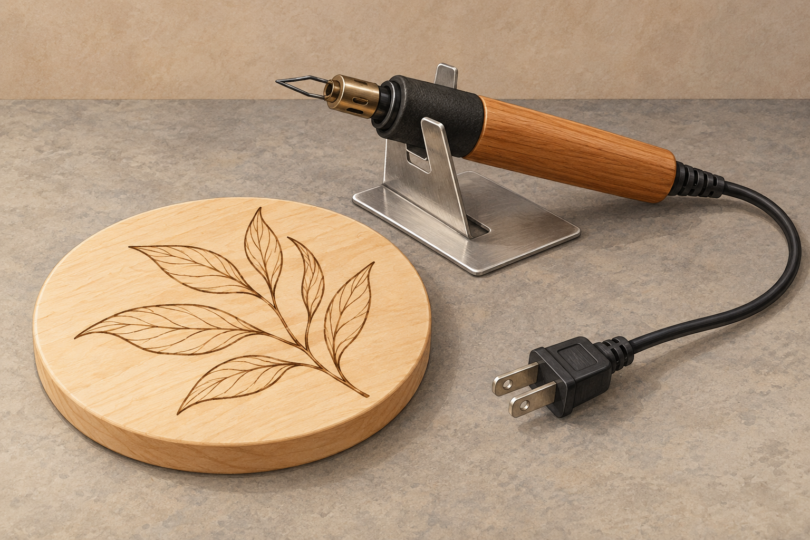
Image note: Generic editorial illustration of inactive wood-burning equipment and a decorative wooden plaque.