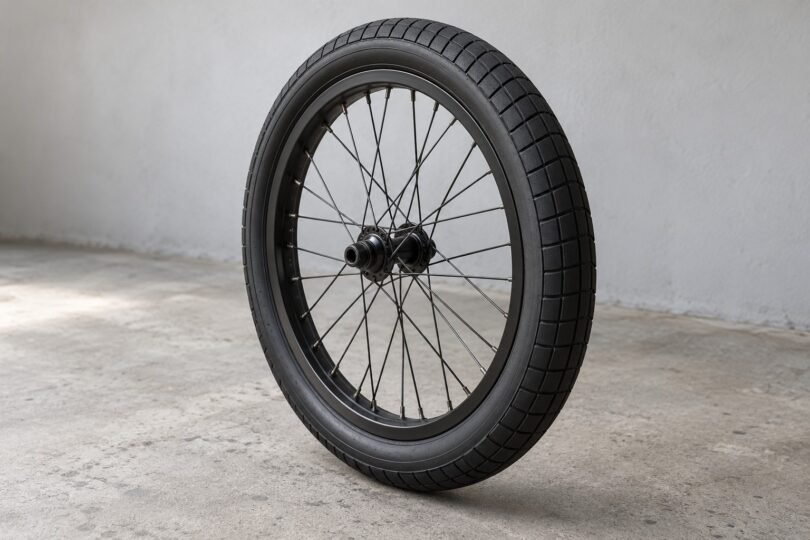

The right 20 × 2.4 BMX tire starts with wheel compatibility, then the casing, tread and pressure limits that suit your riding. A nominal 2.4-inch label does not guarantee the same inflated width across brands, and a tire advertised as “20-inch” is not enough to establish rim fit.
For a folding freestyle option with a clearly published ETRTO size, start with the Maxxis Grifter 20 × 2.40. For a park-focused build, compare the Odyssey Super Circuit. For a wire-bead street tire, look at the Éclat Decoder Street. The differences below matter more than an oversized list of near-identical listings.
Check the 406 mm fit before choosing a tire
Read the metric size on your existing tire and the rim specification. In an ETRTO marking such as 61-406, the first number is the nominal width in millimeters and the second is the bead-seat diameter. Maxxis specifies 61-406 for its 20 × 2.40 Grifter. Schwalbe’s size explanation describes why this metric marking is more reliable than the inch name.
A 406 mm tire and a 451 mm rim are incompatible. Both diameters occur under the broad “20-inch” label, as shown in Schwalbe’s size chart. Do not try to stretch or force one onto the other. Confirm the exact replacement’s bead-seat diameter when a product page gives only the inch size.
Diameter is only the first check. The tire width must also be approved for your rim’s internal width, and your frame, fork and brakes need sufficient clearance. A matching 406 marking alone does not make a 2.4-inch tire suitable for every BMX.
20 × 2.4 BMX tires to compare
Pressure figures in this comparison are the manufacturers’ published maximums, not recommended everyday settings or complete operating ranges. Check the actual tire’s sidewall and your rim limits before inflation.
| Exact option | Bead and casing | Published maximum | Main reason to compare it |
|---|---|---|---|
| Maxxis Grifter 20 × 2.40, black, TB00360700 | Folding; dual compound | 110 PSI | Freestyle tire with a published 61-406 size |
| Odyssey Super Circuit 20 × 2.40, black | Folding K-Lyte Plus; 120 TPI | 100 PSI | Maker-designed for racing and park/transition |
| Éclat Decoder Street 2.4 | Wire; 60 TPI | 80 PSI | Street version with an additional rubber sidewall layer |
| Éclat Decoder Comp 2.4 | Wire; 120 TPI | 120 PSI | Lighter competition version of the Decoder |
| BSD Donnastreet Kevlar Bead 2.4, black | Folding Kevlar; 60 TPI Silkworm casing | 110 PSI | Smooth tread and a folding bead for a street-oriented build |
Maxxis Grifter: a clearly specified folding freestyle option
The current black TB00360700 is a 20 × 2.40 folding tire with a 61-406 ETRTO designation and a 110 PSI maximum. Maxxis lists it for freestyle use at either end of the bike. It is a useful starting point when you want an exact part number to match against a seller’s listing.
Read the row for that part number rather than combining specifications from the whole Grifter family. Other sizes have different beads and protection features; the current 2.40 row does not list EXO. An EXO description or photograph from a smaller Grifter does not establish that feature for this version.
Check the Maxxis Grifter specifications.
Odyssey Super Circuit: the park and transition choice to examine
Odyssey explicitly positions the Super Circuit for racing and park/transition riding. The black 20 × 2.40 version has a folding K-Lyte Plus bead, 120 TPI casing, dual-compound tread and a manufacturer-listed weight of 520 g. Its pressure ceiling is 100 PSI.
The shallow tread blocks and smooth center are part of that design brief. This makes it worth comparing for a park build where casing and weight matter. It does not establish superior grip on every ramp surface or suitability for every street-grinding setup.
The same product page offers 1.75- and 2.10-inch widths, so select 2.40 explicitly. Odyssey does not publish an inflated millimeter width or ETRTO code in this listing; confirm fit using the actual tire marking and your wheel specifications.
Check the Odyssey Super Circuit specifications.
Éclat Decoder Street: the 80 PSI wire-bead version
The Decoder Street 60 TPI has a wire bead and an additional rubber sidewall layer. Éclat describes it as a street/ramp tire, with a lower-profile tread and fine knurling. For the 2.4 option, the maker lists a width of 60 mm, a weight of 750 g and an 80 PSI maximum.
That published width is a useful comparison figure, not a measurement of the tire on your own rim. The page does not give its measurement rim or inflation conditions.
Check that the listing actually says Street or 60 TPI. The similar-looking competition version has a different casing and pressure limit.
Check the Éclat Decoder Street specifications.
Éclat Decoder Comp: a different casing, not the same tire at higher pressure
The Decoder Comp 120 TPI also uses a wire bead. Éclat lists the 2.4 version at 630 g, with a 60 mm width figure and a 120 PSI maximum. It is the competition-oriented option in the Decoder range.
The 120 PSI figure belongs to this casing. It must not be applied to the 80 PSI Street model. A higher permissible maximum also does not mean your rim permits that pressure or that you need to ride at it.
Choose between the two Decoders on the actual casing, use case and component limits, rather than assuming the model name alone identifies the tire.
Check the Éclat Decoder Comp specifications.
BSD Donnastreet Kevlar Bead: distinguish the folding version
The Donnastreet Kevlar Bead 2.4 uses a folding Kevlar bead, a 60 TPI Silkworm casing and a smoother tread that continues around the side of the tire. BSD lists the 2.4 version at 670 g and a 110 PSI maximum.
This is the folding version, not a blanket specification for every Donnastreet listing. BSD also offers a regular Donnastreet, and the shared name makes it easy to order the wrong construction. Select the 2.4 size and confirm that the product explicitly says Kevlar Bead.
The maker’s page does not provide an inflated millimeter width, so leave room for a proper clearance check rather than assuming it matches another brand’s 2.4.
Check the BSD Donnastreet Kevlar Bead specifications.
Watch for lower-pressure versions with similar names
The Odyssey Path Pro is a good example of why pressure cannot be selected by tire name alone. The Path Pro 65 PSI is listed in 20 × 2.40 with a single-ply casing and a 65 PSI maximum. The standard Path Pro page lists a dual-ply sidewall and a 100 PSI maximum, with both 2.25 and 2.40 widths.
Those pages do not establish the bead type for every seller’s version. Check the complete variant description and the tire itself. Never use the standard model’s 100 PSI ceiling for the 65 PSI tire.
Measure clearance instead of trusting “2.4”
Two tires with the same inch label can have different installed widths and heights. Rim width, inflation pressure and the casing affect the result. Schwalbe’s dimension guidance also notes that a newly fitted tire can expand over time.
- Before buying: check the frame and fork manufacturer’s tire-clearance guidance and the rim’s permitted tire widths.
- At the front: check space at the fork legs and crown, plus any brake hardware.
- At the rear: check the chainstays, seatstays and brake area with the wheel correctly aligned in its intended axle position.
- After fitting: verify clearance with the tire properly seated and inflated within its permitted range. Check the full rotation, not just one spot.
Use the bicycle manufacturer’s required clearance margin. A tire that only just avoids touching while stationary is not proof of adequate clearance. Ask a qualified mechanic if the wheel alignment, rim compatibility or clearance is uncertain.
Buying one tire, a pair or a tire-and-tube kit
Check package quantity independently of size. A product photograph showing two tires, or the word “tires” in a title, is not a reliable promise of a pair. Confirm whether tubes and rim strips are included, and budget for two tires when replacing both ends.
For a concrete example, Eastern’s Throttle 20-inch black/yellow repair-kit listing separates 2.2, 2.3 and 2.4 sizes, then offers Tire 1-Pack, Tire 2-Pack, Tire & Tube 1-Pack and Tire & Tube 2-Pack options. The maker describes a 100 PSI tire and includes levers and rim strips in the kits. Select both menus; choosing “2.4” alone does not specify the quantity or tubes.
For replacement tubes, match the wheel diameter, an advertised width range that includes the tire, and the valve type your rim accepts. Do not assume an old, narrower tube is suitable merely because it says 20-inch.
What pressure should a 20 × 2.4 BMX tire run?
There is no single safe PSI setting for every rider and every 2.4-inch tire. Load, tire construction, rim limits and riding conditions all matter. The figures above are upper limits for specific products, not pressure recommendations.
Follow the permissible range printed on the tire and the wheel manufacturer’s instructions. The lower applicable maximum is the ceiling; any stated minimum must also be respected. If the requirements conflict, stop and have the combination checked. Use a pressure gauge rather than judging by squeezing the sidewall. Schwalbe’s pressure guidance explains why load and the sidewall range matter.
Do not overinflate to force an incorrectly seated bead into place. Follow the tire and rim makers’ fitting instructions. A folding bead also does not automatically mean a tire is tubeless-ready; use only a tire, rim and setup explicitly approved for that purpose.
Which option makes the most sense?
For park and transition, the Super Circuit has the clearest manufacturer-specific design brief. For street riding with a wire bead, compare the Decoder Street’s construction with the lighter Decoder Comp rather than mixing their pressure ratings. For a folding freestyle tire with a published metric size, the Grifter TB00360700 is straightforward to identify. The Donnastreet Kevlar version is another folding option for riders who want its smoother street-oriented tread.
Make the final choice only after checking bead-seat diameter, rim approval, actual clearance, exact casing and package quantity. Those checks prevent a much more expensive mistake than choosing between two suitable tread patterns.