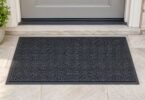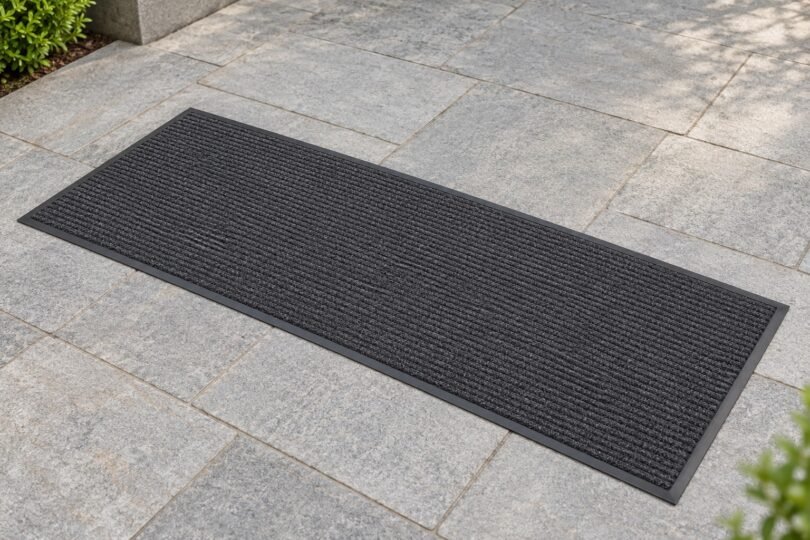

A 24 x 60 outdoor mat can give a wide doorway a useful landing area for wiping shoes, but size labels are only the first check. You also need enough door clearance, a backing compatible with the surface below, and a construction suited to the amount of rain reaching the entrance.
Start by deciding whether you need exactly 24 by 60 inches or simply a runner around that size. Those are different shopping requirements: some mats advertised in the 2-by-5-foot category measure only 22 inches across. The options below separate listed dimensions from approximate sizing and call out information worth confirming before ordering.
Quick choices for different entrances
- For a listed 24-by-60-inch decorative mat: Briarwood Lane’s Black Damask extra-large coir mat has that stated measurement. Ask for its thickness before placing it beneath an outward-opening door.
- For a lower-profile runner when a narrower mat works: WaterHog Squares Small is listed at 22 by 60 inches. It is a near-size alternative, not an exact match.
- For personalization on a sheltered porch: Doormats USA offers a 24-by-60-inch Personalized Name coir option. Confirm its thickness and placement requirements before ordering.
- For an exposed entrance with pooling water: prioritize a manufacturer-approved drainage construction and solve the pooling problem before choosing a decorative mat.
Is 2 x 5 feet the same as 24 x 60 inches?
As a unit conversion, yes: two feet equals 24 inches and five feet equals 60 inches. As a product description, not necessarily. A nominal size is a shopping category; the actual dimensions and stated manufacturing tolerance determine what arrives.
The WaterHog Squares Runner page lists Small at 22 by 60 inches, with plus or minus 3% variation. Height is described as 3/8 inch, with 0.35 inch also shown. Confirm the profile if clearance is tight.
A two-inch difference across the narrow dimension may be fine on an open porch. It can be unacceptable if you are filling a recess or matching an existing mat frame. Write down your maximum usable length, maximum depth, and minimum door clearance rather than searching by a single nominal size.
Three options worth comparing
Briarwood Lane Black Damask: listed 24 x 60 inches
The Black Damask Extra Large Coir Doormat is a decorative choice with the requested listed footprint. Briarwood Lane identifies coconut-husk fibers and a slip-resistant rubber backing and describes the mat for outdoor use.
Its appeal is straightforward: a wide patterned surface without having to substitute a narrower runner. The limitation is that the product information reviewed does not establish total thickness, a dimensional tolerance, or a detailed exposure and cleaning specification. For a sheltered entrance, it belongs on the shortlist. For direct rain or a tight storm door, ask the manufacturer those questions first. An outdoor description alone does not tell you how it behaves in standing water.
WaterHog Squares Small: a near-size wiping runner
This option makes sense when the shorter 22-inch dimension works for your space. It has a polyester surface, rubber backing, and raised texture intended to collect dirt and moisture. WaterHog’s runner collection identifies these runners for indoor and outdoor use.
Consider it when approximate runner sizing is acceptable. Distinguish moisture-catching surfaces from open-hole drain mats: retaining water near an entrance is a different job from letting water flow through.
Doormats USA Personalized Name: coir for shelter
The manufacturer-direct Personalized Name Coir Doormat includes a 24-by-60-inch option with natural coir and a woven coir backing. The maker says it has no rubber underside and favors positioning against a threshold or in a mat recess. Its placement advice favors covered entrances and avoiding standing water or direct downpours.
This is a candidate when personalization matters and the placement suits a woven-backed mat. The current product specifications do not give total thickness, so ask before assuming it clears your door. The maker advises shaking, sweeping, or vacuuming and standing a soaked mat on edge to dry. Confirm cleaning requirements for the personalized finish and check custom-order return conditions before approving a name or layout.
Measure door clearance through the whole swing
Measure the distance from the floor to the lowest moving part of the door, including a sweep or weather strip. Check several positions from nearly closed to fully open. An uneven porch, sloping threshold, or door hardware can make the clearance vary.
Compare that smallest gap with the mat’s total height, not just the pile height. If a listing supplies only the thickness of its fibers, ask whether the backing is included. Leave practical room for normal movement; a mat that only just fits on paper can still catch or bunch.
Mark the intended footprint temporarily and open both leaves of a double door. Include the area where someone stands while unlocking it. Avoid an arrangement that forces visitors to balance on an edge or step around a raised corner. If the door catches the mat, choose another position or profile rather than forcing it across the surface.
Match the material to rain and drainage
Covered outdoor use means the entrance has meaningful protection from direct weather. It is not the same as an open step exposed to wind-driven rain. Read the specific product’s placement instructions even when the search result calls it an outdoor mat.
For example, Fab Habitat’s Minimalist coir guidance specifies indoor or covered outdoor use. Its size guide also distinguishes a 24-by-57-inch thick version from an 18-by-60-inch thinner version. Neither should be assumed to be a 24-by-60-inch mat just because the collection includes long designs.
On an exposed landing, look for explicit information about water passage and the underside. Rubber-Cal explains that some rubber entrance mats use drainage holes to release moisture from the surface. That feature is useful only if the floor beneath can drain too. A perforated mat over a puddle does not repair the drainage problem.
Ask where the water will go, how you will lift the mat for cleaning, and whether nearby leaves can block openings. Do not infer drainage from words such as weather-resistant, waterproof, or heavy-duty. They describe different properties and may not describe the backing at all.
Slip resistance has limits
A rubber backing is a feature to evaluate, not a promise that a mat cannot move. Flat placement, the floor finish, debris underneath, and wet conditions all deserve attention. Do not use an entrance mat as a substitute for clearing ice or correcting an unsafe landing.
Gorilla Grip’s HydroABSORB instructions, for example, tell users to make sure the mat lies flat, keep the area underneath dry, and consult the floor manufacturer’s directions. They also identify limitations for certain surfaces. Those instructions concern that product, but illustrate why a generic “non-slip” label is not enough to establish compatibility for another mat.
Before purchase, check your decking or flooring care guide for restrictions on rubber and other backing materials. If the mat shifts, curls, traps moisture, or leaves marks, stop using that arrangement and contact the relevant manufacturer.
Cleaning without guessing
Follow the selected mat’s instructions rather than treating all outdoor mats alike. WaterHog’s care directions allow shaking or sweeping away loose debris, hosing, and air drying; they prohibit bleach and harsh chemicals and require a dry mat and floor before replacement.
For a coir option, confirm whether the maker recommends dry brushing, spot cleaning, or rinsing. Check again if the mat is painted or personalized. Machine washing, pressure washing, and chemical cleaning should not be assumed acceptable just because an item sits outside.
Before you buy
- Confirm the selected variant’s actual dimensions and tolerance.
- Obtain total thickness and compare it with the smallest door gap.
- Check covered versus exposed placement and drainage requirements.
- Verify backing compatibility with the surface below.
- Read cleaning and return instructions, especially for custom work.
The strongest choice is the mat that fits the entrance and its weather conditions. Keep an exact 24-by-60-inch requirement separate from near-size alternatives, and let clearance and placement instructions decide which candidates remain.