
The right Apache Mills door mat depends on where it will sit. A carpet-topped mat for an indoor entrance or sheltered porch does a different job from an outdoor scraper or a flow-through drainage mat. Start with rain exposure, the space beneath the opening door, and the amount of dirt your household brings inside. Choose a pattern after those practical questions are settled.
This guide compares Apache’s documented mat constructions and intended locations. Product names and retail selections can vary, so match the collection, dimensions, and care label on the particular mat you order rather than relying on a photograph alone.
Which Apache Mills mat fits your entrance?
- Decorative outdoor doorstep: consider Masterpiece, which combines a flocked decorative surface with molded recycled rubber.
- Indoor doorway or covered porch: compare Manhattan’s flat-woven surface with the molded carpet construction of Textures.
- Muddy outdoor entrance: look at CleanScrape or Mission, both specified for outdoor use.
- Entrance needing water to pass through the mat: investigate AquaFlow, then check that the landing itself drains appropriately.
These are use-case starting points. A mat still needs to fit the actual doorway and remain flat on a suitable surface. There is no single collection that automatically suits every entry.
Apache Mills collections compared
Masterpiece: a decorative outdoor mat
Apache’s Masterpiece specification describes a heavy-duty recycled-rubber construction with a flocked fiber face. Molded channels help collect dirt while the surface scrapes footwear. The manufacturer lists outdoor entry doors and patios as its intended locations.
Masterpiece makes sense when the mat will be part of the front-door decoration but still needs a defined shoe-wiping surface. Do not confuse its flocked face with a thick absorbent indoor rug. Apache lists multiple sizes without giving one universal measurement, so verify the exact design’s width, depth, and thickness with the retailer.
Manhattan: a flatter option for sheltered entrances
Manhattan has a tightly woven carpet face and a flat recycled-rubber backing. Apache identifies the yarns as made from recycled plastic bottles and describes the surface as water absorbent. Its specified locations are indoor entrances and covered outdoor entries, including mudroom and garage-door approaches.
The manufacturer highlights a low profile and easy vacuuming. That is useful when shopping for an inward-opening door, but it is not a promise that the mat will clear your particular door sweep. Check clearance across the complete opening arc, especially where the floor is uneven.
Textures: molded carpet for dirt and tracked-in moisture
Textures uses an absorbent fiber surface made from recycled plastic bottles, molded onto recycled-rubber backing. Apache specifies indoor entrances or covered outdoor entries. The surface patterns give it a different construction from Manhattan’s flatter woven face.
Choose between these two collections by comparing the actual mat’s profile, available footprint, and maintenance instructions. A listing that broadly says “indoor/outdoor” should not erase the manufacturer’s covered-outdoor qualification. An open step routinely soaked by rain is a different location from a sheltered porch.
CleanScrape: a grit-faced outdoor scraper
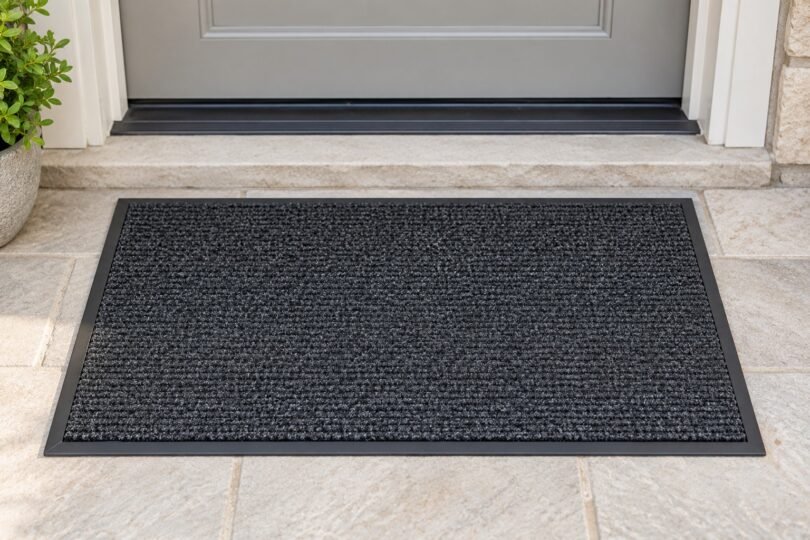
CleanScrape has a grit surface and recessed channels. Apache recommends it for medium-traffic outdoor entrances and muddy conditions, and permits shaking or hosing it off. The collection is described as using 88% recycled materials.
Its size chart is particularly useful because it separates nominal labels from actual dimensions: the 2-by-3-foot version measures 23 by 36 inches, the 3-by-5-foot version measures 35 by 59 inches, and the 4-by-6-foot version measures 47 by 71 inches. Use those actual measurements when checking the landing, then confirm the ordered SKU follows that chart.
Mission: an outdoor rubber mat with a parquet pattern
Mission is a recycled-rubber outdoor mat with a parquet-style scraping pattern. Apache lists medium- to high-traffic outdoor areas and says it can be shaken or hosed clean. Its documented recycled-material content is 96%.
Mission’s published actual sizes are also 23 by 36, 35 by 59, and 47 by 71 inches. It is another collection to compare for a utilitarian entrance where easy access for cleaning matters. Choose the footprint that leaves the surrounding walking route unobstructed rather than buying the largest mat that will barely fit.
AquaFlow: a drainage-focused outdoor design
AquaFlow uses a flow-through construction with wiper blades and nibs. Apache specifies outdoor high-traffic entrances exposed to mud and snow, describes the material as 60% recycled rubber, and allows shake-off or hose cleaning.
The distinction is drainage through the mat, rather than an absorbent carpet face or dirt-catching channels alone. Water still needs somewhere to go below it. Do not expect a drainage mat to correct a low spot, blocked drain, or slippery landing; assess those conditions separately before deciding on placement.
Measure the whole entrance, not just the door width
First mark the available rectangle on the floor with removable tape. Include the border in your measurements, and leave the walking route clear of steps, furniture, and other obstructions. Open the main door, storm door, and screen door through their normal travel.
Next measure the lowest clearance between the floor and the moving door or sweep. Compare that with the mat’s total thickness, including its backing and raised pattern. If a mat catches, folds, or gets dragged each time the door opens, it is a poor fit even if the width looks right.
For a narrow landing, avoid placing an edge where a foot naturally lands when stepping down. For a wider mudroom, think about the path people actually take: a mat tucked to one side does little if everyone walks around it. Never stack mats to fill space beneath a door.
Separate rain exposure, absorption, and drainage
Describe your entrance honestly before shopping. Is it fully indoors, roof-covered but occasionally splashed, or directly exposed to rain? Does wind drive water under the porch roof? Does the surface dry between wet periods?
Absorbency, water resistance, and drainage describe different things. A carpet face may absorb tracked-in moisture; a rubber construction may tolerate outdoor exposure; an open structure may allow water through. None of those features alone means a mat will keep a continuously wet entrance dry.
A practical arrangement can be an outdoor scraper followed by a suitable indoor wiping mat, provided both positions have enough space and clearance. Treat that as a layout choice, not a reason to put a covered-use product on an exposed step.
Cleaning and routine safety checks
Use the instructions for the collection and the label on the actual mat. Apache specifically allows shake-or-hose cleaning for CleanScrape, Mission, and AquaFlow; its Manhattan page highlights vacuuming. Do not extend those methods to every decorative finish or assume a large rubber-backed mat belongs in a washing machine.
Lift the mat periodically to remove grit and check for moisture beneath it. After any wet cleaning, let the mat and supporting surface dry before putting it back into use. Follow the flooring manufacturer’s guidance about backing compatibility, especially on finished indoor floors.
Inspect for curled corners, cracked backing, loose surface material, or shifting underfoot. Reposition or replace a mat that will not sit securely and flat. A traction claim is not a slip-proof guarantee: ice, wet surfaces, accumulated debris, and poor placement can still create hazards.
A final buying checklist
- Match the exact collection to indoor, covered-outdoor, or exposed-outdoor use.
- Confirm actual dimensions and total thickness rather than a nominal size alone.
- Check the entire door swing and the route people take across the entrance.
- Read the specific cleaning label and check backing compatibility with the floor.
- Verify the selected design and size before checkout; a different variant can have a different footprint.
Apache’s FAQ notes that designs and product offerings vary by retailer. If a listing does not clearly identify the mat or its intended location, use the manufacturer’s collection information to resolve the uncertainty before buying. A correctly placed, correctly sized mat is more useful than a decorative match with the wrong construction.