
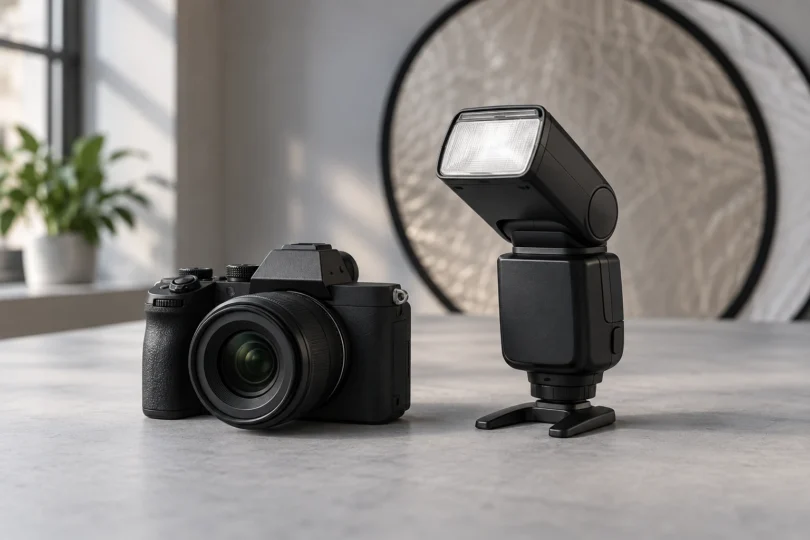

The best flash for a Sony camera depends on the camera body and the lighting system you want to build. Start with the Sony HVL-F46RMA for a versatile Sony-system flash, the Godox V1Pro-S if you want a rechargeable round-head flash in the Godox X system, or the Godox TT350S for a smaller two-AA option. The Sony HVL-F60RM2 is worth the extra size when its longer zoom range, rotating bounce mechanism and external-power connection solve a specific need.
Those names matter: a Canon-version flash, a cold-shoe LED light and a Sony-compatible TTL flash are different purchases. Check the exact camera-and-flash combination before ordering, even when a listing says “for Sony.”
Four flashes for Sony cameras to compare
| Flash | Choose it for | Power and head | Main trade-off |
|---|---|---|---|
| Sony HVL-F46RMA | A medium-size flash within Sony’s radio system | Four AA batteries; 24–105mm zoom | No external battery-adapter connection |
| Godox V1Pro-S | A rechargeable round-head flash and Godox X lighting | Dedicated lithium battery; 28–105mm zoom | Buy the Sony S version and confirm your body in Godox’s compatibility information |
| Godox TT350S | A compact travel or occasional bounce-flash kit | Two AA batteries; 24–105mm zoom | A smaller flash is a compromise for demanding repeated output |
| Sony HVL-F60RM2 | Longer zoom coverage and Sony’s Quick Shift Bounce | Four AA batteries; 20–200mm zoom; external-power support | Larger and heavier than the F46RMA |
Sony HVL-F46RMA: the balanced Sony-system choice
The F46RMA is a sensible starting point if you want Sony’s own flash controls without the bulk of its F60RM2. Sony specifies a Multi Interface Shoe, TTL/manual/multi modes, HSS and built-in radio commander/receiver operation. Its head tilts up to 150 degrees and swivels 180 degrees each way, useful when you need to bounce light from a nearby neutral wall or ceiling. It weighs approximately 317g before batteries.
Its guide number is 46 at ISO 100 and a 105mm coverage setting. That number is meaningful only with its stated conditions; it is not directly comparable with a rival measured at a narrower beam angle. Four AA alkaline or Ni-MH batteries power the unit, and Sony lists no external battery-adapter connection. See Sony’s exact F46RMA specifications.
Buy this if: you want a flexible bounce head and plan to stay within Sony’s radio-flash system. Check the final A in F46RMA when comparing offers; F46RM is a separate model name.
Godox V1Pro-S: the rechargeable round-head choice
Choose the V1Pro-S, also written V1Pro S, for on-camera Sony TTL operation. Godox sells other versions for other camera brands under the same V1Pro family name. The Sony version combines a round head, TTL and manual exposure modes, HSS capability and Godox’s 2.4GHz X radio system. Its removable SU-1 fill-flash module can add forward fill while the main head is bounced.
The dedicated battery can be charged through USB-C or the specified charger. The trade-off is carrying the correct battery and charging equipment instead of using AA cells. Godox lists 28–105mm zoom coverage. Its “up to 1/8000 second” HSS specification remains subject to the camera and shooting mode; it is not a promise for every Sony body. Check Godox’s V1Pro specifications, manuals and firmware.
Buy this if: you want to build around Godox X lights or prefer the round-head accessory system. The selected offer below is one black Sony-version flash kit with the SU-1, battery, charging accessories, stand, bag and LETWING cleaning cloth. It is not a two-flash pack or an off-camera transmitter bundle.

Godox V1Pro-S Sony Flash Kit with SU-1 and LETWING Cleaning Cloth
As an Amazon Associate we earn from qualifying purchases.
Godox TT350S: the smaller AA-powered option
The TT350S deserves a look when a full-size flash makes a small camera awkward to carry. It uses two AA batteries and provides Sony-version TTL, manual flash and HSS, plus a Godox X radio connection. Its 24–105mm zoom head and guide number of 36 at ISO 100/105mm make it a more modest option than the larger flashes here.
Use it for occasional indoor bounce or a lightweight kit, and choose a larger unit when your priority is repeated demanding output. Do not inherit a seller’s blanket compatibility list: Godox publishes a separate TT350S/V350S camera table, and the S suffix is essential. The official TT350 page links the Sony manual, camera list and model-specific firmware. Buy the flash itself, not a diffuser or accessory whose title merely mentions TT350S.
Sony HVL-F60RM2: for a larger Sony lighting kit
The F60RM2 adds a 20–200mm zoom range, a sync terminal and support for an external battery adapter. Sony’s Quick Shift Bounce mechanism is useful when changing between horizontal and vertical camera orientation. At approximately 439g before batteries, it is the heavier Sony option in this comparison.
Sony rates its maximum guide number at 60, measured at ISO 100 and 200mm. The different zoom setting means “60 versus 46” does not tell you the entire power difference from the F46RMA. Both use four AA cells. See Sony’s F60RM2 specifications and the shared Sony flash help guide.
Buy this if: you will use the wider zoom range, bounce mechanism or external-power option. Those are concrete reasons to carry the larger unit; a higher headline guide number alone is not.
Check compatibility before you pay
Match the shoe and the electronic protocol
These recommendations concern supported Sony cameras with the appropriate Multi Interface Shoe connection. A cold shoe only holds an accessory. A flash that fires through a basic contact does not automatically gain TTL metering, HSS or camera-menu control. Older Sony/Minolta shoe designs and adapter combinations need their own compatibility check.
For example, Sony’s F46RMA and α7 IV compatibility entry lists P-TTL and HSS, but not ADI metering. It also qualifies particular functions by camera firmware and shooting mode. That is why an exact model table is more useful than “works with Sony.” For Godox, use the manufacturer’s camera compatibility table and the manual for the exact S-version flash.
Keep the radio system consistent
Sony radio flashes and Godox X flashes are different systems, even though both use the 2.4GHz band. For off-camera work, match the transmitter, receiver or built-in radio and camera version within the chosen system. A flash trigger is a controller, not another light, and a transmitter is not automatically included with a flash.
Check shutter mode and firmware
TTL controls exposure automatically; HSS allows compatible combinations to work beyond normal flash-sync speed. Neither bypasses the camera’s limitations. Check its flash instructions for electronic or silent-shutter restrictions. The α7 IV compatibility notes above, for example, restrict flash burst use with its electronic shutter.
Global-shutter sync is a separate capability. Sony’s help guide requires version 2.00 or later on the listed F60RM2/F46RM/F46RMA models for that feature, together with a compatible global-shutter camera. It does not give an ordinary rolling-shutter body the same behavior. Use only the firmware for your exact flash model and camera-brand version.
Do not assume an adapted vintage flash is safe
A physical fit is not an electrical-safety check. Sony warns against third-party flashes with high-voltage sync terminals or reverse polarity. Confirm the camera’s requirements and the flash’s trigger characteristics before considering older equipment; an inexpensive shoe adapter alone does not establish safety or electronic compatibility. See Sony’s third-party flash warning.
Which one should you buy?
Start with the HVL-F46RMA for a Sony-system bounce flash, or the V1Pro-S for a rechargeable Godox X setup. Pick the TT350S when keeping the kit small matters most. Move to the HVL-F60RM2 when you can name a feature you need from the larger unit. Before checkout, confirm the exact body, flash suffix, firmware, included accessories and return policy. For video, shop for a continuous light instead of treating a speedlight or flash diffuser as an interchangeable substitute.


