
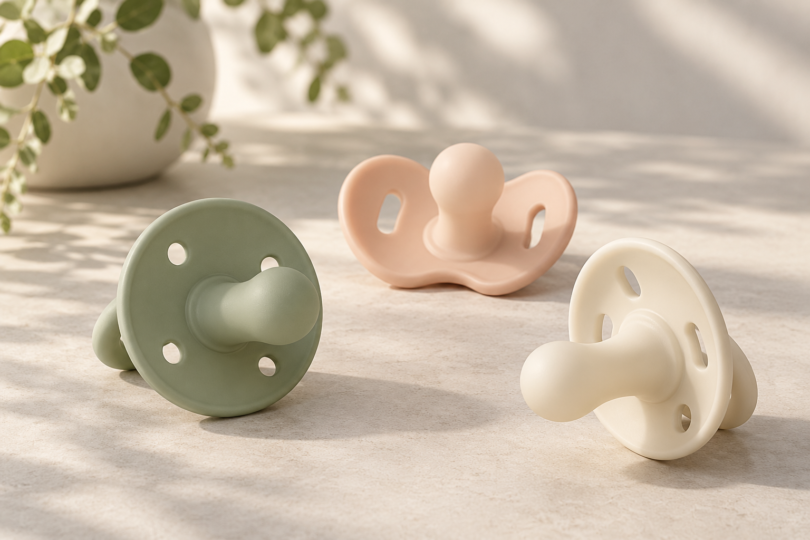

For a breastfed baby in the first few months, Philips Avent Soothie 0–3m, Nanobébé Flexy 0–3m and NUK Comfy 0–6m are three useful pacifiers to compare. They offer different shield and nipple shapes in one-piece silicone designs. Start with the correct age label and a shape your baby accepts, then buy backups once you know it works.
This shortlist is for supervised soothing between feeds. Philips requires adult supervision, and NUK says not to leave a baby unattended while using its pacifiers. Those instructions still apply even though the American Academy of Pediatrics gives general advice about offering pacifiers at sleep time. None of these products is a treatment for feeding problems or a promise of easier breastfeeding.
Before buying: is breastfeeding established?
The AAP recommends waiting until breastfeeding is established before introducing a pacifier: milk supply is adequate, feeding is comfortable and consistent, your baby latches well and weight gain is appropriate. Readiness is about how feeding is going, not simply reaching a particular week or seeing “0 months” on a pack.
Use a pacifier for comfort after feeding needs are met. Do not use it to postpone nursing or quiet hunger cues. For young infants, the CDC lists hands moving to the mouth, turning toward the breast and lip-smacking as possible hunger signs; crying can be a later signal. If latch, feeding pain or weight gain concerns you, ask your pediatrician or lactation professional for help.
Best pacifiers for breastfed babies: quick comparison
| Pick | Exact version | Reason to consider it | Main limitation |
|---|---|---|---|
| Philips Avent Soothie | SCF190/41; 0–3 months; green; four pacifiers | Simple round shield and rounded nipple | Short age window; adult supervision required |
| Nanobébé Flexy | FUS4010433; 0–3 months; Sage/White; four pacifiers | Curved shield offers a different face profile | Do not substitute the older-baby Active version |
| NUK Timeless Comfy | 2190570; 0–6 months; assorted colors; five pacifiers | Asymmetrical nipple offers another shape to try | Color wording varies; do not leave baby unattended |
All three selected versions are silicone. The comparisons below use manufacturer specifications, care instructions and exact product listings. They are not based on hands-on testing, acceptance trials or a claim that one nipple shape is best for every breastfed baby.
1. Philips Avent Soothie 0–3m: a simple first shape to try

Philips Avent Soothie SCF190/41, 0–3m, Green, 4-Pack
As an Amazon Associate we earn from qualifying purchases.
The Soothie SCF190/41 is a one-piece silicone pacifier with a round shield, ventilation holes and an open back. Its straightforward construction is easy to inspect, and the green four-pack provides spares if this is a shape your baby likes.
Why choose it: it is an uncomplicated starting option when you want a rounded nipple and no decorative attachments. Tradeoff: this exact pack is labeled 0–3 months. Other Soothies have different age ranges and shield shapes; the family name alone does not make them interchangeable.
Use and care: Philips’ Soothie instructions linked from the product page require adult supervision. Before first use, boil for five minutes, let it cool and squeeze out retained water. Before each use, clean with warm water and mild soap, inspect carefully and pull the pacifier in all directions. Discard at the first sign of damage or weakness; replace after four weeks of use even if it looks intact. Keep it away from direct sunlight and heat, and do not leave it in sterilizing solution longer than directed. Follow the instructions supplied with your exact pack.
2. Nanobébé Flexy 0–3m: a contoured-shield alternative

The newborn Flexy has a curved shield and a soft silicone nipple in a one-piece design. The selected Sage/White four-pack is model FUS4010433. Its shield profile offers a useful alternative to the round Soothie, but fit and acceptance remain individual.
Why choose it: it lets you try a different shield shape without switching to natural rubber. Tradeoff: this version also has a 0–3-month age window. Nanobébé’s Active Flexy is a separate 4m+ product with a firmer nipple and larger side openings. Do not buy the Active version assuming it is the same newborn size.
Use and care: the manufacturer’s pacifier FAQ allows washing with hot soapy water or on the dishwasher’s top shelf and recommends replacement after four to eight weeks. Inspect before use and replace sooner for damage or weakness. For first-use sanitizing and any sterilizer cycle, follow the enclosed pacifier directions and the compatible equipment instructions; do not borrow a boiling time from the brand’s bottle instructions. This guide recommends supervised use and makes no unattended-sleep claim for this model.
3. NUK Timeless Comfy 0–6m: an asymmetrical nipple option

NUK Comfy pairs a heart-shaped shield with an asymmetrical nipple in a one-piece silicone body. The selected five-pack identifies model 2190570, which is also listed on NUK’s 0–6-month Comfy page. It is worth considering if your baby does not take to a rounded nipple.
Why choose it: it offers a distinct nipple shape and a longer labeled age range than the two 0–3m picks. Tradeoff: the retailer’s color wording is inconsistent, so confirm the pictured assortment before ordering. “Orthodontic” is a design description, not a guarantee of breastfeeding success or future tooth alignment. Follow the directions supplied with the exact pack.
Use and care: NUK explicitly says not to leave a baby unattended while using a pacifier. Boil for five minutes before first use. For daily cleaning, wash with hot water and mild detergent, then rinse; top-rack dishwashing is also allowed. Let it cool and remove retained water. Pull the nipple in all directions before each use and discard it for cuts, tears or other damage. Replace after two months of use. Do not attach ribbons or cords through the ventilation holes.
How to choose and use a pacifier
Buy by age and construction. Match the exact age range on the delivered pack to your baby, and move out of that size when its label requires it. A 6–18m or 16m+ product is not a newborn substitute. Natural-rubber nipples and silicone nipples can have different care requirements; instructions for one should not be applied to the other.
Try a shape before stocking up. A multipack only offers practical value if your baby accepts it. There is no need to force a pacifier or keep offering it to delay a feed. The AAP specifically warns against using a loose bottle nipple as a pacifier, because it can come out of its ring and cause choking. A food feeder or teething toy also serves a different purpose.
Keep sleep guidance separate from product permission. The AAP advises offering a pacifier at naps and bedtime once breastfeeding is established, without forcing it or replacing it after it falls out during sleep. That general advice does not override a product’s supervision warning. These picks are not an endorsement for unattended sleep. If buying specifically for sleep, check the exact pack’s directions and resolve unclear wording with the manufacturer or your pediatrician.
For sleep, keep strings, clips, ribbons and plush attachments out of the sleep space; never tie a pacifier to a baby or crib. Place your baby on their back on a firm, flat sleep surface with no loose bedding or soft toys. A pacifier does not replace those safe-sleep practices.
Check condition and recalls. Match the brand, model, material, age label and any lot information against CPSC recall notices before use. A recall for a different model or material should not be applied to an entire brand, and a search without a matching notice is not a safety guarantee. Stop using a recalled product and follow its remedy. Stop using a damaged pacifier even if its scheduled replacement date has not arrived.
Never dip a pacifier in honey, sugar, syrup or other sweet substances. The CDC warns against honey and honey pacifiers for infants because of infant botulism. Keep cleaned spares dry and protected, and allow any heat-sanitized pacifier to cool before it reaches your baby.
Which one should you buy?
For supervised soothing after breastfeeding is established, start with Soothie 0–3m if you want a simple rounded design, Flexy 0–3m if you want to try a curved shield, or Comfy 0–6m if you want an asymmetrical nipple. Follow Philips’ adult-supervision requirement and NUK’s instruction not to leave the baby unattended; this guide also recommends supervised use for Flexy. Choose acceptance, correct sizing and clear care instructions over promises about nipple confusion, colic or guaranteed comfort.
Frequently asked questions
What is a good first pacifier for a breastfed baby?
Philips Avent Soothie SCF190/41, labeled 0–3 months, is a straightforward shape to try for supervised soothing. Nanobébé Flexy 0–3m offers a curved shield, and NUK Comfy 0–6m offers an asymmetrical nipple. The best fit is an age-appropriate pacifier your baby accepts.
When can I introduce a pacifier while breastfeeding?
Wait until breastfeeding is established, with adequate milk supply, comfortable and consistent feeding, an effective latch and appropriate weight gain. Ask your pediatrician or lactation professional if you are unsure. A 0-month label does not establish feeding readiness.
Will a breast-like pacifier prevent nipple confusion or colic?
No design in this guide is a guarantee against feeding difficulties or a treatment for colic. Use a pacifier for comfort after feeding needs are met, and seek professional help for painful feeding, poor latch or concerns about weight gain.
Can these pacifiers be used for unattended sleep?
This shortlist is for supervised soothing. Philips requires adult supervision, NUK says not to leave a baby unattended, and this guide makes no unattended-sleep claim for Flexy. General AAP sleep guidance does not override product instructions. Never use sleep-time clips, cords or plush attachments.
How often should I replace these pacifiers?
The documented intervals are four weeks of use for Soothie, four to eight weeks for Nanobébé Flexy and two months for NUK Comfy. Inspect before every use and replace sooner for damage or weakness. Follow the care directions and age range on the exact pack.


