
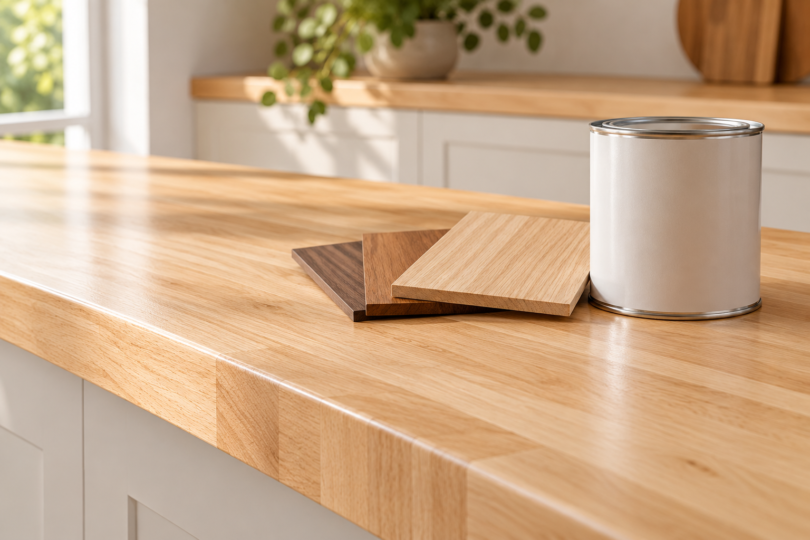

The best polyurethane for a countertop depends on what happens on that surface. A decorative wood counter or occasional-use home bar is a different project from a chopping block or a sink surround that stays wet. For the first group, these three finishes are worth comparing. For direct food preparation, repeated soaking or hot cookware, this shortlist does not establish a suitable coating.
The recommendations below compare manufacturer product instructions, technical sheets and exact shopping variants. They are not based on hands-on durability testing. All three selections are one-quart satin wood finishes, not pour-on epoxy kits, mineral oils or complete countertop-refinishing systems.
Best polyurethane finishes for wood countertops at a glance
| Finish | Best fit within this shortlist | Formulation and selected size | Main tradeoff |
|---|---|---|---|
| General Finishes Arm-R-Seal | A lightly used decorative wood counter with a warm finish | Oil-based polyurethane; Satin, 1 quart, ASQT | 30-day full-cure guidance; manufacturer excludes continuous water and knife cuts |
| ZAR Interior OMU Poly | A wood-counter project where water cleanup matters | Water-based oil-modified urethane; Satin, 1 quart, 36212 / 832734 | Adds a light amber tone; two-hour recoating is not permission to use it for food preparation |
| ZAR Interior Oil Base Poly | An interior wood bar top using a solvent-based finish | Oil-based polyurethane; Satin, 1 quart, 32912 / 832709 | Mineral-spirits cleanup; the quoted drying times do not establish countertop service or food-contact approval |
The paired ZAR numbers are the old and current order numbers in the manufacturer’s product sheets. Match the product family, satin sheen and quart size together. “Oil modified” and “oil base” identify different products even though the cans look similar.
1. General Finishes Arm-R-Seal: best for a lightly used decorative wood counter
Arm-R-Seal is an oil-based polyurethane topcoat for interior wood. It is the clearest fit here for a statement counter that gets gentle use: General Finishes specifically discusses that application in its countertop guidance. The finish brings warmth to the wood and ambers with age, so test it on a sample if preserving a pale color matters.
The manufacturer’s distinction is useful. Arm-R-Seal is an option for a decorative butcher-block top and has been used on home bars, but General Finishes directs people who intend to prepare or chop food toward a different maintenance finish. It also says Arm-R-Seal does not withstand continuous or standing water or knife cuts. Wipe spills promptly and use a separate cutting board.
The technical sheet recommends application around 70°F and 50% humidity, with good air movement and no direct sunlight. Allow at least 24 hours between coats under suitable conditions. The product page distinguishes 7–10 days before light use from 30 days for full cure; cooler conditions, thicker coats and limited airflow can extend the schedule.
- Why choose it: explicit manufacturer guidance for a lightly used wood-counter application, plus a clearly stated full-cure period.
- Why skip it: a busy food-prep counter, standing water, a deadline that cannot accommodate curing, or a project where ambering is unwanted.
The selected listing is one satin quart, model ASQT. It is not General Finishes High Performance, Enduro-Var or Butcher Block Oil.

General Finishes Arm-R-Seal Oil Based Topcoat, 1 Quart, Satin
As an Amazon Associate we earn from qualifying purchases.
2. ZAR Interior OMU Poly: best for water cleanup
ZAR Interior OMU Poly is a water-based, oil-modified urethane. ZAR lists wood countertops among its uses. It is a sensible comparison for an interior decorative wood counter when soap-and-water equipment cleanup is preferable to mineral spirits. Its light amber appearance means it is not a colorless alternative to every oil-based finish.
The satin quart is old order number 36212 and current order number 832734. The shopping listing retains the older “Ultra Max” name, while its main product photo says Interior Oil Modified Urethane, Poly OMU, Satin and 1 QT. Those details distinguish it from ZAR’s solvent-based oil-base product below.
Use the current product data sheet for planning: it specifies air and surface temperatures of 60–90°F and relative humidity below 60%. It gives 30 minutes to touch and two hours to recoat, with drying affected by conditions and film thickness. Neither interval is a food-contact approval or a promise that a counter can return to heavy use that day.
The sheet’s one-week maximum-resistance guidance appears in its floor instructions. This article does not turn that into a universal countertop cure or food-use claim. Ask ZAR for the return-to-service schedule for your wood, existing finish and intended use. Its “child-safe when dry” wording likewise does not establish direct food-contact suitability.
- Why choose it: manufacturer-listed wood-counter use, water cleanup and a comparatively short stated recoat interval.
- Why skip it: direct chopping or food-contact requirements, an unverified existing coating, or a project requiring a completely non-amber appearance.

3. ZAR Interior Oil Base Poly: best for an interior wood bar top
ZAR Interior Oil Base Poly is the solvent-based choice in the ZAR pair. Its manufacturer sheet expressly includes bar tops among the intended uses. Consider it for an interior wood serving or display surface where you want an oil-based film finish and can follow the product’s ventilation and cleanup requirements.
The selected satin quart carries old order number 32912; the current data sheet maps that variant to 832709. The reviewed shopping page calls it “Zar Ultra,” and its main can photo says Interior Oil Base, Satin and 1 QT. It is not the water-based 36212 OMU formula.
ZAR specifies a two-hour recoat interval and four to six hours of drying for the final coat. Cool, damp or humid conditions prolong drying and cure. These are coating-work intervals, not a verified date for direct food preparation or prolonged exposure to liquid. The manufacturer’s one-week resistance statement is in the floor-use instructions, so confirm countertop service timing for your project instead of treating “dries in two hours” as “ready for everything.”
- Why choose it: explicit bar-top application and a solvent-based alternative to OMU.
- Why skip it: water-cleanup preference, uncertain substrate compatibility, or any project needing documented food-contact or hot-pan performance.

How to choose a countertop finish
Start with the surface and the job. This comparison concerns interior wood counters. It does not establish adhesion to laminate, stone, tile, painted surfaces or an unknown epoxy coating. A finish used on a bar top is also not automatically suitable for a surface on which food will be cut, kneaded or placed directly. Obtain approval for that exact use before buying.
Separate a film finish from a maintenance oil or poured resin. These products form a coating. Mineral oil, hardwax oils and two-part countertop epoxies are different systems with their own preparation, renewal and use limits. Do not substitute one merely because a listing says “countertop.” For a working chopping block, start with products explicitly intended for that job.
Identify the old coating. The ZAR sheets require appropriate preparation and a compatibility test. They reject certain wax-, stearate- or aluminum-oxide-containing finishes; the OMU instructions require removal of lacquer, shellac and wax-containing old finishes. Do not assume a new coat will bond to a counter previously treated with an unknown oil or polish. Check the exact product’s directions before sanding or coating.
Budget for all coats and the curing interval. A quart’s coverage figure is not the area of a completed multicoat project. Measure the surface, allow for the specified coats and any edges being finished, and follow the label for your purchased formulation. Dry-to-touch, ready-to-recoat and fully cured describe different stages.
Keep heat and water claims modest. The reviewed instructions do not establish a direct hot-pan rating or direct food-contact certification for these selected variants. Use protective trivets, coasters and a separate cutting board; do not leave pooled water on the finish. A sink surround with persistent wetting needs its own manufacturer-approved system.
Read the safety sheet before opening the can. Water cleanup does not remove the need for ventilation or careful handling. Follow the selected product’s current label and safety data sheet, including its instructions for product-soaked materials and ignition hazards. Those requirements belong in the project plan alongside appearance and drying time.
Frequently asked questions
Which polyurethane is best for a decorative wood countertop?
Arm-R-Seal is the clearest fit here for a lightly used decorative wood counter because General Finishes addresses that use directly. ZAR Interior OMU Poly is an alternative with water cleanup, while ZAR Interior Oil Base Poly lists bar tops among its uses. The right choice still depends on the wood, existing coating, appearance and intended use.
Can I cut food directly on these polyurethane finishes?
This shortlist does not establish that use for any of the three finishes. Use a separate cutting board, and choose a finish explicitly approved for direct food preparation if that is the project's purpose. A dry film, a full-cure period or child-safe marketing does not by itself establish food-contact suitability.
Is ZAR OMU the same as ZAR Interior Oil Base Poly?
No. OMU is a water-based oil-modified urethane with soap-and-water cleanup; its satin quart is 36212, mapped to current order number 832734. Interior Oil Base Poly uses mineral-spirits cleanup; its satin quart is 32912, mapped to 832709. Match the exact product family as well as the sheen and size.
How long should a polyurethane countertop cure?
Follow the exact product's directions and obtain a return-to-service schedule for the intended use. Arm-R-Seal lists 30 days for full cure under suitable conditions. ZAR's two-hour recoat intervals are not full-cure or food-use approvals, and its floor-use timing should not be assumed to authorize every countertop application.
Will polyurethane make a wood counter waterproof or heatproof?
Do not assume either. General Finishes specifically excludes continuous or standing water for Arm-R-Seal, and the reviewed documents do not establish direct hot-pan performance for these variants. Wipe spills promptly, use coasters and trivets, and obtain a separately approved system for persistent wetting or other demanding exposure.

