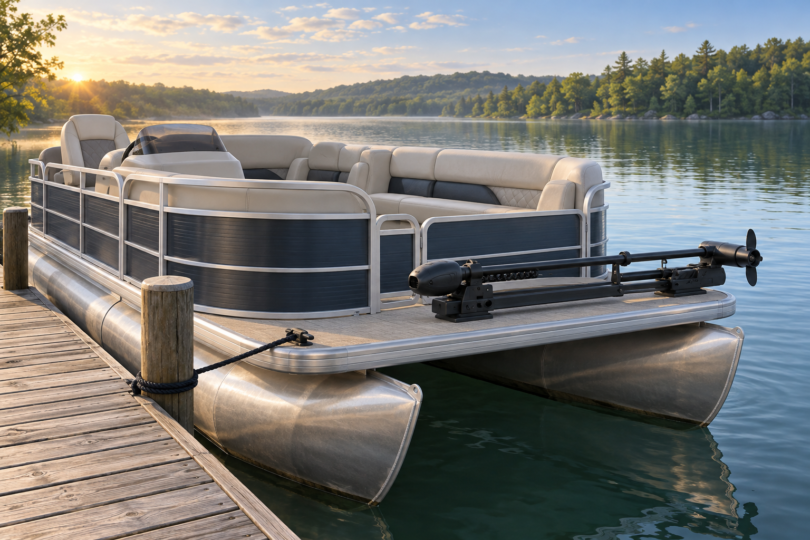

The best trolling motor for a pontoon depends on where it can mount, how far that mounting surface sits above the loaded waterline and the battery system you can install. Start with the Minn Kota Pontoon PowerDrive for foot control, consider the exact Terrova below for GPS positioning, or compare the Newport L-62 for a suitable transom. Each needs a boat-specific fit check.
This is a specification-based shortlist. We have not water-tested these motors, measured pontoon speed or verified runtime. The choices serve different installations; thrust alone does not establish a maximum boat length or guarantee control in wind and current.
Compare the exact configurations
| Motor | Thrust / shaft / voltage | Mount and control | Key buying limit |
|---|---|---|---|
| Minn Kota Pontoon PowerDrive 1358475 | 70 lb / 48 in / 24V | Freshwater bow mount; corded foot pedal | No Spot-Lock or wireless remote |
| Minn Kota Terrova 1358380 | 80 lb / 60 in / 24V | Freshwater bow mount; GPS wireless remote | No included foot pedal or sonar; manufacturer page says no longer sold |
| Newport L-62, part 23M1000097 | 62 lb / 40 in / 12V | Transom clamp; hand tiller; fresh or salt water | Shorter shaft requires careful mounting-height check |
1. Minn Kota Pontoon PowerDrive: for foot-controlled bow mounting
The 1358475 Pontoon PowerDrive packages a 70-lb motor with a 48-in shaft, an 18-ft-cord foot pedal, MKA-16-03 quick-release bracket, MKP-37 propeller and mounting hardware. Variable speed and foot steering suit an angler who wants to keep their hands available while controlling the boat.
Choose this specific 24V configuration if foot control fits your fishing style. It has no Spot-Lock, AutoPilot or wireless remote. The included bracket helps with removal, but does not establish deck strength or clearance around a pontoon gate, fence or furniture. Have the mounting surface and full stow/deploy path checked.
2. Minn Kota Terrova 1358380: a GPS option to verify with the seller
The 1358380 Terrova is an 80-lb, 60-in, 24V freshwater bow motor with Advanced GPS control and Spot-Lock. Its package lists a wireless remote, lanyard, heading sensor, MKP-33 propeller and mounting hardware. This exact version has no built-in sonar and no included foot pedal; other Terrova packages differ.
Minn Kota’s page says this exact model is no longer being sold. A matching retailer listing remains identifiable, but verify the actual model, condition, complete package and warranty eligibility before ordering. Treat it as a conditional shopping option; this guide does not establish current stock.
The longer shaft and remote are useful reasons to compare it with the PowerDrive, provided the measurements fit. Spot-Lock is a fishing-positioning feature, not permission to leave the helm unattended or a guarantee in severe weather. The manufacturer identifies this as freshwater equipment, despite a conflicting saltwater-use attribute on the retailer page.

Minn Kota Terrova 1358380, 80 lb, 60-Inch Shaft
As an Amazon Associate we earn from qualifying purchases.
3. Newport L-62: for a suitable transom and 12V system
The Newport L-Series 62-lb version uses a 40-in shaft, transom clamp and telescoping hand tiller. It has five forward and three reverse settings and is specified for fresh and salt water. Choose the 12V L-62, not the 24V 86-lb alternative on the same product page.
A 40-in shaft is not an automatic fit for a high pontoon deck or raised motor mount. Measure the proposed mounting position and follow Newport’s depth diagram: its manual describes the propeller blades 6–12 in below the surface. Also check that the tiller can be reached comfortably and the clamp has a suitable secure mounting surface.
The selected single-motor listing includes propeller assembly hardware and a 60A manual-reset breaker; a battery is separate. Newport’s current family page lists 50A maximum draw, while the L-62 manual lists 58A. Have Newport and a marine installer confirm the electrical specification for the supplied revision instead of sizing wiring from the generic page alone.

Measure the boat before choosing the motor
- Measure from the actual mounting surface to the water with the boat normally loaded. For its motors, Minn Kota calls for at least 12 in of water above the top of the lower unit and adds 5 in to the waterline measurement for rough-water shaft selection. Use its chart and the exact mount drawing. Newport’s propeller-blade reference is different; do not mix the two measurements.
- Use fully loaded weight, expected wind and current as inputs to the manufacturer’s selection process. Minn Kota’s minimum-thrust guidance assumes normal lake conditions. It is not a promise that a particular motor can control every pontoon of a stated length or weight. More thrust does not necessarily mean more speed.
- Have a marine installer confirm deck support, access beneath the mounting bolts, gate clearance, a level mounting base and unobstructed stowing and deployment. A removable bracket still requires a properly installed base. Budget for an approved mount or reinforcement if the boat needs it.
Plan the batteries and wiring as part of the purchase
The two Minn Kota choices need 24V; their manuals show two 12V deep-cycle marine batteries connected in series. The Newport L-62 needs a 12V deep-cycle or marine supply. Batteries, compatible charging, secure installation and the required cabling belong in the total budget. Have a qualified marine technician design and install the system.
The PowerDrive manual’s 70-lb row specifies a 50A breaker rated for 24V; the Terrova manual’s 80-lb row specifies 60A at 24V. Those tables also change wire size with extension length and include installation assumptions. Do not transfer one motor’s breaker or cable choice to another, or assume a plug, extension cable or battery box is suitable merely because its advertised amp rating looks high.
Before choosing lithium batteries, confirm motor, battery-management system and charger compatibility with the manufacturers. These Minn Kota brushed-motor manuals warn that prolonged operation above 85% speed on lithium can damage the motor. Newport says its battery-meter reading cannot be trusted with lithium. A charge indicator is not a reliable remaining-runtime promise.
Keep people clear of the propeller, wear appropriate life jackets and disconnect power before handling the propeller or clearing line and weeds. If the propeller jams, do not increase thrust to force it free. Follow the motor’s operating limits and maintain a safe return plan; this comparison does not qualify any trolling motor as your pontoon’s sole emergency propulsion.
Frequently asked questions
Will a 55-lb motor move any pontoon?
There is no universal answer from thrust alone. Fully loaded weight, wind, current, shaft immersion and the actual mounting arrangement matter. Ask the motor manufacturer or installer to review your boat and intended conditions rather than relying on a boat-length claim.
Can I use the freshwater Minn Kota choices in salt water?
These selected PowerDrive and Terrova models are specified for freshwater. Minn Kota warns that saltwater use of its freshwater motors can shorten service life and void the warranty. The Newport L-Series is rated for salt water, but its manual calls for rinsing salt-exposed areas with fresh water while keeping the top cover dry.
Does a bigger battery guarantee all-day fishing?
No fixed runtime is established here. Battery capacity, usable charge, speed setting, boat load and conditions affect the result. Choose the battery and charger with the manufacturer, keep a reserve for the return trip and do not turn a marketing runtime claim into an all-day guarantee.