
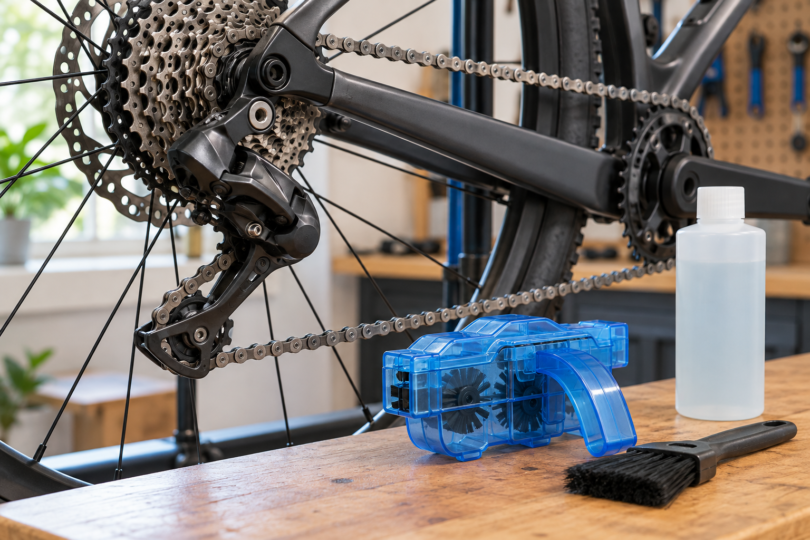

For a bike-chain cleaning kit, start with the Park Tool CG-2.4: it combines a chain scrubber, gear brush and degreaser. If you already have brushes or a cleaning device, compare the 16.9-fluid-ounce Muc-Off Bio Drivetrain Cleaner bottle. The useful distinction is tools plus fluid versus fluid alone.
These are two practical options based on manufacturer specifications and instructions, with no hands-on cleaning-speed or durability testing. Check your chain and bicycle maker’s cleaning restrictions before choosing either formula.
Compare the two chain-cleaning options
| Choice | What you buy | Best fit and limit |
|---|---|---|
| Park Tool CG-2.4 | One kit: CM-5.3 scrubber, GSC-1 brush and CB-4 cleaner | A starting kit for on-bike chain cleaning; lubricant is a separate step |
| Muc-Off Bio Drivetrain Cleaner, 295US | One 16.9 fl oz bottle with trigger; cleaning tools separate | A fluid option for an existing setup; rinse completely after use |
1. Park Tool CG-2.4: a kit for an empty maintenance shelf
Park Tool CG-2.4 Chain and Drivetrain Cleaning Kit
As an Amazon Associate we earn from qualifying purchases.
The CG-2.4 pairs the CM-5.3 Cyclone Chain Scrubber with a GSC-1 GearClean Brush and CB-4 Bio ChainBrite degreaser. Choose this bundle when you need the cleaning tools as well as the liquid. The enclosed scrubber works on the chain while it remains on the bicycle; the separate brush gives you a way to reach the cassette and chainrings.
The CM-5.3 has four rotating brushes and a reversible handle. Park describes a chain-width range from 3/16-inch single-speed chains through 12- and 13-speed bicycle chains. Treat that as a tool-fit statement, not proof that the included fluid is approved for every coating, seal or drivetrain. Check access around your chain and follow any stricter bicycle or component instructions.
For a center-drive e-bike, Park’s current instructions say to switch motor assist off and turn the pedals forward. The instructions use backward rotation for conventional bicycles and rear-hub-drive e-bikes. Read the orientation diagrams before attaching the scrubber, and follow your e-bike’s own maintenance procedure.
The CM-5.3 instructions call for filling to the marked line, cleaning, repeating with soapy water, then drying and lubricating the chain. Do not use gasoline, kerosene or other highly volatile or flammable solvents in the device, and do not store cleaning fluid inside it. See the CG-2.4 kit and its contents.
2. Muc-Off Bio Drivetrain Cleaner: fluid for tools you own
The selected version is SKU 295US, a single 16.9-fluid-ounce trigger bottle. It can be sprayed onto the chain, chainrings, cassette and derailleurs, or poured into a chain-cleaning device. It makes sense when you already have suitable cleaning tools and want a dedicated drivetrain degreaser.
Check the size selector carefully: the 25.3-fluid-ounce refill is listed without a trigger, and the refill bundle is a different purchase. A bottle alone does not include Muc-Off’s X-3 machine. The product is intended to remove oil and wax residue, so do not mistake cleaning for fresh lubrication.
Muc-Off says to shake the bottle, apply the cleaner, leave it for up to one minute and agitate if needed, then rinse thoroughly until all formula is removed. Its instructions finish with moisture dispersal and chain lubrication. Follow your chosen lubricant’s directions after cleaning; a waxed chain may have its own preparation routine. See the 16.9 fl oz Bio Drivetrain Cleaner option.
Check materials, brakes and the cleaning routine
Muc-Off describes its formula as suitable for metal, plastic, rubber and seals; Park gives material claims for CB-4 too. Those claims do not establish compatibility with every finish or electronic component. Check the bicycle maker’s guidance for painted or coated surfaces and seals. For example, SRAM’s drivetrain guidance rules out acidic or alkaline solvents and soaking, while its AXS care instructions use soap and water on electronic components.
If your drivetrain prohibits acidic or alkaline products and you cannot verify approval for the cleaner, do not choose either fluid on generic material-safety claims. Park’s CB-4 safety sheet gives no pH data; the older Drivetrain Cleaner sheet linked by Muc-Off lists pH as not applicable. Neither establishes that the current bottle meets your drivetrain’s restrictions. Use a cleaner your component maker explicitly permits.
Keep dirty drivetrain fluid and chain lubricant away from brake pads and rotors, and keep cleaning tools for those surfaces separate. Follow your brake manufacturer’s procedure if contamination occurs. SRAM, for example, instructs users to avoid contaminating its braking surfaces and to clean them with isopropyl alcohol. A drivetrain-cleaner claim is not a universal brake-cleaner approval.
Use the specified contact time and rinse method instead of a prolonged soak. Park recommends low water pressure with a wide spray and avoiding solvent runoff into bearings. Protect the floor, catch the dirty liquid and follow local disposal guidance; Muc-Off says not to pour its cleaner down drains or onto plants or grass.
Choose CG-2.4 if you need the scrubber and brush as well as the cleaner. Choose the Muc-Off bottle if those tools are already covered. Budget separately for the correct chain lubricant, and check chain wear before spending time cleaning a chain that is due for replacement.
Frequently asked questions
Is chain cleaner the same as chain lubricant?
No. Both selected cleaning routines call for lubrication after cleaning. Dry the chain and use the lubricant and preparation method specified for your chain and riding setup.
Does the Park kit work with e-bikes?
Park provides different CM-5.3 orientations and pedal directions for rear-hub and center-drive e-bikes. For the center-drive procedure, motor assist must be off. Confirm your own bike permits that maintenance setup before starting.
Can I use a jewelry cleaner instead?
Use a cleaner approved for your bicycle drivetrain. Neither the fact that a product cleans jewelry nor the word “degreaser” establishes that it meets your chain, coating, seal and brake restrictions. The two options here have bicycle-drivetrain instructions; those instructions still need to agree with your bicycle’s requirements.


