

A ceramic spray is a practical way to add gloss and water-beading protection during a home car wash, provided you choose a product that fits your routine. The most useful distinction is how it goes on: some sprays need clean, dry paint and a final buff, while others work during the rinse or drying stage. Following the wrong method can leave an otherwise suitable product streaky and disappointing.
The three options below cover those different jobs. They are compared using manufacturer directions and identifiable bottle sizes, without assigning test scores or promising a fixed lifespan. Start with the application method you can do consistently, then compare the cost of the exact bottle.
Choose by your wash routine
- For a separate spray-and-buff finishing step: Turtle Wax Hybrid Solutions Ceramic Spray Coating, 16 fl oz.
- For dry application across several approved exterior materials: Griot’s Garage Ceramic 3-in-1 Wax, 22 fl oz.
- For protection during a hose-based wash: Meguiar’s Hybrid Ceramic Wax, selected here in its 32 fl oz bottle.
These products do not replace washing, paint correction or stone-chip repair. Treat them as exterior maintenance products, and check the label before using one on a matte finish, wrap, protective film, glass or existing professional coating.
Three ceramic sprays to compare
Turtle Wax Hybrid Solutions 53409: a straightforward dry-panel option

Turtle Wax Hybrid Solutions 53409 Ceramic Spray Coating, 16 fl oz, 1 Bottle
As an Amazon Associate we earn from qualifying purchases.
This is a sensible starting point if you prefer to wash and dry first, then work around the car a small section at a time. The selected product is the 16 fl oz Ceramic Spray Coating, rather than Turtle Wax’s similarly named Wet Wax or 3-in-1 Detailer.
Turtle Wax’s application directions call for two mists over a roughly 2-by-2-foot area, spreading with microfiber and buffing with a clean, dry side. The maker allows an optional second coat after a 24-hour cure. That makes it a better match for an owner who enjoys a distinct finishing step than someone who wants to finish entirely during rinsing.
Watch for: buying the wrong bottle from the Hybrid Solutions range or applying much more product than instructed. A thick, visibly wet layer is not the target.
Griot’s Garage 10978: a multi-surface spray-and-wipe choice

Griot’s Ceramic 3-in-1 Wax suits someone who wants one protective product for paint, wheels, chrome, and approved plastic and rubber trim. Those uses are listed on Griot’s product page; they should not be extended automatically to every material on a vehicle.
The 22 fl oz trigger bottle is the convenient small format. Despite the name, it should not be treated as a substitute for removing bonded dirt or correcting scratches. Start with a clean surface and work sparingly with fresh microfiber.
Watch for: application timing. Autogeek’s published directions for this exact 22 oz product specify clean, cool, dry paint and advise allowing 12–24 hours before water, weather or other surface products for maximum durability. They also place an optional second coat 12–24 hours after the first. Plan around rain rather than assuming every spray is immediately ready for it.
Meguiar’s G190532SP: a rinse-stage maintenance option
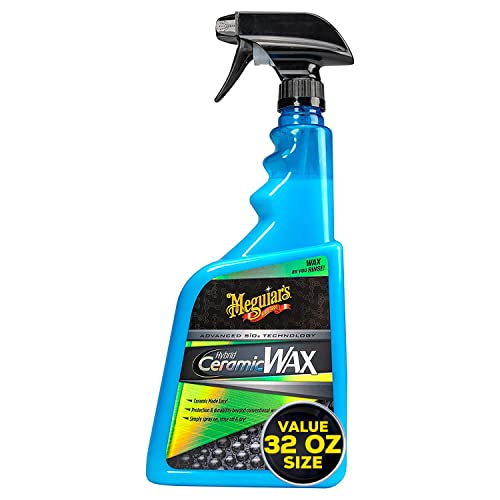
This blue-bottle spray is useful when your regular wash includes a hose rinse. Meguiar’s describes the usual method as washing and rinsing away soap, spraying the product, rinsing again with a strong stream of water, and drying. The second rinse distributes the product. It is a different workflow from applying a dry-panel spray and buffing it off.
For an initial foundation layer, Meguiar’s own application demonstration recommends proceeding from spraying the clean, wet vehicle to towel-drying, rather than doing that second rinse. Read the directions on the bottle you receive before choosing the method.
Watch for: size and product-name changes. This card is specifically the 32 fl oz G190532SP spray, recognized on Meguiar’s G1905 ingredient page. The current main product page also lists a 26 oz G190526 bottle. Neither should be confused with Hybrid Ceramic Liquid Wax or Hybrid Ceramic Detailer.
What the word “ceramic” does and does not tell you
“Ceramic spray” is a broad shopping term. These products use ceramic-related ingredients within usable liquid formulas, but the name does not establish how much preparation is needed, how long the finish lasts, or whether two formulas can be used interchangeably. For example, Griot’s ingredient disclosure lists a mixture that includes water, siloxane, modified carnauba wax and amorphous silica. A ceramic label does not mean a bottle contains only one protective ingredient.
Shop for the actual task: adding protection after a wash, maintaining an existing finish, or cleaning light contamination. A protective wax is not automatically a waterless cleaner. Likewise, a product intended for automotive paint should not be repurposed as a kitchen-counter treatment simply because both products use “ceramic” in their names.
Prepare the surface without making the job bigger than necessary
- Wash first. Remove loose dirt with a suitable automotive wash and clean wash media. Do not wipe a protective spray across a visibly gritty panel.
- Inspect the clean finish. Roughness, tar, bonded contamination and visible swirls are separate issues. Meguiar’s preparation guidance distinguishes washing, clay treatment for roughness and correction for paint defects. Avoid aggressive correction merely to apply a maintenance spray.
- Match the wet-or-dry instructions. Turtle Wax Ceramic Spray Coating and the cited Griot’s directions start from dry paint. Meguiar’s rinse-stage method starts during a wash. Do not average these into one universal procedure.
- Prepare towels and a small test area. Have more than one clean microfiber available. Keep a dry towel for final buffing where required, and replace a towel that becomes saturated or drops on the ground.
- Check the forecast and label. Cooling hot panels and working in shade makes it easier to inspect your work. Respect the chosen product’s timing before additional coats or water exposure.
Avoid the common disappointments
Streaks or patchy gloss: stop and inspect the previous panel before treating the whole car. Excess product, a saturated towel or letting a wipe-off formula dry beyond its directions can complicate removal. Griot’s published application steps specifically call for light misting, prompt wiping and changing saturated towels. Use the maker’s remedy for persistent residue rather than adding a different product over it.
Water spots after impressive beading: beading is not a reason to leave wash water on the car. Continue drying the vehicle; minerals can remain after water evaporates. Meguiar’s recommends cool surfaces and shade when washing and drying to help prevent water spotting. Existing stains may need separate treatment appropriate to the finish.
Expecting scratch repair: a more reflective surface can still have scratches. Correcting defects and applying protection are different stages. If a mark is deep, the clear coat is failing, or you are unsure how much paint remains, get an assessment before using abrasive products.
Compare value beyond bottle size
Use the exact single-bottle volume when comparing prices: 16 fl oz, 22 fl oz and 32 fl oz in this selection. Multipacks, bundles and larger refills can make a search result appear cheaper than the option you actually selected. Calculate price per fluid ounce only after confirming the pack quantity.
That calculation is a starting point, not a prediction of cost per application. Dosage, vehicle size, spraying technique and waste all matter. Also include the practical cost of towels, surface preparation and having somewhere suitable to work. There is little value in a theoretically durable product whose application or cure requirements you cannot follow.
Frequently asked questions
Can I apply a ceramic spray over an existing coating?
Check the coating maker’s maintenance guidance and the spray label. Products intended as compatible maintenance toppers may be appropriate, but a generic recommendation cannot cover every coating, film or finish. Avoid layering several unrelated products simply to add more protection.
How often should I reapply?
Use the specific product’s directions and assess the clean finish during routine maintenance. Storage, weather, washing and preparation vary too much to turn an advertised maximum lifespan into a guaranteed calendar interval. More product at every wash is not automatically better.
Which one is the easiest choice?
Choose Turtle Wax if you want a small-bottle, dry-panel finishing routine. Choose Griot’s if its approved surfaces and cure window fit your detailing plans. Choose the Meguiar’s spray if you prefer integrating protection into a hose wash. The most useful choice is the one whose instructions fit how you actually maintain the car.
Image note: Relevant existing topic illustration retained; not a representation of exact current card contents.