
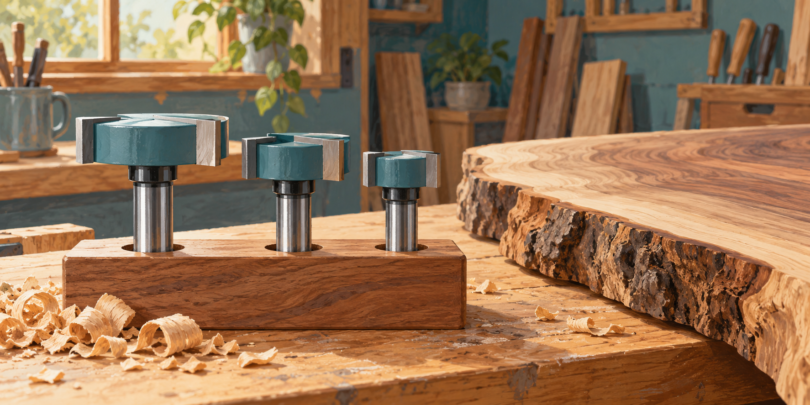

The best router bit for flattening slabs is the one your router and sled can actually accommodate. Start with the Whiteside 6210 for a 1/4-inch-collet setup, compare the slightly wider Amana 45525 in the same shank size, and consider the 2-inch Whiteside 6220 only when a 1/2-inch collet and the complete machine setup allow it. These are our three feature-based picks, with different clearance and speed requirements.
This comparison uses manufacturer specifications and operating guidance. We have not run timed flattening trials or measured the surface finish. The recommendations describe useful buying differences; they do not certify a particular router, jig or cutting setup.
The shortlist at a glance
| Exact bit | Shank / cutter diameter | Cutting length or height | Maker speed guidance | Best reason to consider it |
|---|---|---|---|---|
| Whiteside 6210 | 1/4 in / 1 in | 1/4 in | 14,000–16,000 RPM recommended; 18,000 maximum | Narrowest cutter here for a compatible 1/4-inch setup |
| Amana Tool 45525 | 1/4 in / 1-1/8 in | 1/2 in | 18,000 RPM in CNC chart; product-page maximum 28,000 | A little more width without moving to a 1/2-inch shank |
| Whiteside 6220 | 1/2 in / 2 in | 1/2 in | 12,000–14,000 RPM recommended; 16,000 maximum | Widest cutter here for an approved larger setup |
Cutting-edge length is a tool dimension, not permission to remove that much wood in one pass. A maximum RPM is also not a default operating speed. Check the bit instructions together with the router and sled limits; do not apply a CNC feed chart as a hand-feed recipe.
1. Whiteside 6210: our pick for a compatible 1/4-inch setup
The 6210 has a 1-inch cutting diameter, a 1/4-inch shank and three carbide-tipped wings. Whiteside specifically describes it for router sleds and CNC spoilboard resurfacing. Its documented materials include natural and composite woods, hard plastics and epoxy.
Its smaller diameter is the useful tradeoff: you give up coverage per pass relative to a 2-inch cutter, but have a smaller cutter envelope to accommodate. That makes it the first model we would check for a compact sled. It still needs a router that permits the diameter and operating speed; a 1/4-inch collet by itself does not establish suitability.
Whiteside recommends 14,000–16,000 RPM and states an 18,000-RPM maximum. If your router cannot operate within the approved range for the job, select a different router/bit combination. Read the Whiteside 6210 specifications before ordering.
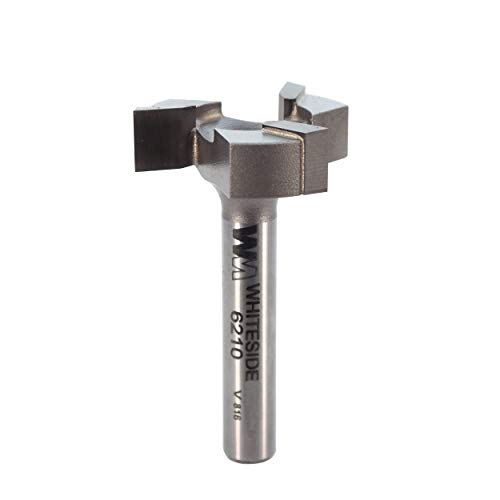
Whiteside 6210, 1-inch cutter, 1/4-inch shank
As an Amazon Associate we earn from qualifying purchases.
2. Amana Tool 45525: a slightly wider 1/4-inch-shank option
The 45525 combines a 1-1/8-inch diameter, 1/4-inch shank and three flutes. Amana lists a 1/2-inch cutting height and a 1-13/16-inch overall length. Its product page expressly includes router sled machines, with the condition that the sled is stable and square.
Choose it when your setup permits the extra 1/8 inch of cutter width over the 6210 and you want Amana’s documented surfacing and rabbeting applications. Do not buy it simply because a listing calls it a flycutter: match the actual 45525 dimensions and check the opening through the base and sled.
Amana’s product page gives a maximum of 28,000 RPM, while its linked CNC surfacing chart uses 18,000 RPM and calls the figures recommendations. Those numbers serve different purposes. Follow the applicable machine and material guidance; the maximum is not our recommended slab-flattening setting.
Use the Amana 45525 product page and dealer route to confirm the supplied version. Some marketplace descriptions give a different overall length, so confirm that dimension if reach or clearance is tight.
3. Whiteside 6220: our pick when the larger setup is approved
The 6220 steps up to a 2-inch cutter, a 1/2-inch shank, a 1/2-inch cutting length and four carbide-tipped wings. Its recommended range is 12,000–14,000 RPM, with a 16,000-RPM maximum. Whiteside lists router sleds among its applications.
The wider cutter can cover a broader strip on each pass, which is the reason to consider it for larger slabs. That does not establish a faster finished job: overlap, cut depth, material, feed and setup all matter. Treat the 1/2-inch collet, cutter clearance and available speed range as purchase requirements, not optional upgrades.
Compare your router and sled instructions with the Whiteside 6220 specifications. Choose the 6210 or another approved arrangement if the 2-inch cutter cannot clear every opening or the router cannot meet the operating limits.

Check fit and operating limits before buying
- Match the actual shank to the correct manufacturer-approved collet. Check the collet condition and required insertion depth. Do not assume a collet extension, reducer or another accessory makes a larger cutter suitable.
- Check the cutter diameter against the router base opening, sled plate opening, travel and permitted cutter size. A bit that fits the collet may still hit the base or jig. Ask the router or sled maker when the manual does not cover your proposed combination.
- Keep the router secured in its base and the slab supported and restrained. Amana calls for guards and a fence and warns against large-diameter bits in handheld routers. A sled is not automatic permission to ignore those requirements: use an arrangement explicitly allowed by all relevant manufacturers.
- Follow the prescribed feed direction. Amana warns against climb cutting and says to feed against bit rotation. Do not improvise alternating directions on a slab simply because the sled can travel both ways.
- Check for embedded metal and other foreign objects, use the required eye and hearing protection, and keep clothing clear. Follow your manuals for cut depth and dust collection; stop if the cut overloads the machine.
Frequently asked questions
Can a trim router use any 1/4-inch flattening bit?
No. A matching shank is only one condition. Confirm the permitted cutter diameter, base and sled clearance, power requirements and usable speed range with the router maker. The 6210 and 45525 are specific candidates to check, not universal trim-router recommendations.
Is a 2-inch cutter always better?
No. The 6220 provides more width but requires a 1/2-inch collet and suitable clearance and speed control. A narrower approved bit can be the better purchase when those requirements are not met.
Which RPM should I use?
Use the maker’s guidance for the exact bit, material and machine. The table separates recommended settings from maximum speeds. Never exceed the applicable limit or copy a CNC operating recommendation into a different setup without checking its instructions.
Are these replaceable-insert bits?
The three selections are described as carbide-tipped cutters. They are not the separate replaceable-insert cutter designs in Whiteside’s larger spoilboard range. If insert replacement is a priority, compare an explicitly documented insert model and its operating requirements separately.
Do these recommendations come from cutting tests?
No. They are a comparison of documented dimensions, applications and operating limits. We do not claim a measured finish-quality winner or a safest bit for every setup.

