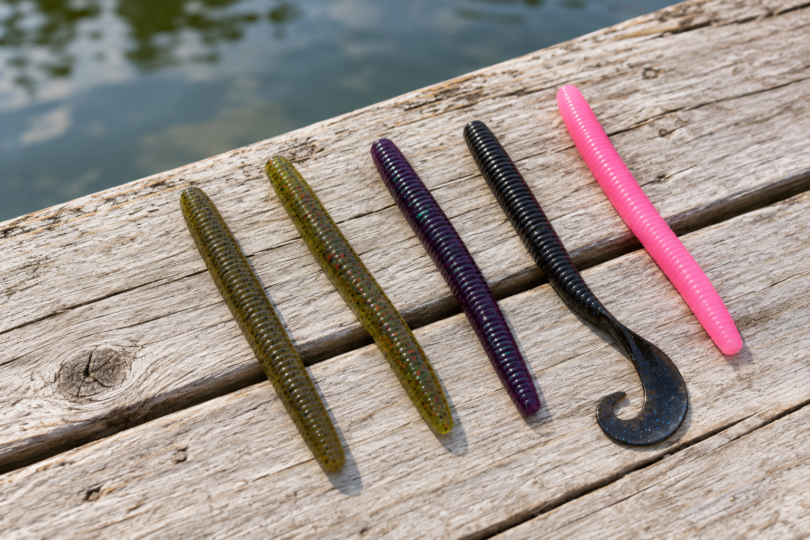

A useful bass-worm selection starts with a natural green or brown, a darker contrasting color and, if you fish shallow enough to watch the bait, a bright option. Green Pumpkin, Watermelon Red, Junebug and Bubble Gum give you those different looks without filling a tackle bag with near-duplicates. None is a universal best color: water clarity, light, background and the way you present the worm all change the decision.
The four packs below are specific Zoom variants, with the color code, worm shape, length and pack count spelled out. They form a small shopping shortlist, not a ranking based on catch rates. Choose the profile you need first, then use color as one variable to compare on your water.
Four worm colors worth comparing
| Exact bait | Size and count | When to consider it | Main trade-off |
|---|---|---|---|
| Zoom Finesse Worm, Green Pumpkin, 004-025 | 4.5-inch tapered straight worm; 20 per pack | A compact natural-color starting point in clear or lightly stained water | Less length than the 6.5-inch Trick Worm |
| Zoom Trick Worm, Watermelon Red, 006-054 | 6.5-inch straight-tail worm; 20 per pack | A translucent green option with red and dark flecks for brighter, clearer conditions | Flash and transparency are different from a solid dark profile |
| Zoom Trick Worm, Junebug, 006-005 | 6.5-inch straight-tail worm; 20 per pack | A dark purple body with green flecks to compare in stained water or shaded cover | A darker color does not make the bait easy to find in every background |
| Zoom Trick Worm, Bubble Gum, 006-039 | 6.5-inch straight-tail worm; 20 per pack | A bright pink option when watching a shallow presentation is useful | Its visibility to you does not prove bass will prefer it |
These are packs of soft-plastic baits. Hooks, jig heads, sinkers, line and other rigging components are separate purchases. A pack count of 20 means 20 worms, not 20 complete fishing rigs.
1. Zoom Finesse Worm in Green Pumpkin: the compact natural option
Choose: 004-025, Green Pumpkin, 4.5 inches, 20-pack. Zoom’s Finesse Worm has a slim body that tapers toward its tail. The Green Pumpkin version is an earthy olive-brown with dark flecks, making it a sensible first comparison when you want a restrained color and a shorter worm.
The appeal here is the combination of size and shape. At 4.5 inches, it gives you a smaller profile than the Trick Worm without switching to a creature bait or a curly tail. Zoom lists several presentations for this body, including a wacky hook, split shot and a shaky or finesse jig head. Those are ways to fish it, not items supplied in the package.
Consider it for clear to lightly stained water when you want to start with a natural-looking shade. If you actually need a longer bait or more obvious tail movement, changing color alone will not supply either. Also check the label carefully: Green Pumpkin 025 is a different color from Green Pumpkin Red 202 and Green Pumpkin Magic 284.
View the Zoom Finesse Worm and select Green Pumpkin.
2. Zoom Trick Worm in Watermelon Red: a translucent green comparison
Choose: 006-054, Watermelon Red, 6.5 inches, 20-pack. This longer, segmented straight-tail worm pairs a translucent green body with red and dark flecks. It is a useful alternative to Green Pumpkin when the water is relatively clear and you want to compare a lighter-looking, flecked finish.
Zoom describes the Trick Worm as suitable for weightless use around shallow cover, as well as Carolina-rig and shaky-head presentations. Its straight tail has a different profile from a ribbon-tail worm; buy it for that slender form rather than expecting a wide swimming tail.
The word “Red” refers to the color pattern, not a solid red worm. Watermelon Red 054 also differs from Watermelon Red Chartreuse 269 and Watermelon Red Magic 304. Red flecks are a visible feature in the product photograph, but they are not evidence of an extra attraction effect or a higher catch rate.
View the Zoom Trick Worm and select Watermelon Red.
3. Zoom Trick Worm in Junebug: the dark-color alternative
Choose: 006-005, Junebug, 6.5 inches, 20-pack. Junebug has a deep purple body with conspicuous green flecks. It gives you a darker alternative to the two green-brown options while keeping the same Trick Worm shape and length as Watermelon Red.
Consider trying it when the water becomes stained or when you move into shaded cover. That is a starting point, not a rule that dark colors only work in dirty water. As one example of how experienced anglers vary their choice, Strike King’s seasonal bait guide describes Denny Brauer choosing Green Pumpkin for a Bull Worm in clear water and Junebug or Black Blue Flake in muddy water. That guidance concerns his particular presentation and conditions; it does not prove one Zoom color will outperform another.
If you want to compare colors, switching between the Junebug and Watermelon Red Trick Worms holds length and shape constant. Be sure the packet says Junebug 005: Junebug Red 177 and Junebug Chartreuse 123 are separate patterns.
View the Zoom Trick Worm and select Junebug.
4. Zoom Trick Worm in Bubble Gum: a bright shallow-water option
Choose: 006-039, Bubble Gum, 6.5 inches, 20-pack. The bright pink finish makes this the clearest visual departure from the natural and dark colors above. It is worth considering when a shallow presentation lets you watch the worm and you want a color that is easier for you to distinguish against the background.
Keep two questions separate: can you see the bait, and are fish responding to it? Bright pink can be useful for following the presentation, but it does not guarantee visibility at depth or make it the right choice in every kind of stained water. Start with the same shape, depth and movement you would otherwise use, then compare the fish’s response.
This is Bubble Gum 039, a solid pink color, rather than Cotton Candy or a pink-and-white blend. It belongs in a small selection as an optional contrast experiment, not as an essential purchase for every angler.
View the Zoom Trick Worm and select Bubble Gum.
How to choose without buying every color
Use clarity and light as starting points
In clear or lightly stained water, begin by comparing natural green-brown shades. If visibility falls, try a darker or brighter contrast option and see how it looks against the actual background. Sun, cloud, depth and dock or vegetation shade can change the view even within the same lake. Treat a color chart as a way to narrow your choices, not a promise about what a bass will bite.
Choose the shape for the presentation
A short finesse worm and a longer straight-tail worm are different buying decisions. Cover also affects whether your chosen hook and weight arrangement can reach the area you want to fish. Buy the bait and compatible rigging separately, and do not assume a color change fixes a worm that is the wrong size or never reaches the fish.
Make a useful comparison
When trying another color, keep the worm model, depth and retrieve reasonably similar where practical. If you switch from a small Green Pumpkin Finesse Worm to a longer Junebug Trick Worm, any different response could involve size and movement as well as color. You do not need to explain every bite scientifically; you do need to avoid turning a single good catch into a universal rule.
Check the full label
Match the model and color code, then confirm length and count. Zoom’s official color list distinguishes closely named patterns. “Trick Worm” is not the same product as Magnum Trick Worm or Thick Trick. Compare the price for the selected 20-pack after any shipping charges, and confirm the retailer has kept the color you chose.
Which pack should you start with?
Choose the Green Pumpkin Finesse Worm if you want the shorter natural-color option. Choose Watermelon Red and Junebug Trick Worms if you prefer a longer straight worm and want two contrasting colors in the same model. Add Bubble Gum when a bright shallow-water comparison has a purpose in your fishing.
There is no need to buy all four at once. Berkley’s discussion of bass color preference also cautions against treating any one color as consistently superior in every situation. Start with the right profile, carry a small contrast choice, and let local conditions and actual fish response guide the next purchase.