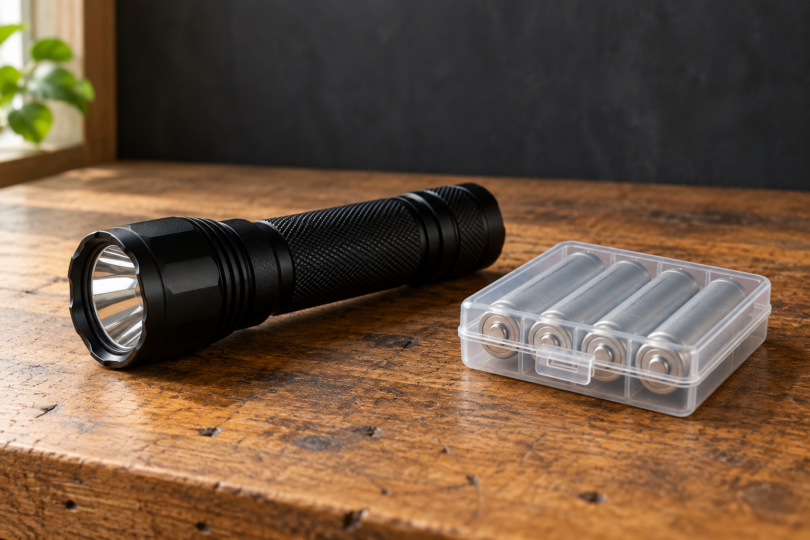

The best batteries for a flashlight are the ones its manual approves. For a compatible, non-waterproof AA light, Panasonic eneloop is a useful rechargeable choice for frequent use, while Energizer Ultimate Lithium makes sense for disposable spares. A CR123A light or an 18650 light needs a different battery entirely.
Check the flashlight’s exact model and battery instructions before ordering. Match the cell size, chemistry, voltage, quantity and terminal style. A battery that fits inside the tube can still be electrically incompatible.
Best flashlight batteries by battery type
| Choice | Exact version | Best fit | Charging requirement |
|---|---|---|---|
| Panasonic eneloop | BK-3MCCA4BA, four AA NiMH cells, 1.2 V | Frequent use in an AA NiMH-approved light with a non-airtight battery compartment | Compatible NiMH charger, such as Panasonic BQ-CC55; charger separate |
| Energizer Ultimate Lithium | L91, four AA primary lithium cells, 1.5 V | Disposable spares for an AA flashlight that permits this chemistry | Do not recharge |
| SureFire 123A | SF12-BB, twelve primary 123A lithium cells, 3 V | Lights whose instructions specify disposable CR123A/123A cells | Do not recharge |
| Fenix ARB-L18-3400U V3.0 | One protected 18650 Li-ion cell, 3.6 V, 3400 mAh | Fenix PD35 V3.0 and other models explicitly approving this cell | Built-in USB-C port; charging cable separate when buying the battery alone |
Panasonic eneloop AA: best for regular use in a compatible AA light
Choose the four-cell BK-3MCCA4BA eneloop pack when your flashlight accepts 1.2 V nickel-metal hydride AA batteries and you use it often enough to recharge them. The practical advantage is reuse: keep a charged matching set ready instead of buying another disposable set after each cycle.
This is a battery-only pack. Panasonic’s BQ-CC55 accepts one to four AA or AAA eneloop/eneloop pro cells and charges cells individually. Follow its instructions; an AA-shaped lithium-ion battery needs a different charging system.
Check before buying: Panasonic’s compatibility guidance excludes waterproof flashlights and devices with airtight battery compartments because gas released by the cells could be trapped. Do not use this eneloop recommendation for those lights. Other devices may prohibit NiMH or have battery-compartment contact issues. Do not assume that every light labeled “AA” accepts this rechargeable chemistry. Runtime and low-battery indication can differ from disposable cells.

Panasonic eneloop BK-3MCCA4BA AA NiMH Rechargeable Batteries, 4 Pack
As an Amazon Associate we earn from qualifying purchases.
Energizer Ultimate Lithium AA: best disposable option for compatible AA lights
The Energizer Ultimate Lithium AA four-pack uses L91 cells. Energizer’s L91 data sheet identifies a 1.5 V lithium/iron disulfide primary battery. “Primary” means disposable: these cells must never go into a charger.
They are a sensible option for approved AA lights carried as spares, particularly when you want to avoid managing a rechargeable set. Energizer specifies a broad operating temperature range, but that does not establish how long your flashlight will run in cold weather. Confirm that its manual permits lithium AA cells before using them.
Check before buying: this is AA, not AAA, and it is not a 3.7 V 14500 rechargeable. Similar appearance is not permission to interchange those batteries.

SureFire SF12-BB: best for a light that specifies disposable 123A batteries
SureFire’s SF12-BB is a box of twelve 3 V primary 123A lithium batteries. It is a practical bulk choice if your flashlight specifically uses this cell type. Buy from SureFire or an authorized dealer, as the maker’s battery safety guidance warns about counterfeit and inferior cells.
Check before buying: this is not the rechargeable LFP123A product, and it must not be charged. Do not substitute a 3.6/3.7 V 16340 Li-ion rechargeable merely because it looks similar. Rechargeable alternatives require express approval in the flashlight manual and their designated charger.
Fenix ARB-L18-3400U V3.0: best matched spare for the PD35 V3.0
The ARB-L18-3400U V3.0 is a protected, button-top 18650 Li-ion battery rated at 3.6 V and 3400 mAh. Fenix specifies a 70 mm length and 18.75 mm diameter. Its built-in USB-C port lets you charge the battery outside the light; the separately sold battery does not include a cable.
It is a particularly straightforward spare for the Fenix PD35 V3.0, whose current instructions name this exact battery. Do not extend that recommendation to every 18650 flashlight: protected-cell length, button-top contacts and current requirements still matter. The PD35 V3.0 page specifically excludes the longer ARB-L18-4000U.
Check before buying: use the battery’s built-in charging port according to Fenix’s instructions, or only an external charger specifically approved for the cell. Protection circuitry reduces certain risks; it does not make damage, short circuits or incorrect charging harmless.
Compatibility checks that matter more than capacity
- AA versus 14500: a 1.5 V disposable AA, 1.2 V NiMH AA and 3.6/3.7 V Li-ion 14500 are different electrical systems. Use only the types your light expressly permits.
- CR123A versus rechargeables: primary 3 V CR123A, rechargeable LiFePO4 and rechargeable Li-ion are not automatic substitutes. Do not replace two CR123A cells with an 18650 unless the flashlight maker explicitly allows that configuration.
- Protected versus unprotected cells: match the specified protection, terminal style, dimensions and current capability. Never force a long cell into a tube or alter its wrapper to make it fit.
- Proprietary packs: for a sealed rechargeable light or a model-specific battery stick, order the exact approved replacement through the maker. A matching connector or capacity number alone is insufficient.
Using and storing flashlight batteries
Energizer’s battery-care guidance calls for replacing the complete set together and avoiding mixtures of old and new cells, brands or battery types. Insert them in the indicated direction. Keep spare batteries in a case that prevents contact with coins, keys and other metal objects, and store them in a cool, dry place.
Charge only batteries marked rechargeable, using the specified system. Stop using damaged cells and follow the maker’s disposal guidance. Remove exhausted batteries promptly; follow the flashlight’s storage instructions when it will be unused for a long period.
Which should you buy?
For frequent use in a NiMH-compatible AA flashlight with a non-airtight compartment, start with the eneloop four-pack and a suitable charger. For disposable AA spares, choose Ultimate Lithium only if the light permits it. For 123A or 18650 lights, buy the exact approved battery type: SureFire SF12-BB and Fenix ARB-L18-3400U V3.0 serve different lights and are not competing drop-in upgrades.