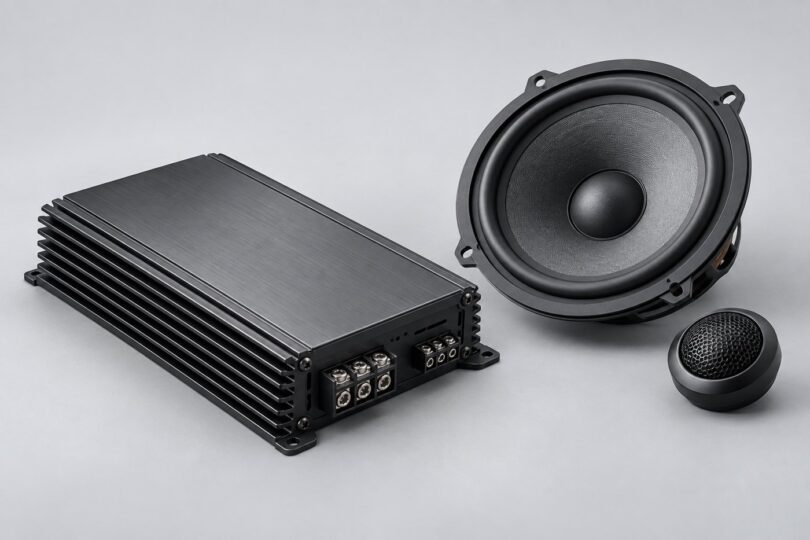

For car-audio mids and highs, start with a full-range amplifier whose RMS output matches your speakers at their actual impedance. A four-channel model is a practical choice for four coaxial speakers or front and rear component sets with their supplied passive crossovers. The important details are per-channel power, crossover range, input compatibility and installation space.
The Rockford Fosgate R2-300X4 and Alpine S2-A36F are two well-documented options for this kind of system. Neither amplifier’s onboard high-pass filter is a substitute for the higher-frequency crossover needed by a bare tweeter. The comparison below uses manufacturer specifications and installation manuals, without claims of listening tests.
Two four-channel amps to compare
- Rockford Fosgate R2-300X4: 50 watts RMS per channel into 4 ohms, with C.L.E.A.N. input/output indicators to assist gain setup and 50–250 Hz filters.
- Alpine S2-A36F: 60 watts RMS per channel into 4 ohms, with 50–400 Hz filters and selectable input/turn-on arrangements.
Those are four-channel ratings. An amplifier advertised as 300 or 360 watts total does not deliver that figure to each speaker. Both models offer different output ratings into 2-ohm loads and when bridged; choose the configuration before comparing wattage.
Rockford Fosgate R2-300X4: useful gain-setting indicators

Rockford Fosgate Prime R2-300X4, 4-Channel Class-D Car Amplifier, Single Amplifier
As an Amazon Associate we earn from qualifying purchases.
The R2-300X4 is a full-range Class-D four-channel amplifier. According to Rockford Fosgate’s product specifications, its continuous output at 14.4 volts is:
- 50 watts RMS × 4 at 4 ohms
- 75 watts RMS × 4 at 2 ohms
- 150 watts RMS × 2 bridged at 4 ohms
Front and rear channel pairs have selectable low-pass, all-pass and high-pass operation, with variable 50–250 Hz crossovers at 12 dB per octave. For many coaxial speakers or passive component sets, the high-pass setting can reduce the low bass sent to the door speakers while a separate subwoofer handles that range. The right crossover point still depends on the speakers and system.
C.L.E.A.N. input and output indicators are the main reason to consider this model. Rockford’s installation and operation manual explains how to use them when setting source volume and amplifier gain. They help with setup; they do not automatically set a safe power limit for every speaker or correct a badly chosen crossover.
Best fit: a four-speaker system whose power needs suit 50 watts per channel at 4 ohms, especially when gain-setting assistance is useful. Main limitation: its 250 Hz maximum crossover setting is far below a typical tweeter crossover region, and it has no built-in DSP for a complete active front-stage setup.
Alpine S2-A36F: a wider adjustable filter range

The S2-A36F is Alpine’s four-channel S-Series Class-D amplifier. Alpine’s published power ratings at 14.4 volts are:
- 60 watts RMS × 4 at 4 ohms
- 90 watts RMS × 4 at 2 ohms
- 180 watts RMS × 2 bridged at 4 ohms
The selectable high-pass and low-pass filters adjust from 50 to 400 Hz, with a 12 dB-per-octave slope. That higher upper limit gives you more adjustment range than the Rockford if a particular midrange installation needs it. It still does not provide the several-kilohertz protection many separate tweeters require.
Alpine provides selectable input-level and turn-on settings for integration with different source units. Speaker-level connection uses an appropriate speaker-to-RCA connection arrangement; the manual identifies the conversion cable as a separate item. Factory-system compatibility depends on signal voltage, existing equalization, channel layout and the vehicle’s electronics, so check the complete installation rather than assuming the amp plugs directly into every original radio.
Best fit: a system that benefits from the 50–400 Hz filter range and whose speakers suit its rated output. Main limitation: it has no integrated DSP or full active tweeter crossover. Its modest power increase over the R2-300X4 should be weighed alongside fit, input requirements and setup features, rather than treated as a promise of dramatically greater volume.
Decide how many channels you actually need
Four coaxial speakers or two passive component sets
Each coaxial speaker normally occupies one amplifier channel. A component set’s supplied passive crossover can divide a channel’s signal between its woofer and tweeter. A four-channel amplifier can therefore power front left, front right, rear left and rear right without needing one channel for every individual driver. Follow the speaker set’s wiring diagram.
An active front stage
An active two-way front system usually needs four channels: left and right midrange/midbass drivers plus left and right tweeters. It also needs suitable crossover processing, typically from a DSP or capable source unit. That uses all four channels before you add rear speakers or a subwoofer. A three-way active front stage generally requires more channels and more filtering.
Do not connect a raw tweeter directly to a full-range channel and rely on a 250 or 400 Hz high-pass setting. Use the crossover frequency and slope specified for that tweeter, with the appropriate passive network or properly configured active processing.
Match RMS power and impedance together
Read the speaker’s continuous-power specification and the manufacturer’s recommended amplifier range. Match those with the amp’s RMS rating at the intended load, not a peak-power number. Four-ohm speakers do not receive the amplifier’s two-ohm rating simply because that larger figure appears prominently in the listing.
Wiring multiple speakers to one channel changes the load. For example, two nominal 4-ohm speakers in parallel present a nominal 2-ohm load, with the channel’s output shared between them. Bridging also changes the amplifier’s permitted load: the quoted bridged ratings for both models are at 4 ohms. Do not treat stereo 2-ohm capability as approval for a 2-ohm bridged connection.
Installation details worth checking before checkout
- Power wiring and fuse: Rockford’s manual lists a 60-amp battery fuse for the R2-300X4 and calls for it within 18 inches of the battery. Alpine’s S2-A36F manual lists a 40-amp fuse and places the external protection as close to the battery positive terminal as possible. Select cable size for the actual run and total system demand, following the chosen manual.
- Ground and cable routing: use a secure chassis ground and protect wires where they pass through metal. Avoid seat tracks, sharp edges, heat and moving parts.
- Mounting space: measure room for the chassis, terminals, cable bends and adjustment access. Keep cooling paths clear; a nominal under-seat fit does not establish adequate ventilation.
- Source signal: confirm whether you have RCA outputs, speaker-level outputs or a factory system that needs an integration interface. Check which adapters and wiring are actually included.
- Safe setup: follow the vehicle and amplifier instructions before disconnecting power. If you are unsure about routing a high-current supply or integrating a factory system, use a qualified installer.
Alpine’s S2-A36F owner’s manual includes connection diagrams, filter controls and power-wire guidance. Refer to the S2-A36F sections specifically: that manual also covers the five-channel S2-A55V, which has different outputs and connections.
Questions about amps for mids and highs
Is Class AB necessary for clear vocals and treble?
Amplifier class alone does not tell you whether a system will sound clear. Both options here are full-range Class-D designs intended to power speakers. Speaker installation, source quality, crossover settings and avoiding clipping all matter; a class label is not a substitute for comparing the actual product.
Can I turn up gain to get more power?
Gain matches the amplifier’s input sensitivity to the source. It is not extra rated power. Excessive gain can cause clipping at a lower source-volume setting. Use the manufacturer’s setup process, then keep the speakers within their operating limits.
Which one is the better starting point?
Choose the R2-300X4 if its power and filter range fit your speakers and you value the C.L.E.A.N. indicators. Choose the S2-A36F if its wider filter adjustment or input arrangements better suit the installation. For independently amplified tweeters and midrange drivers, settle the DSP and crossover plan before buying either amplifier.
Image note: AI-generated editorial illustration; not a photograph of the named product or a compatibility/installation diagram.