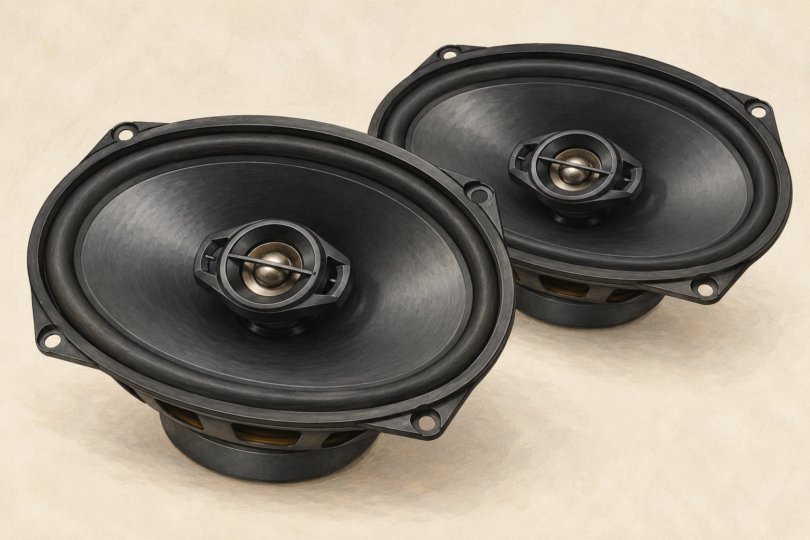

For 6×9-inch car speakers with useful midbass potential, compare the Kicker KSC6930 (51KSC69304) and JBL Club 964M after confirming vehicle fit and amplifier compatibility. Neither is a guaranteed substitute for a subwoofer when the goal is strong deep bass.
Start by identifying what is missing: weak kick-drum impact, distorted door speakers or the lowest bass notes. Replacing a worn factory speaker can be worthwhile, but a new 6×9 cannot correct every factory equalizer, wiring, mounting or power limitation by itself.
Research checked October 4, 2026. This comparison uses official specifications and installation documentation. We have not auditioned these speakers in a vehicle, measured bass output or tested distortion. Published specifications are manufacturer claims, not our listening results.
Compare the exact models
| Model | Nominal impedance | Published power specification | Key check |
|---|---|---|---|
| Kicker KSC6930, 51KSC69304 | 4 ohms | Recommended amplifier power: 15–150 watts RMS | 75 mm top-mount depth and 3 mm tweeter protrusion |
| JBL Club 964M | 3 ohms | Power handling: 85 watts RMS | The existing amplifier must support the speaker load |
The two power descriptions are not identical test labels, and neither tells you how much bass you will hear in your car. Compare the complete installation rather than ranking the products by the larger wattage number.
1. Kicker KSC6930: a 4-ohm three-way option
The 51KSC69304 is a three-way 6×9 with a polypropylene woofer, rubber surround and silk-dome high-frequency drivers. Kicker specifies a 4-ohm load and recommends 15–150 watts RMS of amplifier power.
The fit dimensions are useful: the stated top-mount depth is 75 mm, bottom-mount depth 81 mm and tweeter protrusion 3 mm. The listed mounting cutout is 144 by 215 mm. These measurements are a starting check, not proof that every factory 6×9 location accepts the speaker.
Why compare it: it provides a clearly specified 4-ohm option when that load and size suit the system. Tradeoff: the 30 Hz lower figure in its published frequency range does not establish strong, low-distortion output at 30 Hz inside your vehicle. Do not interpret that number as a subwoofer-equivalence claim.
2. JBL Club 964M: verify the 3-ohm load
The Club 964M is a three-way 6×9 speaker with a polypropylene cone and silk-dome tweeter. JBL lists 85 watts RMS power handling, 3-ohm nominal impedance and a 50 Hz–20 kHz frequency range. The package list includes two speakers, grilles, gaskets and mounting hardware.
Why compare it: it is another full-range replacement option with documented specifications and installation drawings. Tradeoff: a 3-ohm speaker is not automatically interchangeable with the speaker load your factory radio or amplifier expects. Ask an installer to check the system before purchase rather than assuming a lower impedance simply means better bass.
JBL’s direct page showed the item unavailable when checked for this update. Confirm an authorized seller, exact model and return terms if considering it; this guide does not promise current local stock.
Why the sensitivity numbers are not directly comparable
Kicker lists 92 dB at 1 watt/1 metre; JBL lists 93 dB at 2.83 volts. Those are different input references, particularly with different speaker impedances. The larger printed number does not by itself prove the JBL will be louder on your system.
Similarly, frequency ranges without a matching measurement method, tolerance and installation context cannot establish which speaker has more audible bass. Look for an appropriate demonstration or independent measurements for the exact model if that distinction will decide the purchase.
What actually needs checking in the vehicle
- Physical space: check cutout shape, screw locations, depth, grille clearance and moving-window clearance. Nominal 6×9 dimensions do not settle all of these.
- Factory audio configuration: identify whether the location carries a full-range signal, a filtered bass signal or a channel from a factory amplified system.
- Electrical load: confirm the amplifier’s permitted impedance and the correct wiring arrangement. Do not improvise parallel connections to chase more output.
- Mounting and sealing: the speaker needs an appropriate secure adapter and seal. A loose panel or poor fit can create rattles that changing brands will not solve.
- Signal processing: factory bass reduction, crossovers and equalization may remain after a speaker swap. An installer should assess these before promising a result.
Ask for a complete installed quote including adapters, harnesses, any required integration hardware and labor. A pair with an attractive purchase price may be the more expensive option if it needs substantial adaptation. Do not cut structural metal, interfere with airbags, block door drains or damage vehicle wiring to force a fit.
When a subwoofer is the more relevant upgrade
If the main goal is substantial deep bass, discuss a properly integrated subwoofer and amplifier instead of expecting a full-range 6×9 to do every job. Space, electrical requirements, enclosure design and how it blends with the existing speakers become part of that decision.
You may still want new 6×9 speakers for midbass, vocals and treble, but separate those goals. A well-planned system upgrade can be more useful than repeatedly replacing full-range speakers while leaving the same missing low-bass capability.
There is no need to maximize every control. Excessive bass boost can push a system toward distortion without producing the clean improvement you wanted. Have gain and crossover settings established for the actual equipment rather than copying a universal setting from a forum.
Installation and listening limits
The Kicker KS manual includes model-specific wiring and mounting instructions and warns that prolonged clipped, distorted or overpowered operation can overheat equipment. Follow the exact manual and vehicle service procedures, preferably through a qualified installer if you are unfamiliar with the system.
Keep listening levels low enough to remain aware of traffic and warning sounds. Stop and investigate new rattles, intermittent operation or audible distortion rather than turning up the volume. Neither a speaker’s power rating nor the absence of obvious distortion guarantees a safe listening level.
Frequently asked questions
Will these work without an added amplifier?
That depends on the factory system, load compatibility and the result you expect. Do not assume the speaker’s maximum rating is the power it requires at all times. Have the actual radio or amplifier checked.
Are three-way speakers better for bass than two-way speakers?
The number of drivers does not establish bass performance. Woofer capability, installation, power and signal processing matter. These two are three-way examples, not proof that every three-way model beats a two-way design.
Which would we compare first?
Start with the Kicker if a 4-ohm replacement fits the system. Consider the JBL only after confirming the 3-ohm load and availability. If deep bass is the primary goal, get a subwoofer-system assessment before choosing either.
Bottom line: verify fit and compatibility first. Choose a 6×9 for a suitable full-range upgrade, and keep expectations for deep bass separate from the manufacturer’s headline numbers.
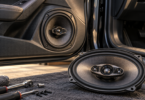
Image note: AI-generated generic editorial illustration; it does not identify a speaker model or demonstrate vehicle fit, wiring or bass performance.