
The best car speakers for bass without a subwoofer are the ones that fit your vehicle and work with its amplifier. For a compatible 6×9-inch installation, the Kicker 51KSC6904 is our first shortlist choice. The Alpine S2-S65 is a practical alternative for 6.5-inch openings, while the JBL Club 964M and Polk DB692 suit different electrical and environmental requirements.
Expect fuller bass lines and more kick-drum impact from a well-installed upgrade. Ordinary door speakers cannot deliver the same deep, high-output sub-bass as a dedicated subwoofer. Replacing speakers alone also does not guarantee more bass than the factory system.
This research-based guide uses manufacturer documentation and verified product listings; we have not performed comparative listening or vehicle-installation tests.
Quick comparison
| Speaker | Size and design | Impedance | Manufacturer power specification | Best reason to consider it |
|---|---|---|---|---|
| Kicker 51KSC6904 | 6×9-inch, two-way coaxial pair | 4 ohms | 15–150W RMS recommended amplifier power | Conventional 4-ohm 6×9 upgrade |
| Alpine S2-S65 | 6.5-inch, two-way coaxial pair | 4 ohms | 80W RMS power handling | Round factory speaker openings |
| JBL Club 964M | 6×9-inch, three-way coaxial pair | 3 ohms | 85W RMS power handling | Systems explicitly compatible with a 3-ohm load |
| Polk DB692 | 6×9-inch, three-way coaxial pair | 4 ohms | 150W continuous power handling | Marine-certified construction for more exposed installations |
Power figures apply per speaker. Kicker publishes a recommended amplifier range; the other entries are handling ratings. None is a minimum power requirement or a measurement of bass output. Check the exact model and package before ordering.
1. Kicker 51KSC6904: our starting point for 6×9-inch locations
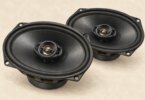
The 51KSC6904 combines a polypropylene woofer, rubber surround, and one-inch silk-dome tweeter. Its 4-ohm load makes it a sensible candidate when the existing system calls for conventional 4-ohm speakers. We favor it as a starting point because its power guidance and installation dimensions are clearly documented.
Kicker lists a 75mm top-mount depth and 3mm tweeter protrusion. Both matter when fitting behind a factory grille or near a moving window. The published 30Hz–21kHz response does not establish flat, powerful 30Hz bass inside your car. See the Kicker specifications.
- Strength: a straightforward coaxial layout with included grilles and a broad recommended amplifier range.
- Limit: the oval basket and mounting depth still require a proper fit check; it will not fit a round opening just because an adapter is available.

Kicker 51KSC6904, 6×9-Inch 4-Ohm Two-Way Coaxial Speakers, Pair
As an Amazon Associate we earn from qualifying purchases.
2. Alpine S2-S65: a 6.5-inch option for everyday installations
Choose the S2-S65 when your car accepts a 6.5-inch coaxial speaker and you want to keep that layout. Alpine specifies 80W RMS handling, 4-ohm impedance, and a high-excursion HAMR surround. Its integrated tweeter avoids the extra mounting work of a separate component tweeter.
Alpine lists approximately 58mm mounting depth. Confirm the cutout, mounting tabs, and front clearance rather than relying on the nominal diameter. Protective KTE-S65G grilles are sold separately. See Alpine’s S2-S65 documentation.
- Strength: a useful round-speaker choice for a planned amplifier upgrade or a compatible existing system.
- Limit: weak factory amplification can restrict output. Its excursion-related design features are not evidence that it outperforms the larger speakers here in bass.
3. JBL Club 964M: for a verified 3-ohm-compatible system
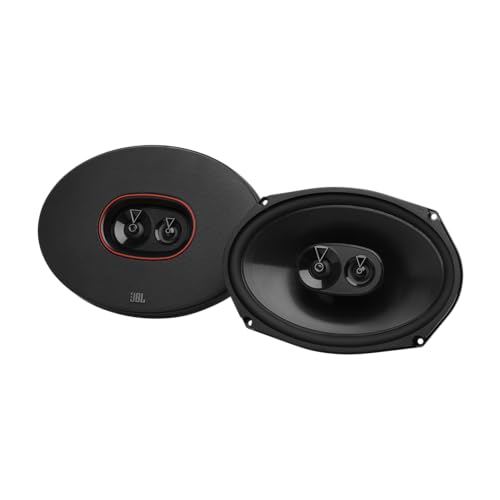
The Club 964M uses JBL’s Plus One woofer-cone design and an edge-driven silk-dome tweeter. Its 6×9-inch format and 85W RMS rating make it worth considering where that basket fits, but its 3-ohm nominal impedance is the deciding compatibility detail.
Do not assume every factory radio or amplifier can safely drive it. JBL’s sensitivity specification is measured at 2.83V, so it should not be compared directly with another speaker’s 1W sensitivity number. See the official Club 964M specifications.
- Strength: a large-format coaxial option with a manufacturer design focused on usable cone area.
- Limit: a lower impedance can increase amplifier demands. Confirm the permitted load before choosing it for an otherwise stock system.
4. Polk DB692: for installations needing extra environmental durability
The DB692 is a 4-ohm, three-way 6×9-inch speaker with 150W continuous power handling. Polk’s DB+ documentation identifies marine certification and IP56 protection, giving it a clear reason for consideration in more exposed vehicles.
Budget space carefully: Polk lists 82.5mm top-mount depth and 97.3mm bottom-mount depth. These are different installation measurements, not interchangeable clearance requirements. See the Polk DB+ specification brochure.
- Strength: documented weather-resistant construction alongside a conventional 4-ohm load.
- Limit: it needs substantial mounting room. Marine certification does not make wiring waterproof or guarantee compatibility with an open-top vehicle.

How to get better bass without adding a subwoofer
Start with fitment and the factory signal
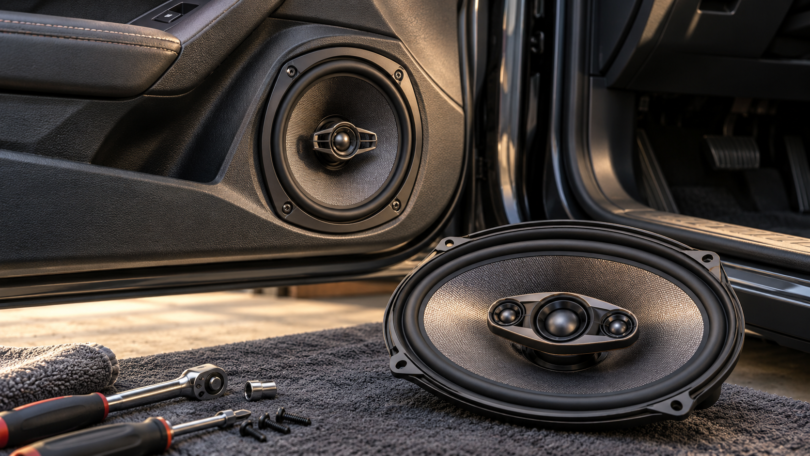
Check your year, make, model, body style, and factory audio package. Measure the opening, depth with the window lowered, bolt pattern, and grille clearance. Add vehicle-specific brackets and wiring adapters to the budget. A 6×9-inch speaker often offers more cone area than a 6.5-inch model, but fitment and installation quality take priority over diameter.
Premium factory systems may use unusual impedance, separate tweeter channels, or frequency-limited door outputs. A coaxial speaker connected to a bass-only channel will not receive the high frequencies its tweeter needs. Have an installer verify the signal path before changing these systems. Crutchfield’s speaker buying guide explains power matching and the difference between coaxial and component layouts.
Match impedance and use clean amplifier power
Check the amplifier’s allowed speaker load and continuous output per channel. Going below its minimum impedance can cause trouble; replacing low-impedance factory speakers with 4-ohm models may reduce available power. Large peak-watt numbers are not a useful buying shortcut.
An appropriate amplifier can provide more clean output, but turning up gain or bass boost cannot make a speaker handle unlimited low-frequency excursion. Use the equipment manufacturer’s setup procedure and back off if you hear distortion. If bass fades as volume rises, the factory system may be reducing it electronically; AudioControl documents this factory bass-roll-off behavior. New speakers alone cannot correct the source signal.
Fix the installation before chasing more watts
Mount each speaker securely and seal gaps between its frame, adapter, and mounting surface. Treat rattling panels with suitable automotive damping material while keeping drains, wiring, window mechanisms, and safety equipment clear. Confirm consistent speaker polarity: reversed wiring can cancel bass between speakers. Kicker’s technical FAQ explains polarity-related cancellation.
Use a high-pass filter when the installation or speaker manufacturer calls for one. Its purpose is to reduce frequencies the speaker cannot reproduce cleanly. The right setting depends on the speaker, power, mounting, and listening level; lowering it as far as possible is not automatically better.
Frequently asked questions
Can car speakers produce good bass without a subwoofer?
Yes, for bass-guitar body and drum impact at reasonable volume. Deep electronic notes and sustained low-frequency output are much more demanding. Choose according to your listening priorities and accept the limits of small speakers mounted in doors.
Will aftermarket speakers always have more bass than factory speakers?
No. Factory speakers may be closely matched to the radio’s power, equalization, and impedance. A replacement can sound clearer yet have less bass if those factors or the installation are mismatched.
Are three-way speakers better for bass than two-way speakers?
Not inherently. The extra driver handles another portion of the frequency range; it does not establish stronger low-frequency output. Woofer capability, mounting, power, and tuning matter more.
Which option should I choose first?
Start with the Kicker 51KSC6904 for a compatible 4-ohm 6×9 installation, or the Alpine S2-S65 for a suitable round opening. Consider the JBL only after confirming its 3-ohm load is acceptable. Choose the Polk when environmental durability matters and its deeper basket fits.