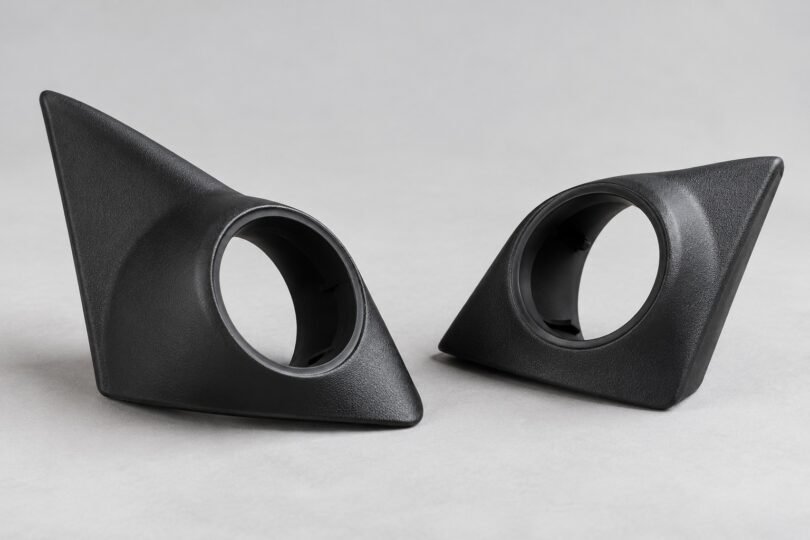

The best A-pillar tweeter pods are the ones that match both your tweeters and an approved mounting location in your exact vehicle. A round opening of roughly the right size is not enough. Before buying, confirm the tweeter’s mounting drawing, the pod’s usable space, the pillar’s shape and the vehicle manufacturer’s airbag restrictions.
For a small component tweeter, start with the mounts supplied by its manufacturer. For an empty enclosure, ask for its actual cutout and internal dimensions. For a replacement pillar, require a match to the vehicle’s year, body style, trim and factory audio equipment. None of these choices automatically makes an A-pillar installation safe.
Choose the right kind of mount
| What you need | What to look for | What still needs checking |
|---|---|---|
| A housing for tweeters you already own | An empty pod with a dimensioned drawing and a written match to your exact tweeter model | Cutout, flange, rear clearance, fastening method, quantity and vehicle suitability |
| Tweeters and their matching mounts | A complete tweeter kit with the manufacturer’s own mounting pieces | Installed dimensions, crossover requirements and a permitted location in the car |
| A molded replacement pillar | A part explicitly identified for the exact vehicle and interior configuration | Airbag provisions, trim retention, left/right pieces, factory speaker openings and visibility |
A gauge pod is not a tweeter enclosure just because its opening looks similar. Door-speaker pods, motorcycle fairing pods and dashboard speaker enclosures also serve different locations. Keep those out of an A-pillar shortlist unless the manufacturer documents the intended application.
Three manufacturer-documented examples
DS18 EN2T: an empty pod that needs careful size confirmation
DS18 lists the EN2T as one empty black ABS pod with hardware included and external dimensions of 6.89 × 1.26 × 2.76 inches, stated as L × W × H. The page recommends the TW2.5 tweeter and says tweeters are sold separately. One pod has two tweeter positions; “two tweeters” does not mean two separate pods.
There is an important ambiguity: the page title describes 2 × 2.5-inch tweeters, while its specification table says 2 × 1-inch dome tweeters. Those labels are not a verified cutout measurement. Ask DS18 to confirm the opening, usable depth and current tweeter revision before ordering. Its “universal” description does not establish fit to a particular pillar or clearance for an airbag. Check the DS18 EN2T specifications.
KICKER 46CST204: a tweeter kit with its own mounting hardware
The 46CST204 manual identifies a pair of CST20 tweeters, two crossovers and mounting hardware. Its 3/4-inch nominal tweeter size is very different from the specified flush-mount hole: 1-9/16 inches (40 mm). Flush mounting depth is 9/16 inch (14.5 mm). The manual illustrates flush, angle and pod mounting.
This is a useful starting point when you need both tweeters and matched mounting pieces. It is not an empty replacement A-pillar or a documented fit inside the EN2T. Use the drawing for the chosen mounting method, rather than transferring the flush dimensions to a surface pod. The supplied crossover is part of the system; the manual specifies a 6 dB high-pass at 4,500 Hz. Read KICKER’s 46CST204 manual.
Rockford Fosgate P1T-S: another example of nominal size versus mounting size
Rockford Fosgate’s P1 component manual lists the P1T-S as a 1-inch tweeter, with a mounting diameter of 1.75 inches (44.4 mm) and mounting depth of 0.91 inch (23.1 mm). These specifications show why a pod advertised for “1-inch tweeters” cannot be assumed to accept every 1-inch model.
Check the full drawing and the chosen mount before buying a housing. Rockford also calls for adequate mounting area and depth, protected wiring and professional installation when the owner is unsure. These instructions do not certify an arbitrary A-pillar location. See the P1T-S specifications and installation guidance.
Check airbag clearance before choosing a pillar location
Airbag compatibility is a condition of the installation, not a feature proved by an enclosure’s size. Ford’s Safety Canopy guidance, for example, says: “To reduce risk of injury, do not obstruct or place objects in the deployment path of the airbag.” It also warns against equipment on or near the side-rail trim or A-pillar that could contact a deploying curtain airbag. Read Ford’s curtain-airbag warning.
Use the owner’s manual and service information for your own vehicle. A warning from one vehicle does not define a safe distance for another. If the proposed location, fastening or wire route could interfere with an airbag, its deployment path or the pillar trim’s retention system, stop and have the vehicle manufacturer or a qualified installer assess it. Do not modify airbag components, defeat trim retainers or use a general speaker-installation guide as permission to drill into a pillar.
Visibility is a separate check. From your normal driving position, the finished installation must leave the windshield, side view and mirror view unobstructed. Include the pod, protruding tweeter, trim ring and any aiming adjustment in that assessment.
The measurements to take before ordering
- Tweeter identity: record the exact model and revision, not just the brand or dome size.
- Mounting opening: compare the manufacturer’s cutout requirement with the actual pod opening. An advertised speaker diameter is not a substitute.
- Front footprint: allow for the outer flange, grille, trim ring and access to the fasteners.
- Usable rear space: include the driver body, terminals, connector and an unstrained wire route. External pod depth alone cannot establish this.
- Panel interface: check the required panel thickness, clamp arrangement and mounting surface against the relevant drawings.
- Vehicle details: give the supplier the year, make, model, body style, left- or right-hand-drive layout and factory audio trim.
- Package contents: establish whether the purchase includes one pod, a left/right pair, tweeters, crossovers, grilles and mounting hardware.
Ask for written confirmation if any measurement is missing. A product photo can show the general shape, but it cannot establish hidden depth or whether a retaining nut has room behind the panel.
Plan the whole audio installation
Choose the speaker system before the cosmetic housing. Give the installer the amplifier or factory-audio details, the tweeter manual and the pod drawing together. The crossover, impedance and connection plan must suit that system; changing a mounting pod does not resolve an electrical mismatch.
Discuss the desired listening position and aiming adjustment before fabrication. Sound quality cannot be ranked from the enclosure shape alone. Once a safe mounting plan is confirmed, compare the complete installed cost: pods, matching tweeters if needed, crossovers, trim work, wiring and labor. Check the seller’s return conditions before painting, trimming or otherwise altering a part.
Common buying questions
Do universal A-pillar pods fit every car?
No. Treat “universal” as a description of an adaptable accessory. It does not verify the pillar contour, attachment points, driver visibility or airbag clearance in your car.
Can I put any 1-inch tweeter in a 1-inch pod?
Not without comparing the drawings. The nominal dome diameter, outer housing diameter and mounting-hole diameter describe different things.
Should I buy the pod or the tweeters first?
Identify the exact tweeters and a safe location first. Then choose a housing whose dimensions and mounting method are documented for that combination.