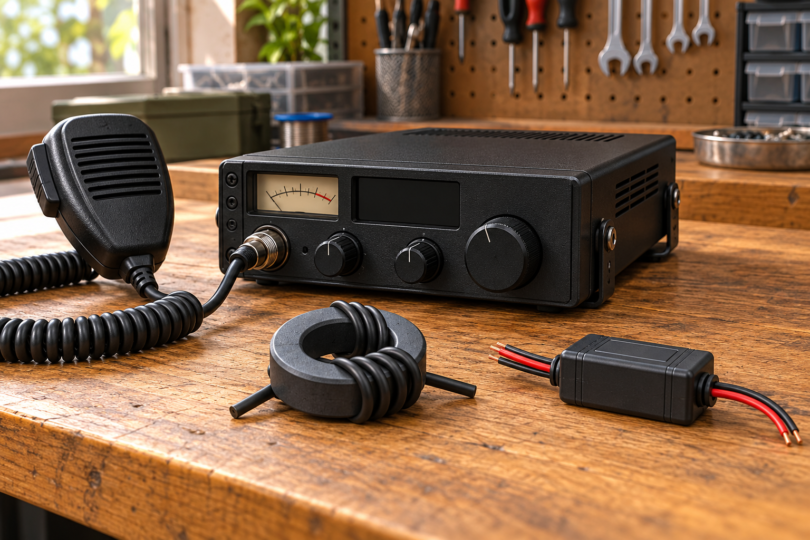

The right noise filter for a CB radio depends on where the noise enters. For alternator whine carried on the DC power cable, consider the Powerwerx LF-1-PP. For common-mode interference on power and antenna cables, the Palomar RFI-CB-MOBILE kit is the more relevant choice. If reception is usable but the speaker audio is tiring, the Cobra HG S500 adds a switchable audio filter. These products solve different problems, so diagnose the noise before ordering.
This guide compares manufacturer specifications and installation guidance. It does not claim hands-on testing or a measured noise-reduction ranking. No accessory can guarantee a silent receiver in every vehicle.
Quick comparison: three useful CB noise-reduction options
| Product | Best suited to | Connection or installation | Main limitation |
|---|---|---|---|
| Powerwerx LF-1-PP | Noise conducted through DC power wiring | Inline Anderson Powerpole connections; 16A continuous, 20A maximum | Does not remove interference the antenna receives over the air |
| Palomar RFI-CB-MOBILE | Common-mode RF on the power cable or outside the coax shield | Two ferrite rings; cables wind through them following the supplied instructions | Needs room for cable turns; results depend on the actual noise path |
| Cobra HG S500 | Receive-audio filtering and a separate speaker position | External-speaker output; separate PA connection for talk-back | Audio filtering does not repair noisy power wiring or improve antenna performance |
1. Powerwerx LF-1-PP: for noise on the power leads
The Powerwerx LF-1-PP is designed to suppress alternator noise in the DC supply of a mobile transceiver. Its specified capacity is 16 amps continuously and 20 amps maximum. The fitted Powerpole connectors use 30-amp contacts; that connector rating does not raise the filter’s own current limit.

Powerwerx LF-1-PP DC Line Noise Filter, Powerpole Connectors, 1 Filter
As an Amazon Associate we earn from qualifying purchases.
Why choose it: It is a defined, purpose-built power-line filter with published current limits and a clear installation location. Powerwerx says to fit it close to the transceiver and secure it without straining the connectors. That makes it a sensible candidate after testing points to noise entering through the radio’s power feed.
Check before buying: Many CB power cables do not use Powerpole plugs. Allow for a correctly wired, appropriately rated adapter or professional installation. Also check the radio’s supply-voltage and current requirements. This filter cannot promise to remove ignition noise that reaches the receiver through the antenna.
2. Palomar RFI-CB-MOBILE: for common-mode interference
The Palomar RFI-CB-MOBILE kit contains two ferrite rings for the DC cable and antenna coax. Its specified suppression range is 20–60 MHz, covering the CB region around 27 MHz. The manufacturer’s instructions call for several cable turns through the rings, rather than simply attaching an unspecified bead anywhere on a wire.
Why choose it: It targets unwanted RF current on cables. It is a more defensible starting point for that problem than a mixed bag of ferrites with no published material or useful frequency range.
Check before buying: Measure available cable slack, connector clearance and space behind the radio. A thick coax cable may not accommodate the same winding arrangement as a thinner one. Follow Palomar’s instructions and the cable’s bend limits. Palomar describes a lower receive noise floor as a possible benefit depending on how much common-mode noise is present, not a guaranteed improvement.
A choke on the coax treats current traveling along the outside of its shield. Noise picked up by the antenna itself can still remain. Palomar’s feedline-choke guide explains this distinction and why placement matters.
3. Cobra HG S500: for filtered receive audio
The Cobra HG S500 is an external communications speaker with a switchable noise filter and adjustable talk-back. It is useful when you want to position the speaker where speech is easier to hear and have an audio-filter switch available.

Why choose it: This is the HG S500 Noise Cancelling with Talk Back variant. According to Cobra’s connection instructions, the black lead plugs into the external-speaker jack and the red lead into the PA jack. Without a PA jack, it functions as an extension speaker and the talk-back feature is unavailable.
Check before buying: Confirm that your radio has a compatible speaker output, including the correct connector and speaker-load requirement. Keep the speaker inside the cab: Cobra explicitly says it is not waterproof. Treat its filter as an audio-listening feature, not a substitute for tracking down interference. Talk-back monitors your own transmitted audio; it does not establish that a distant station can hear you clearly.
How to find the noise source before spending money
- Compare conditions while parked. Listen with the engine stopped and running. Switch optional accessories, such as a phone charger, off individually. Note when the noise changes. A persistent sound with the engine off can still come from nearby electronics.
- Use the radio’s existing controls. Try the noise blanker or automatic noise limiter if fitted. Set squelch only high enough for the listening conditions. Excessive squelch or reduced RF gain can also hide weak transmissions.
- Separate antenna pickup from power noise. Cobra recommends comparing the noise with the antenna disconnected. Do this only while receiving, never press transmit without the proper antenna or test load connected, and reconnect the antenna before normal use. Noise that drops substantially points toward the antenna system; noise that remains warrants checking the power path.
- Inspect the installation. Loose connections, damaged coax, cable routing and an unsuitable antenna installation deserve attention before buying another accessory. Have a competent installer check vehicle wiring, grounding and antenna tuning if the cause is unclear.
This is a starting test, not a complete electrical diagnosis. See Cobra’s CB-noise troubleshooting guidance. For interference from surrounding electronics, ARRL’s RFI troubleshooting guide also emphasizes locating the source first.
What to avoid when choosing a filter
- AUX or RCA ground-loop isolators as a universal CB fix. These belong in compatible audio signal paths. A 3.5-mm plug alone does not establish that a device is suitable for a radio’s speaker output, power feed or antenna connection.
- Unspecified ferrite multipacks. Cable-hole diameter tells you whether a core fits. It does not establish useful suppression at the frequency causing trouble. The ARRL interference primer cautions that an unsuitable ferrite material or frequency range may be ineffective.
- Buying by peak ratings alone. Match continuous current for a power filter and the radio’s required speaker impedance for an audio accessory. Check connector type, polarity and installation instructions separately.
- Improvised changes to vehicle systems. Do not splice filters into safety-related circuits or alter charging, fuel or ignition wiring based on a generic buying guide. Use the vehicle manufacturer’s guidance and a qualified installer.
Frequently asked questions
Will a CB noise filter increase range?
Reducing local interference can make an otherwise buried signal easier to hear. It does not increase transmitter power. Antenna installation, terrain, the other station and propagation still matter, so a mileage claim would be misleading.
Why does a power-line filter make no difference?
The noise may be reaching the antenna, may originate in another device, or may not be the type the filter targets. Recheck the source and path rather than stacking more filters into the same cable.
Is a noise blanker the same as squelch?
No. A noise blanker addresses certain interference pulses, while squelch mutes reception below its threshold. Neither is a guarantee against all interference. Cobra’s control glossary explains RF gain, ANL and noise-blanker functions.
Which of these should I buy first?
Buy the LF-1-PP if testing identifies conducted power noise and its electrical connections suit the installation. Consider the Palomar kit when common-mode RF is the likely path. Choose the HG S500 when the practical need is a separate filtered speaker. If the diagnosis is uncertain, an installation check can be more useful than another accessory.