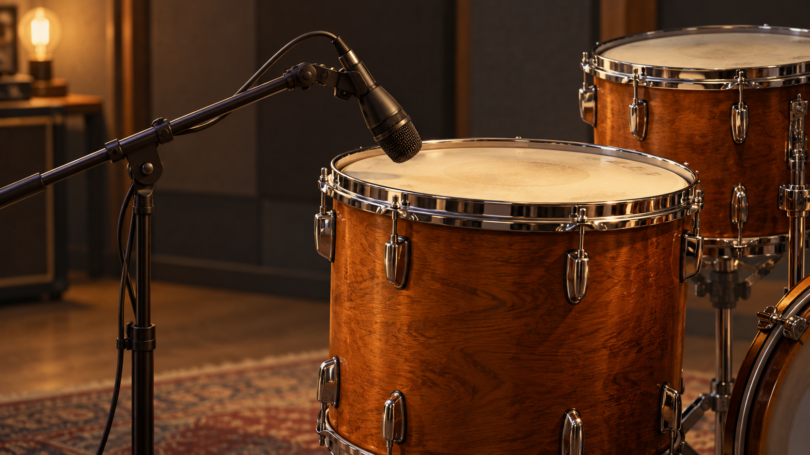

The best mic for your toms depends on the job: fitting around a crowded kit, reinforcing a floor tom, or making one microphone cover several instruments. Start with the mounting space and recording setup you actually have, rather than buying a long list of loosely related products.
The choices below are based on manufacturer specifications and application guidance, not a hands-on shootout. They are recommendations for different situations, not a measured ranking of sound quality.
Sennheiser e 604 for a compact tom setup
The e 604 is a dynamic cardioid microphone with a three-pin XLR connection. Sennheiser includes its MZH 604 drum-rim clip and specifies a 40 Hz–18 kHz response. The official specification also states sound-pressure handling above 160 dB; treat that as the manufacturer’s rating, not a listening-test result.
Choose it when a small microphone and included rim attachment solve your main practical problem. Before ordering several, check that the clip can seat securely on your rims without obstructing sticks, tuning hardware or nearby cymbals. A compact body still needs space for its XLR plug and cable.
Audix D4 for floor toms and larger rack toms
Audix specifically lists large rack toms and floor toms among the D4’s applications. It is a hypercardioid dynamic XLR microphone, with a published 40 Hz–18 kHz response and a maximum-SPL specification of at least 144 dB. Its specification sheet lists a stand clip as supplied and drum-rim mounting accessories separately.
That makes the D4 a sensible candidate when a larger tom is the priority, but budget for the mounting method you need. Audix’s initial drum-placement suggestion puts the bottom of the grille one to two inches above the head, aimed toward its center. Adjust from there rather than assuming the same position works on every drum.
Shure SM57 for a microphone that does more than toms
The SM57 is a cardioid dynamic XLR microphone, and Shure expressly includes toms in its user guide. Its stated response is 40 Hz–15 kHz. The supplied microphone clip fits a stand; do not mistake it for a drum-rim clamp.
Choose it when you also want to record a guitar cabinet or snare, or when you already have one available. Shure suggests one mic per tom, or one between two toms, one to three inches above the heads. Sharing a mic sacrifices independent positioning and level control for those two drums.
Blue Baby Bottle SL for a controlled studio setup
The Baby Bottle SL is a genuine cardioid XLR condenser, not merely a gaming microphone. Its manual explicitly discusses toms, recommends the −20 dB pad for loud transients, and gives a starting drum position two to four inches above the rim. It requires 48 V phantom power and is side-address: aim the logo side toward the drum.
Blue lists 134 dB maximum SPL at 1 kHz and 0.5% distortion, without a separate padded maximum in the specification table. Do not simply add 20 dB to that figure. Use a secure stand and shockmount, protect the mic from stick strikes, and audition it before buying another microphone. Our preference for it in a controlled studio is a practical judgment, not a claim that it cannot work live.
Can an existing USB microphone do the job?
A USB mic you already own deserves a test recording before you replace it. For this shortlist, however, the goal is a microphone you can position on an individual tom and integrate into a conventional multichannel XLR setup. A USB connection is a different workflow, not proof of poor sound.
Blue Yeti
The original Yeti has USB output, selectable patterns including cardioid, and a published maximum of 120 dB SPL at 1 kHz and 0.5% distortion in its official guide. Aim its logo side at the source. We would try an existing Yeti at a safer distance for a rehearsal or whole-kit recording, rather than buy it as a dedicated close-tom mic. Check the loudest hits for distortion and listen for cymbal spill.
Blue Yeti X
The Yeti X guide specifies USB, side-address operation, four patterns and a 122 dB maximum SPL. Cardioid is the sensible starting pattern when targeting one direction, but it will not erase the rest of the kit. Retain it for an existing computer-recording setup if a test works; the different connection and unverified close-hit headroom keep it off our dedicated-tom shortlist.
Blue Snowball iCE
Blue’s Snowball iCE manual expressly includes drums among its uses. It is a cardioid USB microphone, with the logo side facing the source. The manual does not supply a maximum-SPL figure, so we would not promise clean close-miking of hard tom hits. Try a secure stand farther from the kit and evaluate the recording. It remains a possible practice-recording tool, not an evidence-backed substitute for every close tom channel.
HyperX QuadCast
The original QuadCast specifications list USB Mini-B, a headphone output and four patterns, including cardioid. The cited page gives no maximum acoustic SPL, so its loud-tom headroom is unresolved here. Try an existing unit in cardioid on a stable support, outside the stick path, and listen for distortion and spill. Its headphone jack is not a specified balanced XLR microphone output; it is not a drop-in replacement for a tom mic on an XLR mixer.
FIFINE AmpliGame
Check the exact model on your microphone rather than relying on the AmpliGame family name. If yours is the AmpliGame A6V, FIFINE specifies USB, cardioid pickup and 110 dB maximum SPL. That does not establish clean headroom beside a hard-hit tom. We would reserve it for an existing practice setup after testing distance and gain, not buy it for close-tom duty. Do not apply A6V specifications to every AmpliGame model.
What matters before you buy
Count the complete setup, not only the microphones: the number of simultaneous mic inputs, XLR cables, stands or compatible clamps, and enough space to route everything safely. Write down what you already own. Three toms do not automatically require three new microphones if your present recording already gives you the balance you want.
Pay attention to the pickup pattern and orientation. A cardioid is least sensitive behind it, while a hypercardioid has some rear pickup. Aim unwanted sound toward the appropriate rejection area instead of assuming every microphone rejects best directly behind its body. Shure explains the distinction in its live-sound microphone guide. Placement still matters when cymbals are close to the toms.
The three dynamic choices do not need phantom power; the Baby Bottle SL does. Check your interface or mixer’s power controls before combining microphones. Also keep maximum-SPL figures in perspective: where test conditions are missing or differ, a larger published number alone does not establish which mic will sound better on your kit.
A useful setup and listening check
Start with the model-specific position above, then have the drummer make slow practice strokes to confirm clearance before playing normally. Secure the support and route cables away from moving sticks and pedals. Record the loudest expected playing with conservative gain, then listen to the actual file rather than relying only on meters.
Listen with the rest of the kit microphones open, not only with the tom soloed. Close microphones can provide separation and individual control, but the combined sound is what matters. Compare placement and polarity choices by listening, as described in Shure’s drum-recording setup guide. Do not leave a setting in place merely because the soloed tom sounds impressive.
If the tom loses body when other microphones are added, check their timing relationship and positioning before reaching for more EQ. Shure’s phase-cancellation guide explains why signals arriving at different times can weaken the combined sound. Its 3-to-1 spacing guideline is a starting point, not a guarantee that every drum-mic combination is phase-compatible.
Frequently asked questions
What is a good first mic for rack toms?
The Sennheiser e 604 is a practical starting point when compact size and an included drum-rim clip are priorities. Check the mounting fit on your kit first.
Which microphone should I consider for a floor tom?
The Audix D4 is a well-matched candidate because Audix specifically includes floor toms in its intended applications. Placement and tuning still need to suit your desired sound.
Can I use a Shure SM57 on toms?
Yes. Shure provides tom-miking instructions for the SM57, including one microphone on each drum or one shared between two. A shared mic gives you less independent control.
Can a condenser microphone record toms?
Yes. The Baby Bottle SL manual specifically supports tom recording. Follow its powering, pad and placement guidance, and check clearance and recording headroom.
Should I replace a USB microphone I already own?
Not automatically. Make a test recording first. Replace it when you need a different mounting arrangement, cleaner results at your intended position, or individual tom channels in your chosen recording system. A successful rehearsal recording and a dedicated close-tom setup are different goals.