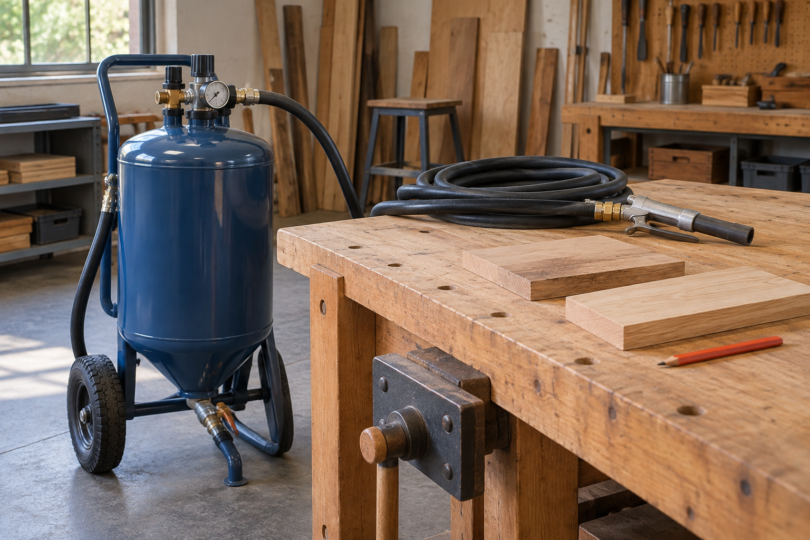

The best sand blaster for wood depends first on whether blasting is appropriate for the piece. For an assessed small project, the Eastwood Blast Out of a Bucket Kit, item 21109, is the simpler equipment option to consider. For an established shop that also needs separate soda and abrasive circuits, the Eastwood Master Blaster, item 11737, offers more flexibility. Neither is a default recommendation for stripping fine furniture or historic trim.
These choices are based on manufacturer specifications and instructions, with safety guidance from the National Park Service, EPA and OSHA. We have not performed hands-on wood-stripping tests. The comparison is intended to help you decide whether to buy equipment, confirm a suitable setup or leave the work to a specialist.
Decide whether the wood should be blasted at all
Abrasive blasting can remove wood as well as a coating. The National Park Service’s woodwork guidance explains that softer grain erodes faster than denser grain, leaving ridges and pits; projecting carved details can disappear before recessed paint is removed. It strongly advises against sandblasting historic exterior woodwork, even when an operator promises controlled pressure.
Our buying advice is to avoid treating antiques, veneer, carved details or a smooth furniture finish as a beginner blasting project. Establish the wood’s condition, the coating and the surface texture you want with an experienced wood finisher before buying. A deliberately textured, expendable sample presents a different decision from an irreplaceable door. A small gun or a softer-sounding medium does not establish suitability.
Check old coatings before disturbing them. EPA says pre-1978 homes may have lead-based paint and recommends a certified lead inspector or risk assessor to identify affected surfaces. It also recommends a lead-safe certified contractor for these renovation projects. For suspected lead or another hazardous coating, stop equipment selection and obtain that assessment; do not use this article as a DIY blasting procedure.
Quick comparison: two equipment options
| Equipment option | Best fit after assessment | Air supply to budget for | Main limitation |
|---|---|---|---|
| Eastwood Blast Out of a Bucket Kit 21109 | Small, assessed jobs where a siphon gun is suitable | Manual: at least 7 CFM at 90 PSI; moisture separator and regulator required | Gun kit has no media or compressor; no guarantee against grain damage |
| Eastwood Master Blaster 11737 | A shop needing separate soda and abrasive capability | Manual soda table: 6–25 CFM at 80 PSI, depending on nozzle | Large air demand and two pressure tanks; unnecessary complexity for one wood piece |
The air figures above describe equipment demand. They are not recommended blasting pressures for wood. Media, nozzle, coating and intended finish need a project-specific assessment. A maximum pressure rating is a limit on the equipment, not a setting that makes a material safe to blast.
1. Eastwood Blast Out of a Bucket Kit: the simpler small-job option
The 21109 uses a siphon-feed gun and a pickup tube in a separate media container. Eastwood includes a five-foot suction hose, a gun with a 2.5 mm air jet and 4 mm nozzle installed, three spare 4 mm ceramic nozzles, a replacement air jet and a quick-disconnect fitting. This is the gun kit; it does not include a compressor, media or complete protective equipment.
Its appeal is the compact, replaceable-component setup. Eastwood also sells this same 21109 gun as part of its separate Soda Blast Intro grouping, which establishes a manufacturer-supported soda option. That does not turn the bare gun kit into the bundled media package, or establish that soda is suitable for every wood finish. Confirm both the medium and the finish-preparation requirements for your actual piece.
Read the 21109 manual before comparing compressors. It calls for a minimum of 7 CFM at 90 PSI, a moisture separator and a suitable regulator, and limits inlet pressure to 90 PSI maximum. Some catalog copy mentions 80 PSI, but that does not remove the manual’s air-delivery requirement. Choose by sustained output at the specified pressure, rather than the tank’s maximum PSI alone.
Pros: A relatively simple siphon arrangement, a five-foot pickup hose and spare wear parts in the kit. Cons: It still needs substantial compressed air, a separate media supply and a controlled outdoor work area. The manual prohibits indoor operation and sand or silica-based abrasives. A garage with the door open is not permission to ignore that instruction.
See Eastwood’s Blast Out of a Bucket Kit, item 21109. Check the item number and package contents when ordering; the separate soda-media bundle is a different purchase.
2. Eastwood Master Blaster: for a shop needing two media circuits
The Master Blaster 11737 combines two pressure tanks with controls that switch between soda and abrasive media. Eastwood includes wood among the materials for its soda application, but we would consider this machine only after a specialist has established that blasting suits the work. The second circuit is most useful when the same shop also tackles other appropriate materials; it is difficult to justify solely for one furniture project.
The 11737 manual lists two 10-gallon tanks, with capacity stated as 100 pounds of abrasive or 75 pounds of soda per tank, and an eight-foot, half-inch-ID hose. The package includes a dead-man discharge valve, a 3.5 mm nozzle installed, additional 2, 2.5 and 3 mm nozzles, a moisture trap and gauge. The listed face shield is not respiratory protection.
Compressor capacity is the main practical limit. The manual’s approximate soda table ranges from 6 CFM for a 2 mm nozzle to 25 CFM for the installed 3.5 mm nozzle, at 80 PSI. Eastwood explicitly labels this comparison data and says results vary. Do not read a marketplace headline about “10 CFM” as assurance that your compressor will support every supplied nozzle.
Pros: Separate media circuits, a wheeled frame and several nozzle sizes. Cons: More equipment to maintain, potentially much greater air demand and pressurized tanks requiring careful handling. The manual prohibits indoor operation and sand or silica-based abrasives, limits inlet pressure to 125 PSI, and requires the air supply to be disconnected and tank pressure released before refilling or servicing.
The selected listing below identifies manufacturer part number 11737, the dual-tank Master Blaster. It is not a single-tank soda blaster or a bundle with an air compressor. Verify the supplied components against the manual rather than assuming pictured equipment provides a complete blasting and breathing-air system.
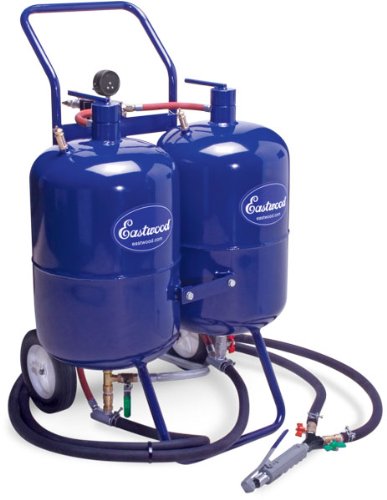
Eastwood Master Blaster 11737 Dual Abrasive and Soda Blaster
As an Amazon Associate we earn from qualifying purchases.
Budget for the full setup before buying a blaster
Compare the whole equipment plan: suitable compressor output, air treatment and hose capacity, approved media, replacement nozzles, containment, dust handling and the protective equipment identified by a hazard assessment. A small compressor’s high maximum PSI does not compensate for insufficient CFM while the gun is running. The two manuals above make air delivery a central requirement.
There is no single best medium for every wood species and coating. Eastwood identifies soda media as an option for wood, while both selected manuals explicitly reject sand and silica abrasives. That is a compatibility starting point, not a universal recipe. Check the medium’s safety data sheet and obtain advice on residue removal and compatibility with the intended stain, paint or clear finish. Do not transfer a metal-refinishing process to wood.
Dust control and protection are part of the decision
The hazard is more than the unused media. OSHA’s abrasive-blasting fact sheet explains that harmful dust and metals can come from the abrasive, the underlying surface and its coating. A “natural” or “less toxic” medium does not make old paint dust safe. Identify the hazards and plan isolation, containment and suitable ventilation before selecting PPE.
OSHA’s occupational guidance describes a NIOSH-certified Type CE positive-pressure airline blasting respirator, with protection covering the head, neck and shoulders. A loose dust mask, ordinary face shield or unverified hood is not equivalent to that equipment. Respirator selection, the breathing-air supply and any required fit testing or program need competent advice for the exposure and equipment involved. Do not assume the tool compressor can directly supply breathing air.
The manufacturers also call for eye protection and abrasive-resistant gloves; a shield or hood does not remove the need for the specified safety glasses. Account for hearing and body protection and keep unprotected people, pets and property away. Both selected tools prohibit indoor operation, and going outdoors alone does not provide adequate containment or protect bystanders.
Plan cleanup and disposal before work starts. OSHA advises wet methods or HEPA-filtered vacuuming to control accumulated dust and warns against compressed-air cleanup because it puts dust back into the air. Hazardous-coating debris needs an appropriate specialist plan; a generic shop vacuum or blowing residue around the yard is not a substitute.
Frequently asked questions
Can I sandblast wooden furniture without damaging it?
There is no general damage-free promise. Blasting can remove softer grain unevenly and erode detail. For antiques, veneer or a smooth furniture finish, get a wood-restoration assessment before buying a blaster. NPS specifically advises against sandblasting historic exterior woodwork.
Is soda always the best blasting medium for wood?
No. A manufacturer-supported soda option does not establish suitability for every species, coating or intended finish. Confirm material compatibility, dust hazards and the later refinishing process. Neither selected machine permits sand or silica-based abrasives.
Will a small pancake compressor run these blasters?
Check its delivered CFM at the required pressure and the selected nozzle, not its shape or tank-pressure rating. The 21109 manual calls for at least 7 CFM at 90 PSI. The Master Blaster’s approximate soda table reaches 25 CFM at 80 PSI with its installed 3.5 mm nozzle. Many purchase mistakes begin with ignoring that demand.
Can I blast old painted doors or trim?
First identify the coating and whether blasting would damage the wood. EPA recommends lead assessment for potentially affected surfaces in pre-1978 homes and using a lead-safe certified contractor for those renovation projects. Suspected hazardous paint is a reason to stop and obtain specialist advice, not experiment with media or pressure.
Is the face shield included with the Master Blaster enough protection?
No. Its package lists a face shield, but the manual separately requires breathing apparatus, safety glasses and protective gloves. OSHA’s blasting guidance describes specialized respiratory protection and exposure controls. Assess the complete protective system before purchasing or operating the equipment.