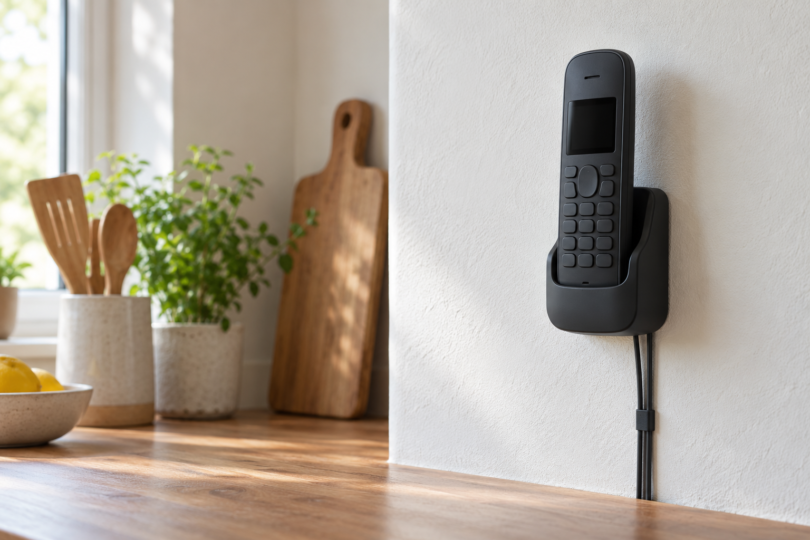

A wall-mountable cordless phone can free up a kitchen counter or hallway table, but check exactly which part mounts to the wall. The main telephone base connects to your phone service; a separate handset charger only recharges a handset. A listing that mentions a wall-mountable charger does not, by itself, confirm that the answering-machine base can be wall mounted.
Start with the Panasonic KX-TGD832W for a two-handset system with documented mounting arrangements for both the base and charger. Consider the AT&T CL82207 for its call-screening features, the VTech CS6529-2 for a straightforward answering system, or the Panasonic KX-TGD863W if you want to route a compatible mobile phone’s calls through cordless handsets.
Wall-mountable cordless phones at a glance
These are US-market model numbers. Match the complete model and handset count before ordering; a similar-looking accessory handset or differently numbered bundle is not necessarily the same package.
| System | Handsets in this bundle | Main-base mounting hardware | Best reason to consider it |
|---|---|---|---|
| Panasonic KX-TGD832W | 2 | Wall-mounting adaptor included | Base and separate charger mounting documented |
| AT&T CL82207 | 2 | Wall-mount bracket included | Smart Call Blocker and expansion options |
| VTech CS6529-2 | 2 | Wall-mount bracket included | Conventional answering-machine features |
| Panasonic KX-TGD863W | 3 | Wall-mounting adaptor included | Link2Cell Bluetooth calling |
The supplied bracket or adaptor is the part that attaches to the phone. It does not mean a new wall plate, screws, anchors or installation work are included. Check the manual and the seller’s package contents, especially for used, refurbished or open-box units.
1. Panasonic KX-TGD832W: a practical two-handset starting point
The white KX-TGD832W bundle combines a KX-TGD830 answering base with two handsets and one separate charger. Panasonic documents wall mounting for the main base and the charger individually. That makes it a useful option when you want one phone on the kitchen wall and a second charging location elsewhere.
The base’s wall-mounting adaptor is included. The charger uses its own screw mounting arrangement, and those screws are not supplied. See the KX-TGD830/832/833 manual, parts list and mounting diagrams before planning either location.
Panasonic lists call-blocking functions and support for up to six handsets. This series does not have Bluetooth or power-backup operation, so choose a different system if mobile-phone linking is essential. Some caller-identification and blocking functions depend on your provider’s Caller ID service. The manufacturer’s feature list spells out those requirements.
Choose it if: you want a two-handset home-phone package with clearly documented base and charger mounting. Check that the retailer’s selected variant says KX-TGD832W; the one-handset KX-TGD830 and three-handset KX-TGD833 are different bundles.
2. AT&T CL82207: for call screening and a larger handset system
The CL82207 is a two-handset answering system with Smart Call Blocker, caller-name announcements, a high-contrast display and a lighted keypad. AT&T lists expansion to 12 handsets using its CL80107 accessory handset. Smart Call Blocker requires a Caller ID subscription; check that your service supports it before treating this feature as a deciding factor. See the CL82207 product specifications.
The package includes one separate charger and a wall-mount bracket. The mounting instructions apply to the main telephone base and use a standard dual-stud telephone wall plate. An existing phone jack without the required mounting studs is not automatically a suitable mounting plate. The complete manual’s parts checklist and installation section show the bracket arrangement.
Choose it if: call screening or adding several compatible handsets matters more than mobile-phone linking. Buy the complete CL82207 system first; a CL80107 accessory handset is not a standalone phone system.
3. VTech CS6529-2: for a straightforward answering system
The CS6529-2 package has two handsets, an answering base and a separate charger. Its everyday features include a handset speakerphone, a backlit display and keypad, intercom, and up to 14 minutes of answering-machine recording. Caller ID requires the corresponding service from your telephone provider. VTech’s exact CS6529-2 product page also explicitly lists an included wall-mount bracket.
The CS6529-series installation guide shows how the main base locks into that bracket and onto a telephone wall plate. Treat that as confirmation for the base, rather than assuming every separate charger in the package has the same mounting options.
Choose it if: your priority is an ordinary home-phone answering system with a documented wall-mount bracket. Keep the model suffix in your shopping notes: CS6529, CS6529-2 and the larger bundles contain different numbers of handsets.
4. Panasonic KX-TGD863W: for Bluetooth mobile-phone calls
The white KX-TGD863W package includes three handsets. Its Link2Cell feature lets a compatible Bluetooth mobile phone provide the calling service, including a cellular-only setup without an active landline. Your mobile phone still needs service and must stay connected to the base; this is not a phone plan or a cellular booster. See the KX-TGD86x product page and select the three-handset white bundle.
Panasonic’s KX-TGD862/863/864 manual lists an included base wall-mounting adaptor and two separate chargers for the KX-TGD863. It also provides separate base and charger mounting instructions. Charger screws are not supplied.
The important limitation is voicemail: the built-in answering system does not answer or record calls arriving over the cellular lines. Plan to use your mobile service’s voicemail for those calls. Panasonic also lists no power-backup operation. Both points appear in the KX-TGD86x specifications.
Choose it if: you want cordless handsets around the house while keeping a mobile phone as the source of your calls, or you want both supported mobile and landline calling options.
Check the mounting location before buying
- Identify the piece you want on the wall. A main base needs its power connection and, for landline use, its telephone cable. A satellite charger needs power; its handset communicates wirelessly with the main base.
- Compare your wall plate with the model’s diagram. For example, the Panasonic KX-TGD83x manual shows base mounting positions for 83 mm or 102 mm wall-phone-plate spacing, while its separate charger uses 27.2 mm screw spacing. Those are different mounting jobs, not interchangeable fittings.
- Plan the cable route. The wall jack and electrical outlet may be in different places. Check the supplied cable lengths, outlet access and whether the cord can reach without being stretched, pinched or left across a walkway.
- Allow room to lift the handset. Check nearby cabinets, doors and shelving. Mounting height should let the intended user comfortably read the display, reach controls and remove the handset.
- Use the supplied installation instructions. Choose a sound wall or suitable phone plate and the correct fixings for that surface. Have a qualified installer handle any new jack or mounting work you cannot safely complete.
- Try calls before committing to the location. Check reception where you actually use the handset, along with the ringer, speakerphone and charging contacts. A wall location that looks tidy may be inconvenient in daily use.
Keep the packaging until the bracket fit, charging and normal calling all work as expected. If buying a replacement bracket, match its part number to the exact base model rather than choosing by appearance.
Landline, VoIP or Bluetooth: what service do you need?
“Cordless” describes the connection between the handset and its base. It does not mean the base can make calls through any Wi-Fi network.
- Traditional telephone service: connect the base’s telephone cord to an active, compatible telephone jack and connect the AC adaptor as instructed.
- Cable, fiber or other VoIP service: you normally need the provider’s supported analog telephone port, either on its gateway or on a compatible analog telephone adapter. An Ethernet socket is not a substitute for that phone port, as illustrated by Cisco’s separate phone and network connections. Confirm the equipment and service requirements with your provider.
- Mobile-phone service: choose a model that explicitly supports mobile linking, such as the KX-TGD863W, and verify compatibility with your particular phone.
Panasonic’s VoIP connection guidance recommends using the provider-designated telephone port and confirming that voice service is included in your plan. For DSL sharing a telephone line, follow the phone manual and provider’s filter instructions.
Will a wall-mounted cordless phone work in a power outage?
Do not assume a charged handset makes the whole system work without electricity. The base needs power too. Panasonic explicitly says the KX-TGD83x and KX-TGD86x systems cannot make or receive calls during a power failure; AT&T’s CL82x07 manual likewise warns that calls cannot be made if the base is unplugged or electrical power is interrupted.
With internet-based phone service, the gateway, modem, optical network terminal or adapter may also need backup power. Backing up one device does not necessarily power the others. AT&T’s battery-backup guidance explains this equipment-by-equipment dependency. Even suitable backup power does not guarantee service during a network outage; see the provider’s digital-phone emergency-calling limitations.
Ask your provider what your setup needs for outages and emergency calling, and keep an alternative way to communicate. A wall-mount bracket, handset battery or advertised talk-time figure is not a guarantee of 911 availability.
Frequently asked questions
Can any cordless phone be wall mounted?
No. Look for mounting instructions for the exact base or charger you want to install. A generic shelf can hold some equipment, but it is not evidence that the phone has a manufacturer-supported wall-mount arrangement.
Does a wall-mount bracket come with these phones?
The manufacturer documentation lists a base bracket or adaptor for all four packages above. Verify that it is present in the particular unit you buy. Wall plates and surface-specific mounting hardware are separate considerations.
Does every handset need a telephone jack?
No. In a multi-handset system, the main base connects to the telephone service, while additional handsets use compatible chargers near electrical outlets. The handsets must be compatible with and registered to that base.
Can I use a cordless phone without a landline?
Yes, with the right system and another source of calling service. A supported VoIP adapter can provide an analog phone connection, while a mobile-linking model can use a compatible paired cellphone. The phone itself does not include either service.
Which model should I start with?
For two handsets and flexible documented mounting, start with the Panasonic KX-TGD832W. Compare the AT&T CL82207 if call screening or a larger handset network matters, the VTech CS6529-2 for a simple answering-system setup, and the Panasonic KX-TGD863W for mobile-phone linking. The best fit is the one whose mounting hardware, calling service and handset count match your home.