The right bar stool foot rail protector depends on the rail’s cross-section, not the stool’s seat height. For a straight, flat-sided wooden rail, a closely fitted clear channel can hide relatively little of the finish. For repeated shoe contact, a purpose-made metal cover is another option, provided its dimensions and fastening method suit the stool.
The shortlist below separates two verified Outwater clear-channel sizes from a direct-supplier stainless-steel cover. These are specification-based options, not results of hands-on wear testing. None should be used to reinforce a loose or damaged footrest.
Foot rail protectors worth comparing
| Option | Verified format | Best reason to consider it | Main limitation |
|---|---|---|---|
| Outwater 341-CL clear channel | Nominal 3/4-inch profile; four 36-inch lengths | A discreet cover for a matching straight, flat-sided rail | Rigid profile must match; it is not a stretch-fit sleeve |
| Outwater 100-CL clear channel | Nominal 1-inch profile; four 36-inch lengths | A wider square-edged rail that needs a larger channel | Check the profile drawing and side-wall clearance |
| CAP stainless-steel U-shaped protector | 0.75 × 0.75 × 0.75-inch profile, 12-inch length | A purpose-made metal cover with selectable fastening | Confirm inside dimensions and attachment before ordering |
Outwater 341-CL: clear protection for a narrow rail
The verified Amazon pack contains four 36-inch pieces of Outwater 341-CL clear rigid vinyl channel. The listing specifies a 3/4-inch bottom width and an 11/16-inch top opening. The difference matters: the tapered sides grip an edge, so the opening is not a roomy sleeve that slides over any 3/4-inch object.
This is a candidate for a straight, flat-sided rail with a compatible profile. Measure the actual finished wood, including paint or varnish, and compare the dimensions with the seller’s drawing. Rounded corners, a bowed rail or a thick decorative molding can prevent the channel from seating properly.
Outwater’s clear-channel catalog identifies 341-CL as the 3/4-inch clear PVC family. The Amazon box below is the four-piece, 36-inch pack; other lengths and pack sizes are separate purchase choices. This general-purpose edge trim is an option to assess for fit, rather than a manufacturer-certified fit for your particular stool.

Outwater Plastics 341-Cl Clear 3/4'' Rigid Vinyl Clear Plastic U-Channel/C-Channel 36 Inch Lengths (Pack of 4)
As an Amazon Associate we earn from qualifying purchases.
Outwater 100-CL: a wider clear-channel option
The 100-CL version is intended for 1-inch-thick panels. Outwater’s specification lists rigid PVC, symmetrical tapered legs and a 1/2-inch leg height. The manufacturer describes it as an indoor-use product and says it is not UV stabilized. Those details make an exposed outdoor bar an unsuitable default application.
The verified Amazon variant contains four 36-inch lengths. Choose it because its cross-section matches the rail, rather than because a larger protector seems more forgiving. A loose channel can move under a shoe; adding adhesive to fill a poor dimensional match is not a dependable solution.
Clear plastic also has a visual tradeoff. It leaves the underlying finish visible, but scuffs and debris underneath can still be noticeable. For a light-colored or carefully finished stool, test a short section before cutting an entire pack.

CAP stainless-steel U-shaped cover: a purpose-made alternative
CAP’s 12-inch stainless-steel barstool protector, SKU BSU75757512SS, is listed with a 0.75 × 0.75 × 0.75-inch U-shaped profile. The supplier offers stainless covers with countersunk holes and screws or with two-sided tape. It also describes ordering shorter custom lengths from an appropriate longer option.
A metal cover is worth considering when you want a visible, replaceable surface where shoes regularly rest. Ask whether the stated width is the usable inside opening and check corner clearance. Select the fastening format deliberately: screws leave holes, while tape depends on the surface finish and may damage it on removal.
This recommendation links to the supplier because we could not establish an exact Amazon listing for that SKU and configuration. Confirm the drawing, finish, quantity and custom-order return terms directly before purchasing. A similarly sized L-shaped scuff plate does not cover the same faces as a U-shaped channel.
Measure the rail before choosing a cover
- Identify the shape. Note whether the rail is square, rectangular, round, curved or tapered. A flat U-channel will not neatly conform to a round metal tube.
- Measure at several points. Check width, height and corner radius, not just one dimension at the center. Paint buildup and hand-finished wood can change the fit.
- Measure the straight usable length. Leave room for joints, leg intersections and decorative transitions. The full distance between stool legs may exceed the area a rigid cover can occupy.
- Check how much surface needs protection. A top-only strip, L-section and U-channel protect different faces. Look at where shoe marks actually occur.
- Plan the attachment. Confirm that screws will not hit hardware or penetrate through the rail, or that an adhesive is suitable for both materials and the existing finish.
If the rail is cracked, loose at its joints or visibly bent, repair it using the stool manufacturer’s guidance before adding a cover. A cosmetic protector has no established load-bearing role. Do not use it to make a damaged stool appear serviceable.
Installation and everyday checks
Start with a clean, dry surface and a trial fit. Follow the selected product’s cutting and fastening directions; protect yourself from sharp cut edges and remove burrs before the stool returns to use. Avoid forcing brittle plastic over an oversize rail or bending a rigid metal profile around a curve.
For adhesive-backed covers, check the finish in an inconspicuous place and observe the adhesive’s stated preparation and curing requirements. For screw-mounted covers, use the supplied or specified hardware and an appropriate pilot-hole method for the wood. If you cannot establish safe screw depth, ask the stool maker or a furniture repairer.
After installation, inspect for movement, raised corners and exposed sharp ends. A protector that catches clothing, shifts under a foot or traps grit against the wood needs adjustment or replacement. Use a cleaning method compatible with both the cover and the stool’s finish; do not flood the joint with cleaner.
Common mix-ups to avoid
- Chair-leg caps protect floors. They do not cover the horizontal rail where someone places their feet.
- A complete bar foot rail is a different purchase. Tubing and brackets mounted to a counter are not replacement covers for a stool.
- Soft corner bumpers serve another purpose. A cushioning strip is not automatically suitable for repeated shoe pressure and abrasion.
- Nominal width is not guaranteed clearance. Read the profile drawing and distinguish inside opening, wall thickness and overall dimensions.
Choose a measured fit first. Outwater’s two clear profiles provide useful starting points for compatible indoor rails; a purpose-made stainless cover is the alternative when the shape, appearance and attachment suit the stool.
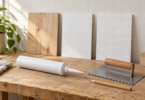
Image note: Examples of foot-rail protection formats. Profile, dimensions and fastening must match the stool.