
For a 5-gallon freshwater aquarium, the Aquarium Co-Op Black Easy Flow Sponge Filter in Nano is our starting point when you want an air-driven filter with reusable media. The Fluval AquaClear AC20 is the alternative when you prefer a hang-on filter with separate media compartments and an adjustable flow control. Choose between them only after checking the animals’ needs, the tank’s dimensions and the current each setup creates.
A filter’s gallon rating does not establish which fish or how many animals a tank can house. Species differ in space, temperature and social needs. Confirm that a 5-gallon aquarium is appropriate for the intended inhabitants before buying equipment.
These picks compare manufacturer documentation and buying details. We have not measured filtration, flow, noise or long-term reliability, and neither recommendation promises clear water, a completed biological cycle or trouble-free fishkeeping.
Two filters worth comparing
| Filter and exact selection | Why consider it | Main limit |
|---|---|---|
| Aquarium Co-Op Black Easy Flow Sponge Filter, coarse, Nano | Reusable sponge with an air-driven design; maker lists Nano for 5 gallons and up | Air pump, airline tubing and check valve are separate; filter occupies tank space |
| Fluval AquaClear AC20, model 19595 | Adjustable flow and separate foam, carbon and BIOMAX media; rated 5–20 US gallons | Needs rim, lid and rear clearance; its current may still be unsuitable for some inhabitants |
Aquarium Co-Op Nano: an air-driven starting point
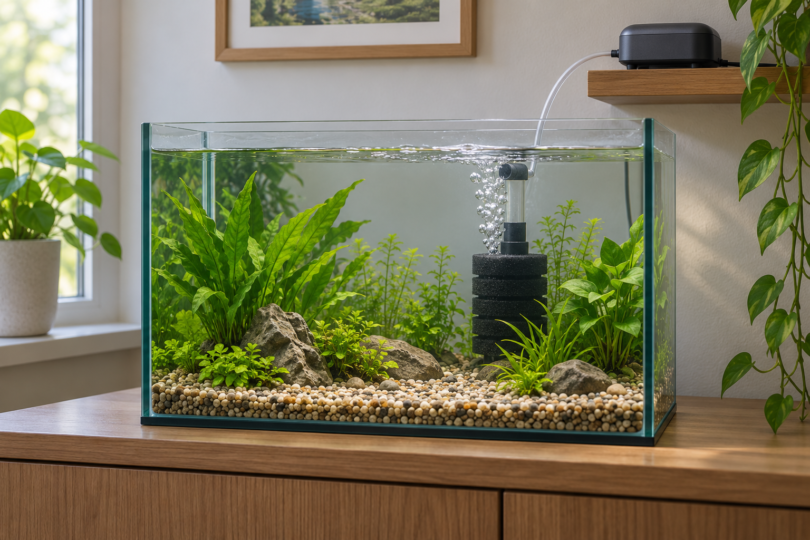
Select the black, coarse Nano version of the Easy Flow Sponge Filter. Aquarium Co-Op’s separate size guide recommends Nano for tanks of 5 gallons and up. This is a filter inside the aquarium, so allow room for its base, sponge and uplift tube without crowding the layout.
The filter needs a separate air pump, airline tubing and check valve. Budget for the whole operating setup, and choose air equipment with suitable output and installation instructions. An air pump by itself is not the sponge filter.
The curved Easy Flow outlet creates a directional current. Do not assume that every air-driven setup produces negligible flow: pump output, outlet position and the tank layout still matter. Check the manufacturer’s sizing and setup guidance for the water depth you actually have.
Choose this option if reusable sponge media and a separate air supply suit your maintenance routine. The maker instructs owners to squeeze debris from the sponge in aquarium water and clean the air collar. It still needs attention when debris builds up or flow falls.
Fluval AC20: for a hang-on filter with separate media
The current Fluval AquaClear AC20, model 19595, is rated for 5–20 US gallons. Its included media are an intake sponge, Bio-Foam, BIOMAX and activated carbon. The adjustable flow control and accessible media compartments are its main reasons to make this shortlist.
Check the tank rim, lid opening and space behind the aquarium before ordering. The AC Series manual lists a maximum rim thickness of 0.9 inch for the AC20. A gallon rating alone cannot tell you whether the filter will physically fit your particular tank.
The manual requires filling the filter case with water before startup and prohibits dry running. Follow its priming and water-level instructions. The intake sponge also needs regular inspection and cleaning; included foam is not a universal guarantee that every tiny animal is protected.
This selection is the newer AC20, not a promise that an older AquaClear 20 has the same parts or included media. If you are replacing an older filter, match the model number before ordering accessories. Buy equipment with an electrical rating appropriate to where you will use it.

Fluval AquaClear AC20 Power Filter, Model 19595
As an Amazon Associate we earn from qualifying purchases.
How to choose for the tank you have
Put current and intake protection first
The useful question is whether the animals can swim, feed and rest normally in the resulting current. For a low-flow setup, begin with an appropriate adjustable air supply or the powered filter’s lower flow setting, then observe the tank. If the lowest practical setting is still excessive, choose a different filter instead of relying on the gallon label.
For very small inhabitants, examine the intake and every accessible gap. Ask the filter manufacturer about appropriate protection for the species and life stage you intend to keep. Do not assume a coarse sponge or a “nano” label proves that an intake is suitable for all shrimp or fry.
Allow time for biological filtration
Mechanical media catches particles; biological filtration depends on established microorganisms that process waste. As the RSPCA explains, a new tank or filter does not immediately have an effective biological filter. Clear-looking water is not a substitute for checking ammonia and nitrite.
The RSPCA recommends fishless cycling when setting up a new tank. Use a proper cycling procedure and water tests before introducing animals. Do not use a product’s flow rate, carbon insert or elapsed calendar time alone as proof that the aquarium is ready.
Plan for routine care and safe installation
Continue water testing and appropriate partial water changes after the filter is established. Use aquarium-specific water conditioner as directed for replacement tap water, and keep aquarium buckets separate from household cleaning. A filter does not make toilet cleaners, drain products, drinking-water purification tablets or RV treatments appropriate aquarium supplies.
Follow the exact equipment manual. Fluval requires drip loops, matching the electrical rating label, and disconnecting aquarium appliances before hands enter the water or equipment is serviced. If a plug or receptacle is wet, its manual says to disconnect power at the fuse or circuit breaker before handling the plug. Keep the air pump installed according to its own instructions.
Frequently asked questions
Which filter should I start with for a 5-gallon tank?
Consider the Nano sponge setup if reusable media and a separate air pump suit you. Consider the AC20 if the tank can accommodate a hang-on unit and its current. The inhabitants and actual fit decide whether either is appropriate.
Will a new filter cycle the aquarium immediately?
No. Biological filtration must become established. Follow a cycling procedure and check water chemistry; buying a filter does not establish that animals can be added immediately.
Is an air pump enough?
An air pump supplies air. For the Nano sponge choice, it must be connected to the filter with the required tubing and check valve. Include those separate items when comparing the total setup.
Can a filter be too strong for a small aquarium?
Yes, the current can be unsuitable even when the stated gallon range includes the tank. Observe the inhabitants and choose a setup that allows normal swimming and resting. Do not treat maximum flow as a target.
How were these picks selected?
We compared the documented design, media, installation needs and buying identity of two complete aquarium filters. This is a practical shortlist, with no hands-on test scores, price ranking or guarantee of animal suitability.