
The best foam core cutter depends on the cuts you make most. For standard 3/16-inch presentation board, the Logan FoamWerks WC-6010 is a sensible first choice because it handles both straight and beveled edges. Choose the WC-6001 for repeated straight cuts across a wider thickness range, or add the WA-8001 when your projects need consistent circles.
This guide compares manufacturer specifications and instructions, checked October 2026. We have not hands-on tested these tools. Recommendations reflect material compatibility and project needs; they are not laboratory rankings.
Which foam core cutter should you buy?
- For everyday 3/16-inch foamboard projects: Logan FoamWerks WC-6010 Straight/Bevel Cutter.
- For straight edges in 1/8- to 1/2-inch foamboard: Logan FoamWerks WC-6001 Straight Cutter.
- For circular openings and round pieces: Logan FoamWerks WA-8001 Circle Cutter, covering 1- to 6-inch diameters.
These tools solve different problems. A circle cutter is an addition to a straight cutter, while the choice between WC-6010 and WC-6001 comes down to bevels, material thickness and guide compatibility. Check the thickness printed on your board before ordering.
Logan FoamWerks WC-6010: the versatile starter
The WC-6010 changes between straight and bevel cutting by rotating its angled base. It has adjustable blade depth, a handle with blade storage and two supplied blades. Logan specifies 3/16-inch, approximately 5 mm, foamboard and permits use with a suitable straightedge. These details make it a practical option for display panels, school models and small architectural mockups. See Logan’s WC-6010 specifications.
Its main attraction is avoiding a second tool when a project moves from square edges to angled joints. The limitation is its specified board thickness. Do not interpret adjustable depth as permission to cut any thick insulation panel, matboard or rigid plastic. If your shopping list is mainly thicker foamboard and rectangular cuts, the WC-6001 is the more appropriate comparison.
Buy this if bevels are part of your project and you already have, or will buy, a stable straightedge. A small cutter by itself will not establish a long, square reference line.
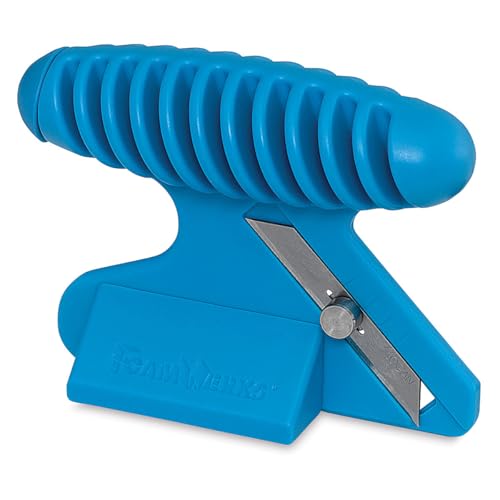
Logan Foam Werks Foam Cutting Tool, Straight/Bevel
As an Amazon Associate we earn from qualifying purchases.
Logan FoamWerks WC-6001: for repeated straight cuts
The WC-6001 is specified for foamboard from 1/8 to 1/2 inch, or 3.1 to 12.7 mm. Logan lists adjustable depth, a magnetic blade slot, a quick-change clip, onboard storage and five included blades. It works with the FoamWerks Channel Rail, Adapt-A-Rule and Team System. See the manufacturer’s WC-6001 product page.
Choose it when most jobs involve trimming large sheets into panels, building rectangular model walls or repeating straight edges. The guide-system compatibility is useful if your work already uses one of Logan’s listed rails. Measure your longest cut and confirm the guide length separately; a compatible cutter does not mean the guide is included.
The trade-off is specialization. It does not replace the WC-6010’s bevel function or a circle cutter. For a single occasional project on standard thin board, compare the full cost of the cutter, guide and blades with the simpler starter setup before buying additional equipment.

Logan FoamWerks WA-8001: for controlled circular cuts
The WA-8001 cuts circles from 1 to 6 inches in diameter in foamboard 1/8 to 1/2 inch thick. Its rail has inch and metric markings, while a centering pin establishes the pivot. Logan also lists a depth-progress indicator, magnetic blade slot, clear safety dome and five blades. The WA-8001 specifications identify WA replacement blades.
This is the strongest fit of the three for round bases, circular windows and repeated discs. Buy it when maintaining the same diameter matters more than cutting unrestricted freehand shapes. The center-pin design also deserves consideration: decide whether a center mark is acceptable on the piece you intend to keep.
Its limits are straightforward. It cannot make a circle larger than its stated range, and it will not cut an oval just because both shapes are curved. Keep a straight cutter for the surrounding panel work.

Match the cutter to the material, not just the word foam
This comparison focuses on craft foamboard and foam core used for displays and models. Product listings can mix those tools with hot-wire machines, upholstery cutters and tools for foam-core pipe. A shared search term does not establish compatibility.
Before ordering, write down the board’s thickness, facing material, foam type and required edge shape. If you cannot identify the material, ask its supplier. For a heated cutter, both the cutter instructions and the material manufacturer must permit the intended use. Do not assume that an electric hot knife is an upgrade for paper-faced presentation board, and do not heat unknown foam or plastic.
Logan’s FoamWerks range overview describes a blade-based system for dimensional craft and modeling projects. Its model-specific thickness limits are more useful buying information than a marketplace headline promising to cut every foam.
What else belongs in your cutting setup?
- A suitable guide: Match it to the cutter and the longest panel. Keep fingers outside the blade’s path.
- Scrap foamboard underneath: Logan specifically requires a sacrificial foamboard layer to protect its tools and blades.
- The correct replacement blades: WC-6010 and WC-6001 use the WC family; WA-8001 uses WA blades. Similar names do not mean interchangeable blades.
- A stable work surface: Support the sheet so it cannot rock or slip as the cutter moves.
The WC-6001 instructions specify WC-5 or WC-20 blades and scrap foamboard underneath. Follow the instructions supplied with your exact tool for blade fitting and depth adjustment. Keep spare blades safely enclosed and supervise younger users. Practice on an offcut before cutting a finished display.
Frequently asked questions
Which one should a beginner start with?
Start with the WC-6010 if you are using its specified 3/16-inch foamboard and need both straight and bevel cuts. Choose the WC-6001 instead when your project needs straight cuts through a wider range of foamboard thicknesses.
Will a mat cutter work on foam core?
Some mat cutters support particular foamboard thicknesses, but this must be stated for the exact model. Check its material list, maximum depth and blade requirements. Do not assume a matboard bevel cutter and a foamboard bevel cutter are equivalent.
Why are my edges ragged?
Check for a worn blade, a depth setting that does not match the board, an unstable guide or unsupported material. Test the setup on scrap and follow the tool’s cutting instructions. Extra force can make control worse rather than solve the underlying problem.
Should I buy a large FoamWerks kit?
Only if you need its specific tools. Logan’s support list identifies several older kits and specialty cutters as discontinued. Verify the exact contents and replacement-blade support instead of buying an old bundle solely for its item count.
The bottom line
For standard foam core with occasional bevels, choose the WC-6010. For straight panel work across several thicknesses, choose the WC-6001. Add the WA-8001 for circles. Spending first on the right cutter, a matching guide and fresh blades is more useful than accumulating specialty tools your project never uses.
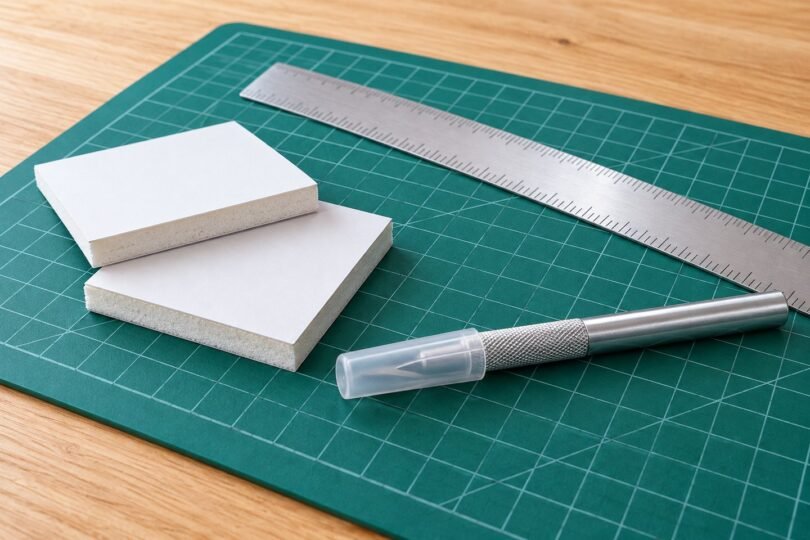
Image note: AI-generated editorial illustration of generic items; not a photograph of a named or recommended product.