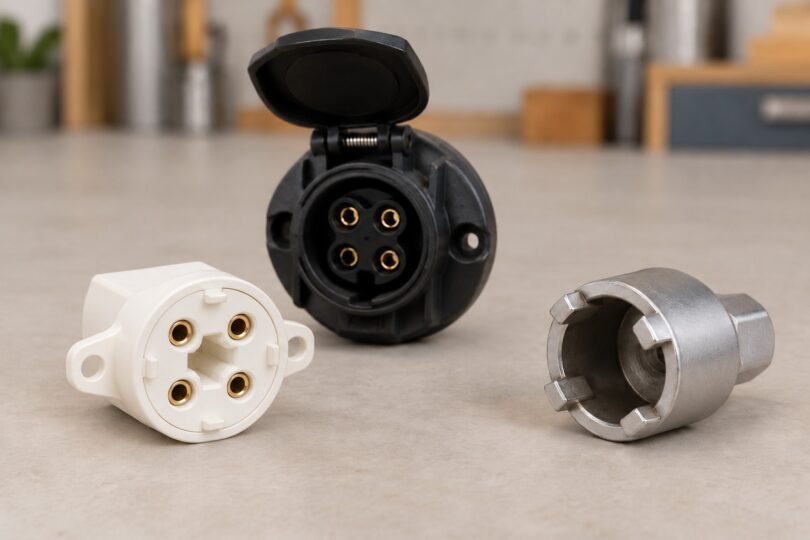

A 4-pin socket is not one standardized product. The term can mean a compact-fluorescent lampholder, a trailer connector, an electronics connector, or a mechanical socket with four driving pins. The right purchase starts with identifying what the socket connects to, then matching the exact part number, geometry and operating requirements.
For a light fixture, read the lamp’s complete base code and the fixture’s ballast label. For a trailer, distinguish round from flat connectors and identify the required electrical functions. For a hub or clutch tool, match the vehicle application and the nut’s engagement pattern. The options below are separated by application so that an attractive-looking part does not become an expensive wrong fit.
First identify which kind of 4-pin socket you need
- Lighting: A lamp pushes into a keyed holder. Look for markings such as G24q-3 or GX24q-4, plus the lamp wattage and holder model. Four contacts alone do not identify the correct base.
- Trailer wiring: A vehicle socket accepts a trailer plug. Four-way round and four-way flat connectors have different physical interfaces.
- Electronic equipment: The socket belongs to a particular connector family or circuit board. Record the equipment model, connector series, pitch, keying and pin assignments before choosing a replacement.
- Mechanical tools: Four pins or tabs engage a locknut. Here, drive size, engagement diameter, pin spacing and application matter; electrical ratings do not.
Photograph the original part and its markings before ordering. Include the mating part, the mounting face and a ruler beside an accessible, safely disconnected component. A product photo that looks similar is only a starting point. If a marking is unreadable, ask the equipment manufacturer to identify the replacement rather than choosing by pin count.
Four-pin CFL lampholders: three specific options
For a fixture repair, a like-for-like holder approved for the fixture is usually the clearest buying route. These Leviton models illustrate why the suffix matters. They are component selections for matching applications, not a ranking of interchangeable sockets.
Leviton 26725-414: for a 42 W GX24q-4 application
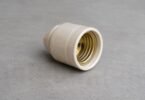
The Leviton 26725-414 is a vertical, bottom screw-down holder for a four-pin GX24q-4 lamp. Leviton specifies the 42 W lamp application and a yellow identification code on a white body. This is the relevant model to investigate when those details match the existing fixture.
Its specified termination accepts 18 AWG solid or suitably tinned stranded conductors, with a 3/8-inch strip length. The holder’s component rating is 75 W and 600 V. Those ratings do not authorize fitting an arbitrary 75 W lamp or connecting the holder directly to building power. The intended lamp, ballast and fixture combination still controls selection.
Leviton 26725-413: for the listed G24q-3/GX24q-3 applications
The 26725-413 manufacturer specification lists G24q-3 and GX24q-3 bases, a 26 W/32 W lamp range and orange color coding. Like the preceding model, it mounts vertically with bottom screws and uses an 18 AWG quick-connect termination.
Choose it only after checking the complete lamp designation against the fixture documentation. A 26 W label without the base code is incomplete information. Do not remove a key, file a plastic obstruction or force a lamp into a holder to make a near-match work.
Leviton 26725-419: only with the specified universal-wattage ballast
The 26725-419 specification lists G24q-3/GX24q-4 bases and 26 W, 32 W and 42 W lamp applications. Its important restriction is use with a universal-wattage ballast. It has white color coding, vertical bottom screw-down mounting and the same listed 18 AWG termination type.
“Universal” in this product description does not mean every four-pin lamp, every ballast or every fixture. If the old ballast label cannot be read, replacing the socket alone does not establish compatibility. Have the fixture identified before selecting this option.
Check mounting dimensions, not just the lamp opening
The “10 mm” wording in these product names is not a complete external-size specification. A holder can accept the intended lamp yet fail to fit the mounting plate or leave insufficient clearance behind it.
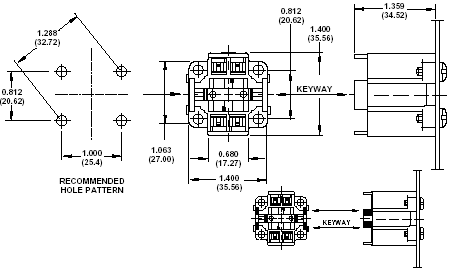
Leviton’s dimensional drawing linked for the 26725-414 shows a 1.400-inch (35.56 mm) square face envelope and a 1.359-inch (34.52 mm) side dimension. Its recommended mounting-hole pattern has 1.000-inch (25.4 mm) horizontal and 0.812-inch (20.62 mm) vertical spacing. Compare the drawing’s orientation and reference surfaces with the fixture; do not use a shipping-package measurement as a substitute.
Also check screw-down versus snap-in mounting, access to wiring ports, room for the lamp body and any required lamp support. Do not assume that the drawing for one suffix proves the fit of another. Keep insulation clear of sharp metal edges and retain the fixture’s intended enclosure and mechanical support.
Replacing a socket and converting a fixture are different jobs
A new lampholder does not diagnose a failed ballast, a damaged lamp or overheating wiring. Cracked plastic, discoloration, loose contacts or a burnt smell warrant taking the fixture out of service and having the cause checked. Do not keep trying replacement lamps in a visibly damaged holder.
Leviton’s installation instructions require isolation at the breaker or fuse and verification that power is off before wiring. They also state that these holders are not intended for direct branch-circuit connection. If you cannot identify the circuit or follow the fixture documentation confidently, use a qualified electrician.
A four-pin-to-E26 adapter changes a mechanical interface; its presence does not establish an electrically compatible system. Do not treat an adapter listing as permission to bypass a ballast. Any conversion needs a suitable, documented retrofit product and an installation that follows its instructions, including the required wiring configuration and labeling.
For a ballast-compatible LED replacement, match the exact lamp to the exact ballast, lamp count and fixture orientation. LEDVANCE’s Type A pin-base lamp instructions, for example, require consulting the ballast compatibility list; they also impose application restrictions. A bulb fitting into the socket does not prove it will operate safely or correctly. Emergency fixtures need their own specifically approved solution.
For trailer wiring: CURT 58671 is a round connector pair
The CURT 58671 includes a trailer-side male plug and vehicle-side female socket in the four-way round format. It uses die-cast metal bodies, concealed terminals and a spring-loaded cover. CURT states that wires are not included, so this is a splice-in connector pair rather than a vehicle-specific plug-in harness.
In CURT’s trailer wiring guide, the four basic circuits are ground, running lights, left turn/brake lights and right turn/brake lights. There is no dedicated electric-brake or auxiliary-power circuit in that four-way arrangement. An adapter cannot create an electrical function that the vehicle wiring does not supply.
Check the mating plug, mounting space and manufacturer wiring diagram before purchasing. Follow terminal identification and test functions; do not assume an old or repaired harness follows standard wire colors. A round trailer socket is not an alternative to a similar-looking industrial or electronics connector.
For locknuts: verify the tool’s exact application
The OEMTOOLS 25969 is a mechanical four-pin hub-locknut socket with a 1/2-inch square drive. The manufacturer describes Toyota 4WD free-wheel/lockout-hub applications, listing Tacoma from 1995 and T100/4Runner from 1996.
Those broad catalog dates are not proof that every later Toyota uses the same hub nut. Verify the actual hub design and vehicle service information, especially if hubs or axles have been changed. The 1/2-inch measurement describes the wrench drive, not the nut diameter or distance between pins.
Confirm that all four pins seat correctly before applying force. Follow the vehicle’s specified locknut procedure and torque requirements, and do not assume a tool is impact-rated unless its manufacturer says so. A motorcycle clutch socket or another four-tab spindle socket is not a substitute merely because it has four engagement points.
Final buying checklist
- Identify the application and copy every letter and suffix from the original part.
- Confirm the mating geometry, mounting method and measured clearances.
- For electrical parts, verify voltage, current or lamp limits, wiring requirements and the permitted environment.
- Read what is actually included: a holder is not a ballast, a connector pair is not a harness, and a socket tool does not include the vehicle-specific repair procedure.
- Resolve any missing compatibility information before ordering or installing.
The best 4-pin socket is the one documented for the job. Start with the exact replacement specification, then compare sellers and package contents after compatibility is established.