
If a belt buckle leaves an itchy patch at your waist, buying another shiny buckle with an “allergy free” label is not enough. The useful questions are what touches your skin, what those parts contain, and whether you actually need a replacement buckle or a complete belt. A metal-free closure can remove one possible source of nickel exposure, but no belt can be guaranteed suitable for every skin allergy.
For a straightforward starting point, compare a full-length belt with a hook-and-loop closure against a short buckleless belt-loop connector. Both options below have a documented nonmetallic design. They serve different purposes, and neither is a medical treatment. These recommendations are based on product specifications and material information, not hands-on wear testing.
What “allergy free” should mean when shopping
The American Academy of Dermatology’s nickel-allergy guidance identifies belt buckles, metal buttons, zippers and snaps as possible nickel sources. Avoiding an identified trigger is more useful than relying on the appearance or price of the buckle. A gold-colored, black-coated or brushed-silver finish does not tell you the underlying composition.
“Nickel-free,” “metal-free” and “hypoallergenic” are different descriptions. Nickel-free addresses a particular material; metal-free describes the absence of metal components; hypoallergenic does not establish that every wearer will tolerate the product. Fabric, rubber coatings and other components still matter. If a rash persists or its cause is uncertain, stop wearing the suspected item and ask a dermatologist. The AAD explains how medical patch testing can help identify delayed contact allergies.
Two buckleless alternatives to compare
Loopbelt Black No-Scratch Web Belt: a complete belt without a buckle

Loopbelt No-Scratch 35mm Web Belt, Black, Medium 34-38, 1 Belt
As an Amazon Associate we earn from qualifying purchases.
This is the conventional full-length option: a black, 35mm-wide polypropylene web belt that closes using combined hook-and-loop fasteners. Loopbelt’s specification states that it has no buckle, hard plastic or metal parts. The ends have a rubber coating, and the closure uses two 9.5-inch fastening strips. The linked variant is Medium, labeled 34–38, supplied as one belt.
Why consider it: you want support around the waistband without a rigid central buckle. Its plain black appearance is easier to use with casual trousers or workwear than a large decorative buckle. Check first: whether a 35mm strap passes through your belt loops and whether the stated size range suits your actual belt-wearing position. The rubber-coated ends also deserve attention if rubber-related materials are among your known triggers.
This is a complete replacement belt, not a buckle you can transfer onto a leather strap. Inspect the fastening surfaces and the condition of the webbing during normal use; do not treat the product name as a guarantee that it cannot mark a delicate surface.
BeltBro Titan MultiPack: short connectors for belt loops

BeltBro Titan fastens between belt loops rather than circling the whole waist. This specific black MultiPack contains one Small, one Medium and one Large connector, intended for 1.5-inch belt loops. It is not three full-length belts. The manufacturer’s FAQ describes the Titan as metal-free and distinguishes it from the narrower Original version.
Why consider it: you dislike a closure across the front of your stomach and only need to take up some slack in suitable trousers. Check first: the spacing and strength of the loops on the actual pair you plan to wear. The different lengths address loop spacing, so the pack’s Small/Medium/Large labels should not be read as ordinary waist sizes.
The maker recommends trying one connector on each side for more even support. This Amazon pack contains one of each length, not two of each; the manufacturer’s direct-store bundles may differ. BeltBro also says the Titan was not designed for concealed-carry support. Treat it as an everyday clothing accessory, rather than a replacement for a purpose-built load-bearing belt.
If you want to keep your existing belt strap
First check whether the buckle is removable. Some straps use a snap or screw attachment; others are stitched permanently around the buckle bar. A replacement that looks the right size in a photo may still be incompatible with the strap’s attachment method, thickness or hole position. Do not cut apart a favorite belt before confirming how the new buckle will connect.
Measure the strap itself in millimeters. Then compare that measurement with the buckle’s stated internal strap width, not the outside width of its decorative frame. A nominally wide buckle can have a much narrower opening. Check that the prong, if present, will pass through the existing holes without tearing them.
Ask for the composition of every skin-facing part, including the back plate, prong, attachment bar and any screws or snaps. A product description that only identifies the front decoration leaves important gaps. If avoiding nickel is essential, a written material statement is a better starting point than “premium alloy,” “rust resistant” or a color name. Keep that information with the order so you can compare it with the item that arrives.
Choosing the right closure for everyday use
- Full waistband support: choose a complete belt if you want the strap to run through every loop. Check how much adjustment remains after fastening, especially when sitting.
- Less hardware at the front: a short connector may suit trousers that are only slightly loose. It depends on the garment’s belt loops and will not work on trousers without them.
- Plastic-buckle alternatives: verify the entire assembly. A plastic-looking buckle can still be paired with metal rivets, a metal strap tip or a separate metal fitting.
- Dress clothing: consider whether the belt will be visible. A discreet nonmetallic design may be practical under a shirt even when it does not resemble a traditional leather dress belt.
- Work equipment: use the equipment maker’s requirements for tool pouches or other loads. A comfortable everyday belt is not automatically rated for those jobs.
A useful arrival-day check
Keep the packaging until you confirm the size and closure. Lay the belt flat and compare the supplied item with the order: color, width, length range, number of pieces and attachment type. Look at the back as well as the front. Check for unexpected metal parts and rough seams, and make sure the closure engages properly without forcing it.
Follow the care label rather than assuming every woven belt is machine washable. Clean fastening surfaces when necessary and let the belt dry as directed. If your skin reacts, stop using it; repeated wear is not a useful way to prove that a material is safe for you. Keep the label and material description available for a clinician if needed.
Common questions
Is stainless steel automatically a good choice for nickel allergy?
No. Do not choose a buckle solely because it is called stainless steel. Ask for the relevant material information and follow advice specific to your diagnosed allergy. A metal-free construction can be simpler to evaluate, although the nonmetal components may still matter to your skin.
Will covering the old buckle solve everything?
A barrier may separate skin from a buckle, but it must remain intact and the rest of the belt and trousers still need checking. It does not identify the cause of an existing rash. For a permanent purchase, prioritize a design with clearly documented materials rather than making an unknown buckle acceptable by appearance alone.
Which option is the sensible starting point?
Choose the Loopbelt if you want a complete casual belt with no rigid buckle. Consider the BeltBro Titan if compatible belt loops and a small waistband adjustment are your main needs. If you specifically want a replacement buckle, confirm material composition and strap compatibility before ordering; neither featured product is a standalone buckle.
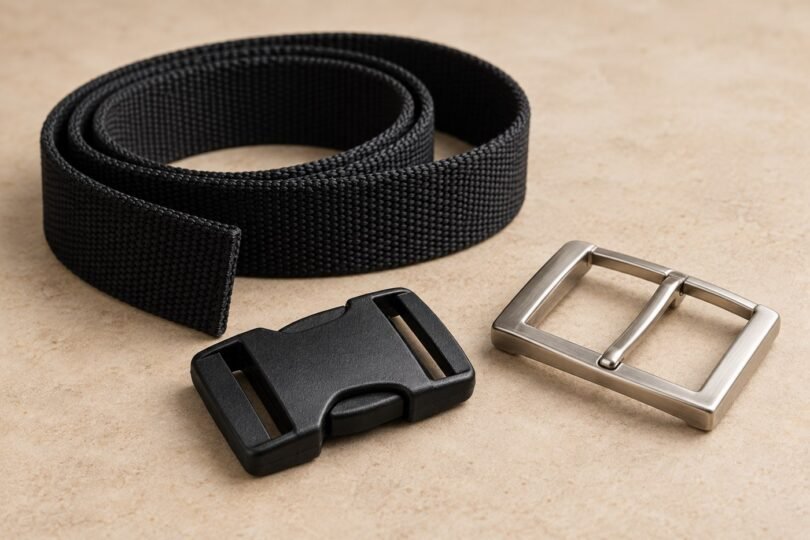
Image note: AI-generated editorial illustration; not a photograph of the named product or a compatibility/installation diagram.