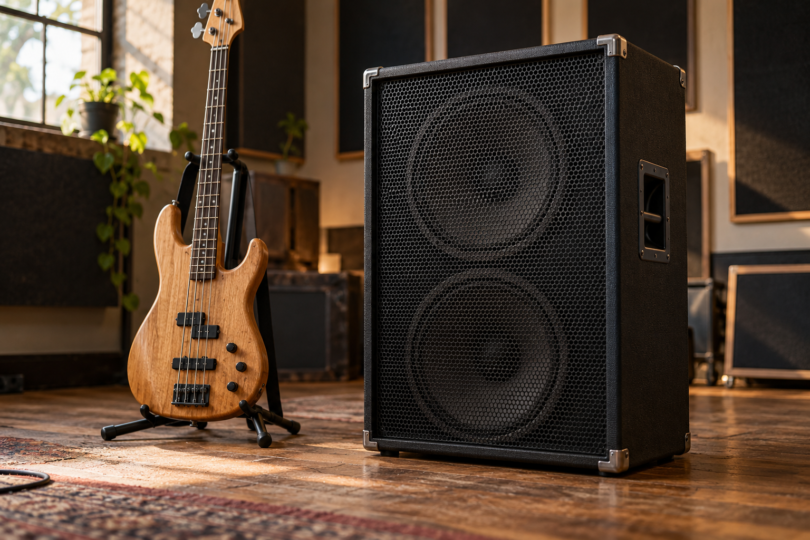

The best bass guitar speaker cabinet depends on your amplifier and the rig you want to carry. Compare the Fender Rumble 115 for a single 15-inch speaker with an adjustable horn, the Ampeg SVT-210AV for a narrow 2×10 cabinet, and the Hartke HyDrive HD210 for a higher-rated 2×10 design. All three are passive cabinets that need a compatible amplifier.
These recommendations compare documented designs, ratings and connection instructions. They do not represent listening tests, measured loudness rankings or a promise that a cabinet will cover a particular venue.
Compare the three bass cabinets
| Cabinet | Speaker layout | Power handling and load | Connections and main trade-off |
|---|---|---|---|
| Fender Rumble 115, model 2370900000 | One 15-inch speaker plus compression horn | 300W continuous; 600W program; 8 ohms | One 1/4-inch and one Speakon jack; 23-inch-wide enclosure |
| Ampeg SVT-210AV | Two 10-inch speakers | 200W RMS; 8 ohms | Two parallel 1/4-inch jacks; lower power rating than the other two picks |
| Hartke HyDrive HD210 | Two 10-inch hybrid-cone speakers plus a 1-inch HF driver | 500W RMS; 8 ohms | Two twist-and-lock and two 1/4-inch connections, wired in parallel; 24-inch-wide enclosure |
1. Fender Rumble 115: the single-15 option
Choose the Rumble 115 if you want a 1×15 cabinet with a horn you can turn down or switch off. Fender specifies a ported plywood enclosure, removable grille and included pop-out casters. Check its 23-inch width against your car and storage space before buying.
Keep the two power figures separate: 600 watts is the program rating, while 300 watts is the continuous rating. The cabinet presents an 8-ohm load. It does not contain a powered amplifier.
- Pros: both Speakon and 1/4-inch connections, removable casters and a three-position horn control.
- Cons: wider than the SVT-210AV; its 600W headline figure should not be treated as 600W continuous handling.
The selected offer is the Black/Silver Rumble 115, model 2370900000, cabinet only. Use the Fender specifications for electrical ratings: the retailer’s generic “20 watts” attribute conflicts with the manufacturer’s cabinet specification.
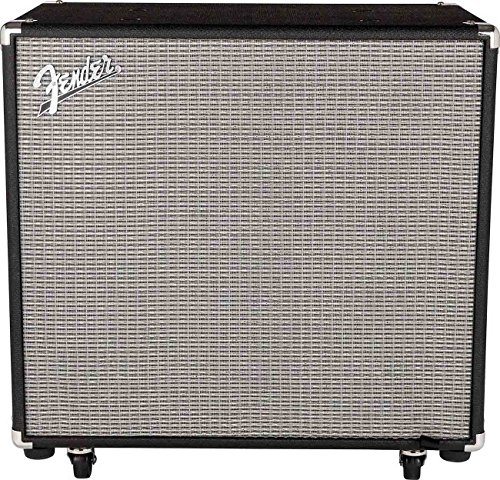
Fender Rumble 115 2370900000 — Black/Silver Cabinet
As an Amazon Associate we earn from qualifying purchases.
2. Ampeg SVT-210AV: the narrow 2×10 option
Compare the SVT-210AV first when floor width matters. Ampeg’s manual gives a 13-inch width, two 10-inch Eminence speakers and a top handle. It is narrower than either alternative here, though that does not establish which is easiest for you to lift.
Ampeg rates this cabinet at 200W RMS into 8 ohms. Its two 1/4-inch TS sockets are parallel input and output connections. The manual calls for a speaker-level amplifier output rated up to 200W into 8 ohms and an unshielded speaker cable.
- Pros: narrow footprint and a second parallel jack for a compatible extension arrangement.
- Cons: no Speakon socket in the documented connector layout; another cabinet changes the total load seen by the amplifier.
The selected offer is an SVT-210AV cabinet, not a Micro-VR head-and-cabinet stack. Its retailer bullet lists 100W while another listing field says 200W. Follow the Ampeg owner’s manual and confirm the exact model and rear-panel rating before connecting an amplifier.

3. Hartke HyDrive HD210: the higher-rated 2×10 option
The HD210 combines two 10-inch paper/aluminum hybrid-cone speakers with a 1-inch high-frequency driver in a sealed enclosure. Its 500W RMS rating makes it worth considering when your amplifier needs more cabinet power handling than the other two picks provide. That figure does not prove greater loudness or better tone.
Hartke specifies an 8-ohm load and four parallel connections: two twist-and-lock and two 1/4-inch sockets. The HF switch offers on, -6dB and off positions. Check the exact HD210 model when comparing offers.
- Pros: the highest documented power handling in this shortlist, two connector types and an adjustable HF driver.
- Cons: a 24-inch-wide enclosure; the shared sockets are not separate inputs for multiple amplifiers.
See Hartke’s exact HD210 product page for specifications and dealer information. Compare the cabinet itself with any offer that also includes an amplifier or accessories.
Check amplifier compatibility before ordering
Start with the amplifier manual’s permitted speaker loads and its power output at the load you intend to connect. Two 8-ohm cabinets connected in parallel create a 4-ohm total load. Only use that arrangement if the amplifier supports it; an extra socket does not establish compatibility.
Fender’s cabinet instructions say not to connect a total load below the amplifier’s minimum impedance or cabinets whose combined power handling is below its output rating. Consult the exact amplifier and cabinet instructions together rather than relying on headline wattage.
Use speaker cable, not a shielded guitar cable. For the HD series, Hartke specifies unshielded 12–18 AWG speaker wire and a two-conductor twist-and-lock cable using pins 1+ and 1-. Never connect two amplifiers to the same cabinet. Check the connector and wiring at both ends before powering the rig.
Frequently asked questions
Can I plug a bass straight into one of these cabinets?
These passive cabinets need the speaker-level output of a compatible amplifier. Buying the cabinet alone does not provide the amplifier.
Is a 600W program rating the same as 600W continuous?
No. Fender lists the Rumble 115 at 600W program and 300W continuous. Keep those labels attached when comparing products.
Can I connect two 8-ohm cabinets?
In parallel, they present a 4-ohm total load. Check that your amplifier supports that load and that each cabinet’s power handling is suitable for the arrangement.
Can I use my normal instrument cable?
Use an appropriate unshielded speaker cable for the amplifier-to-cabinet connection. Ampeg and Hartke explicitly warn against substituting a shielded instrument cable.
Does a larger power rating mean a louder cabinet?
Do not treat this specification comparison as a loudness ranking. Choose a compatible load and power-handling rating first, then audition the rig if tone and usable volume are decisive for your purchase.