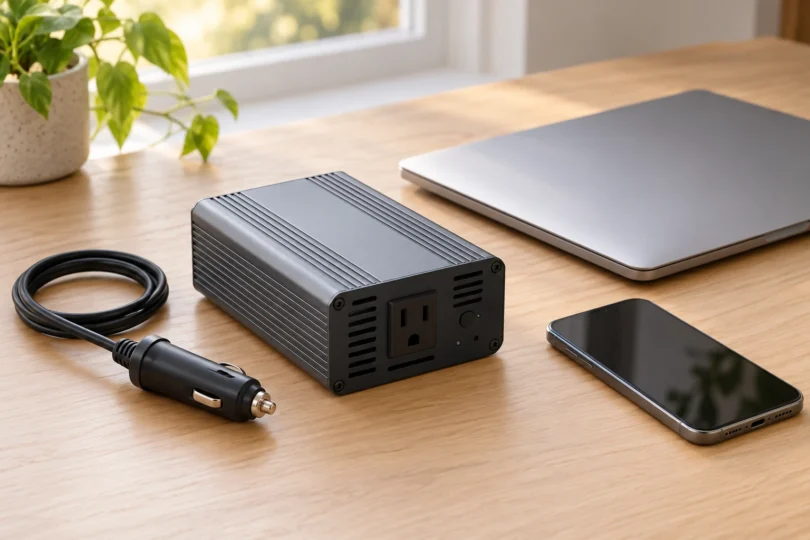

The BESTEK MRZ4011AU 400W pure sine wave inverter is the stronger starting point if you want a documented waveform, two AC outlets and USB-C charging. The smaller MRI4011CU is worth comparing when space matters, but its published specifications leave important power details unresolved.
Before choosing either, check your vehicle’s accessory-outlet limit. A 400W label on an inverter does not mean a car socket can supply 400W. The usable load must stay within the lowest applicable limit of the vehicle outlet, inverter, plug and cable, with conversion losses included.
Two BESTEK 400W options compared
| Model | Why consider it? | Published power and charging | Main limitation |
|---|---|---|---|
| MRZ4011AU, Gray | First choice when a specified pure sine waveform matters | 400W continuous; 800W peak; two AC outlets; USB-C PD30W and USB-A QC18W | Full output is not established for an arbitrary vehicle socket |
| MRI4011CU | Smaller body for a tightly spaced setup | Marketed as 400W; USB-C PD30W and USB-A QC3.0 | Maker page does not specify waveform or distinguish continuous and peak power |
These are specifications-based selections. Dimensions and ratings below come from the exact model listings; they are not measured performance results.
1. BESTEK MRZ4011AU: the clearer choice for waveform requirements
BESTEK identifies its gray US version as MRZ4011AU-GY-US-E01. Its product page specifies nominal 12V DC input, 110V AC output, 400W continuous power and an 800W startup peak. The Amazon selection below is the Gray MRZ4011AU, one inverter.
The appeal is a clearly stated pure sine waveform plus two AC receptacles and separate PD30W USB-C and QC18W USB-A ports. The maker lists dimensions of 6.45 × 3.93 × 2.36 inches, so allow room for its body, plugs and ventilation.
Choose it if: your equipment manufacturer calls for pure sine AC and confirms the rest of this model’s electrical specifications suit the device. Check first: the source connection and permitted load in the supplied manual. We did not establish a model-specific socket power ceiling or a guaranteed simultaneous AC-plus-USB budget. The 800W figure is a brief peak rating, not power you can draw continuously.
Pure sine output does not certify compatibility with every appliance or medical device. The number of outlets also does not multiply the inverter’s total capacity.

BESTEK MRZ4011AU 400W Pure Sine Wave Inverter, Gray, 1 Unit
As an Amazon Associate we earn from qualifying purchases.
2. BESTEK MRI4011CU: a compact alternative with specifications to confirm
The BESTEK MRI4011CU manufacturer listing describes a 12V DC-to-110V AC inverter with PD30W USB-C and QC3.0 USB-A charging. Its listed 4.20 × 3.10 × 1.80-inch body is smaller than the pure sine model above.
Choose it if: compact size is important and BESTEK can confirm its output is appropriate for your intended load. Check first: waveform, continuous versus peak rating, the permitted input connection, and simultaneous charging limits. The maker page does not resolve these details, so do not assume it shares the MRZ4011AU’s pure sine waveform or 800W peak.
Match the model on the unit and order details. A retail listing we checked had conflicting model identifiers despite an MRI4011CU product photo; the manufacturer link above is the better starting point for checking the exact version.
How to decide whether either inverter fits your setup
Start with the vehicle’s outlet rating
Read the manual for your exact vehicle and outlet. For example, the 2016 Ford F-650/750 manual limits its 12V power point to 180W. That is an example for that vehicle, not a universal allowance.
At 12V, delivering 400W would require more than 33 amps before allowing for inverter losses. A lower-rated outlet cannot provide that load simply because the inverter says 400W. Include USB charging and inverter consumption in the source budget. A splitter does not increase the circuit’s capacity.
Do not replace a vehicle fuse with a higher-rated one to run a larger load, or improvise a battery connection. If your load exceeds the approved plug-in setup, choose a power system designed and documented for it and obtain qualified installation advice.
Check running power, startup demand and waveform separately
Use the device manufacturer’s input requirements, including any startup surge and waveform restrictions. A continuous rating describes sustained output; a peak rating describes a short surge whose duration also matters. We did not verify the MRZ4011AU’s peak duration.
Do not buy either model on the assumption that every refrigerator, pump, microwave, heater or other appliance under a headline wattage will work. Startup demand and electrical compatibility still need checking, and some loads exceed the available source power before the inverter’s own limit is reached.
Match USB charging to the device
A 30W USB-C port cannot provide a laptop’s requested 65W or 100W. Check the device’s accepted charging profiles and use a suitable cable. PD and QC ratings are maximum advertised port outputs, not promises that every connected device charges at that rate. Do not add the AC and USB labels together and assume that total is available simultaneously.
Use a separate plan for medical equipment
For a CPAP machine, nebulizer or other medical equipment, ask its manufacturer or equipment provider for an approved power arrangement for the exact device and accessories. A humidifier or heated tube can change power needs. ResMed’s travel guidance directs users to their equipment provider for suitable portable power options and converters. Neither an inverter’s wattage nor its pure sine label establishes that approval.
Practical use limits
- Follow the inverter’s own manual for placement, ventilation and operating conditions. Keep its vents clear and the equipment dry.
- Use only a power source permitted by the exact inverter and vehicle documentation. Do not infer 24V-system or electric-vehicle compatibility from a similar product name.
- An inverter draws energy from its source; it is not a battery. Prolonged engine-off use can leave insufficient charge to restart a vehicle. Follow the vehicle’s guidance and disconnect equipment when finished.
- Never leave a vehicle engine running in an enclosed or partly enclosed area, including a garage. CDC guidance warns of carbon monoxide buildup in these settings.
- Connect compatible devices to the inverter’s outlets. Never backfeed a building’s wall outlet or improvise a connection to household or RV distribution wiring.
Which one should you buy?
Start with the MRZ4011AU when you need a published pure sine specification and the documented load fits your approved power source. Consider the MRI4011CU for its smaller body only after the missing waveform and power details are confirmed for your equipment.
If you only need USB charging, compare a vehicle charger that supplies your device’s required USB profile before paying for AC outlets. If you need sustained power beyond your vehicle socket’s limit, neither 400W label makes that socket suitable.