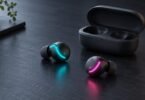
If you want Bluetooth earbuds that look like earplugs, the Plugfones Basic Pro Blue/Yellow is the closer visual match: yellow flanged plugs with a blue connecting cord. The ISOtunes FREE 2.0 Green is a true wireless alternative with foam tips, but its round button housings look more like conventional earbuds.
Appearance is not a hearing-protection rating. A snug fit, passive noise isolation or active noise cancellation does not by itself establish protection from hazardous noise. NIOSH advises that noise-cancelling earbuds and headphones should not be treated as hearing protection unless labeled with a Noise Reduction Rating (NRR).
Two Bluetooth options with specific rating evidence
| Exact option | Shape and connection | Rating and tip combination | Main compromise |
|---|---|---|---|
| Plugfones Basic Pro Blue/Yellow, PBT-UY | Flanged yellow plugs, connecting cord and inline controls; Bluetooth to phone | 25 dB NRR on the matching package; fixed silicone tips | Tips are not interchangeable on this color/model |
| ISOtunes FREE 2.0 Green, IT-74 | Separate true wireless earbuds and charging case | 25 dB NRR with the supplied TRILOGY Short foam tips | Needs a good foam-tip seal; bulkier than a plain earplug |
These are labeled laboratory ratings, not a guarantee of the reduction you personally receive. They do not mean you can simply subtract 25 from any workplace sound reading and declare the result safe.
1. Plugfones Basic Pro Blue/Yellow PBT-UY
The Blue/Yellow Basic Pro combines yellow silicone plugs with blue cords, an inline microphone and physical controls. It connects wirelessly to your phone, while a cable still joins the earpieces. That arrangement can be easier to keep together than two separate buds, provided the cord is suitable for your activity and workplace.
The matching Blue/Yellow package shows a 25 dB NRR. Plugfones explicitly says this version has fixed, non-interchangeable silicone plugs. Do not transfer the 27 dB foam-tip claim from the separate Light Blue/Orange Basic Pro to this one, or assume that a pack of replacement tips will fit it.
The listed kit includes the headset, USB charging cable and cable-management clip. The inline controls handle playback and calls. A noise-isolating microphone is intended to help the person on the other end hear you; that microphone feature is separate from the protection provided by the earplug seal.
Choose it if: you prefer the shape of corded flanged earplugs and physical controls. Check first: that the fixed tip shape seals comfortably in both ears. If it does not, choose another properly fitted protector rather than relying on the package rating.
2. ISOtunes FREE 2.0 Green IT-74
The Green IT-74 version of FREE 2.0 removes the connecting cord. The set includes two earbuds, a charging case, USB-C cable and a selection of tips. For this recommendation, use the supplied TRILOGY Short foam tips in the size that seals correctly. The matching IT-74 packaging and manufacturer manual support a 25 dB NRR.
The Green model’s specified audio-output limit is 85 dB. Check the exact color and SKU: the current Matte Black IT-73 product option is listed with a different, 90 dB limit. A volume limiter does not make every exposure duration safe or replace assessment of outside noise.
There is a material tip-documentation conflict. The current FREE 2.0 support page assigns a rating to its double-flange silicone tips, while the linked legal manual warns against using silicone tips in noisy environments. This guide recommends the documented foam configuration only. Get model-specific clarification from ISOtunes before relying on silicone tips for protection.
Choose it if: you want separate Bluetooth earbuds and are comfortable fitting and maintaining foam tips. Check first: that both tips seal and that the earbuds are allowed for the task. The manual warns against use when full awareness of surroundings is needed, including driving, motorcycling and outdoor cycling.
What “OSHA approved” does not mean
OSHA states that it does not approve or endorse commercial products. A listing that calls earbuds “OSHA approved” is not evidence of agency approval. Even a product with an NRR must be appropriate for the measured exposure, properly fitted and permitted under the employer’s hearing-conservation and communication rules.
Music can mask alarms, moving equipment and spoken warnings. Ask the person responsible for workplace safety whether entertainment audio and the particular device are allowed. Earplug-like appearance does not change those rules, and these products should not be used to conceal prohibited headphone use.
Fit and maintenance matter more than appearance
- Match the complete configuration. Verify the exact model, tips and package rating. Foam, silicone and different product generations can have different instructions.
- Follow the manufacturer’s fitting instructions. A loose or damaged tip undermines protection. NIOSH recommends individual fit testing to establish the protection actually achieved.
- Keep both ears protected. Being able to play audio through one bud does not protect the uncovered ear.
- Inspect and maintain the tips. Follow the maker’s cleaning and replacement guidance; stop relying on worn, damaged or poorly sealing tips.
- Do not generalize to gunfire or every machine. An NRR alone does not establish adequate protection for impulse noise or your specific exposure. The FREE 2.0 manual explicitly notes the limitation for impulse noise.
Which pair makes sense?
Pick the Basic Pro Blue/Yellow for the familiar flanged-earplug shape and a connecting cord. Consider FREE 2.0 Green with its supplied foam tips if a true wireless layout matters more. If you need hearing protection at work, the deciding factors are fit, exposure and employer approval of the device and audio use; appearance comes after those checks.