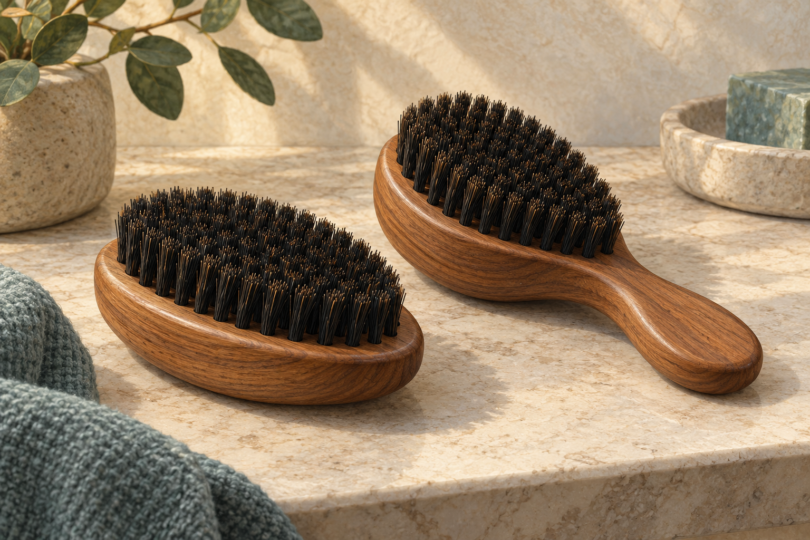

The best brush for 360 waves is one that moves your hair comfortably at its current length. Start with bristle firmness, then compare the shape and grip. A firmer brush is worth considering only when a softer one no longer suits your hair; it should never require you to tolerate scraping or pain.
Three useful models to compare are the soft Diane D8169, the medium curved Diane D1727, and the medium-hard Torino Pro #57. They fill different roles rather than forming a first-to-third ranking. The manufacturers’ length guidance matters as much as the firmness label.
Research checked October 4, 2026 using official product descriptions and American Academy of Dermatology guidance. This is a researched buying guide, not hands-on testing. We have not measured bristle stiffness, shedding, grip comfort, durability or wave results. Prices and availability should be checked with the seller.
Three wave brushes compared
| Brush | Manufacturer-described construction | Why consider it | Main limitation |
|---|---|---|---|
| Diane D8169 | 100% soft boar bristles | A softer option for the longer fine, wavy or curly hair Diane specifies | Softness does not establish how well it will move your particular hair |
| Diane D1727 | 100% medium boar bristles, curved head and pointed tip | A medium option for longer thick or curly hair; targeted crown work | The curve and firmness still need to suit your head and scalp |
| Torino Pro #57 | Medium-hard curved brush | A firmer comparison for hair grown beyond a fresh cut | Explicitly unsuitable for fresh cuts and shower brushing |
Diane D8169: the softer option
The D8169 product page identifies soft boar bristles and positions the brush for longer lengths of fine, wavy or curly hair. That makes it a sensible starting comparison if your priority is a softer styling brush.
Read that description carefully: a soft label alone does not make this a manufacturer-verified choice for every very short haircut. Likewise, a seller’s claim about sensitive scalps is not a guarantee that it will feel comfortable for you.
Buying check: match the D8169 item number. Diane sells several similarly named wave brushes, including different shapes and firmness levels. Do not assume the brush pictured in a multipack is this exact model.
Diane D1727: medium bristles with a pointed crown tip
The D1727 combines medium boar bristles with a curved head and a pointed end. Diane describes the tip as useful for precise brushing around the crown and recommends the model for longer thick or curly hair.
Consider it when you want a more targeted shape and a step up from a soft brush. We have not compared its stiffness directly with the D8169 or Torino model. A manufacturer category is useful for narrowing the choice, but it is not a standardized stiffness measurement.
Buying check: look at how you would hold the brush when approaching your crown and the back of your head. A pointed shape can help you aim; it does not identify your brushing direction for you.
Torino Pro #57: medium-hard with clear use restrictions
Brush King’s #57 listing describes a medium-hard curved brush and specifically warns against using it on a fresh cut. It also says this model should not be used for wash-and-style routines or in the shower.
Consider it when a firmer brush suits your longer hair. For an uncertain beginner, assessing comfort first is more useful than choosing the firmest option.
Buying check: confirm the #57 model, read the length guidance with your barber if necessary, and check the seller’s current stock and return terms. Do not substitute another numbered Torino model based on color alone.
Choose firmness before buying a whole set
Use the brush you already own to identify the actual problem. Is it failing to move the hair, awkward to hold near the crown, or uncomfortable against your scalp? Those are different reasons to change a brush.
- Immediately after a haircut: reassess comfort. Do not automatically continue with the firm brush you used when your hair was longer.
- If a softer brush suits your hair: there is no need to buy a harder one simply because it is advertised as advanced or professional.
- If hair is longer or denser: compare a medium option and the manufacturer’s intended use before choosing medium-hard or hard.
- If the brush scratches or snags: stop and inspect the brush and your technique. More pressure is not a useful way to compensate for an unsuitable tool.
These are selection checks, not a prescribed progression. You do not need to own soft, medium and hard versions before you can begin. A second brush should solve a specific problem in your routine.
Comfort matters more than a stroke target
The American Academy of Dermatology advises brushing only as needed for styling and avoiding pulling or tugging. It also rejects the idea that hair needs 100 strokes a day. That is a useful boundary when online wave routines encourage long sessions or a fixed daily stroke count.
Do not interpret discomfort as proof that a brush is working. Pause if brushing hurts, and seek appropriate professional advice if irritation, breakage or a scalp concern persists. A wave brush is a styling tool, and this guide does not claim that any model grows hair or treats a scalp condition.
Care instructions: check before getting the brush wet
Follow the directions supplied with the exact brush, including any limits on water, cleaning products and drying. We did not verify a complete cleaning procedure for the two Diane models from their product pages, so we do not prescribe soaking times, water temperatures or cleaners for them.
The #57’s no-shower warning is explicit. If wet brushing is part of your routine, choose a model the maker specifically identifies for that use rather than assuming every wave brush can handle it. General hair-care advice and a particular brush’s water resistance are separate questions.
Before using a new brush, inspect the bristles, base and handle. Ask the seller about rough edges, persistent loose bristles or damage instead of accepting them as a necessary break-in process. Keep the packaging and care information so the model and instructions remain easy to identify.
What to check before ordering
- Exact model number, firmness and shape, rather than a generic “360 waves” title
- Manufacturer guidance for your current hair length and texture
- Bristle material, particularly if you prefer to avoid animal-derived bristles
- Grip and reach at the crown, sides and back of your head
- Whether wet use is expressly allowed
- Total delivered cost and hygiene-related return restrictions before opening or using it
Frequently asked questions
Is a hard brush best for 360 waves?
Not automatically. Choose based on whether it moves your current hair comfortably and is appropriate for its length. Check the manufacturer’s length guidance before using a firm brush after a haircut.
Is a curved brush better than a flat brush?
We have not tested a universal advantage. Compare the grip and how easily you can control the head at your usual angles. The D1727’s pointed end is a concrete design feature; better results for everyone would be a much broader claim.
How long will it take a brush to produce waves?
We cannot promise a timetable. The sources checked do not establish a reliable number of days or weeks for these models. Avoid paying extra on the strength of a guaranteed result by a particular date.
Can I use my wave brush in the shower?
Only if the instructions for that exact model permit it. The Torino Pro #57 listing specifically excludes shower use, and we have not verified shower suitability for the two Diane brushes.
Image note: AI-generated generic editorial illustration of hair brushes; it does not identify a specific brush model or establish bristle firmness.