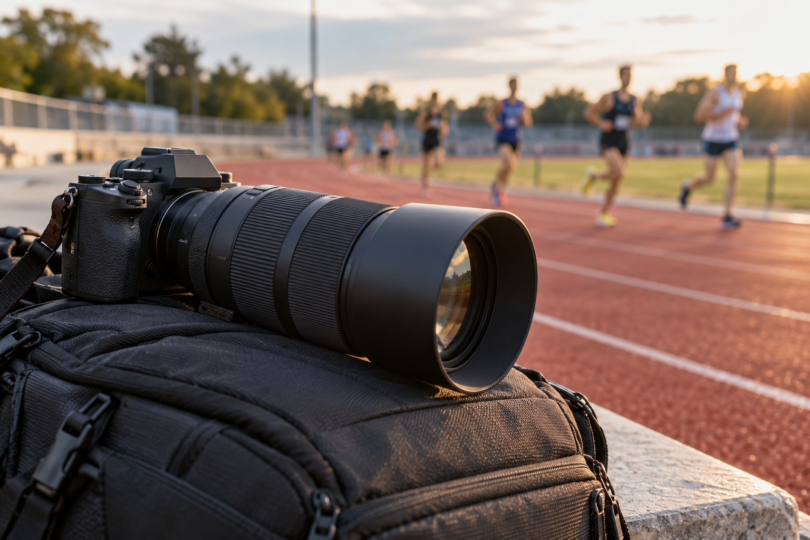

The Canon EOS R7 is our first pick for daylight field sports: its APS-C sensor, fast mechanical burst and two memory-card slots make a useful combination when the action is distant and unpredictable. The EOS R10 is a simpler starting point, the EOS R6 Mark III adds full-frame flexibility, and the EOS R5 Mark II suits photographers who need more cropping room and advanced sports autofocus.
All four recommendations below are camera bodies without a lens. Budget for a compatible lens, memory cards and a spare battery. A long accessory list in a retailer bundle is less useful than a lens that reaches the action and lets in enough light.
The best Canon sports cameras at a glance
| Camera body | Best fit | Sensor | Mechanical burst | Electronic burst | Main trade-off |
|---|---|---|---|---|---|
| EOS R7 | Daylight field sports | 32.5MP APS-C | Up to 15 fps | Up to 30 fps | Electronic shutter can distort fast movement |
| EOS R10 | Learning action photography | 24.2MP APS-C | Up to 15 fps | Up to 23 fps | One card slot; no in-body stabilization |
| EOS R6 Mark III | Full-frame sports and everyday work | 32.5MP full-frame | Up to 12 fps | Up to 40 fps | Highest rate requires electronic shutter |
| EOS R5 Mark II | Detailed files and advanced sports AF | 45MP stacked full-frame | Up to 12 fps | Up to 30 fps | High-resolution bursts increase file-management demands |
These are Canon’s maximum still-photo rates, not guaranteed speeds in every situation. Battery condition, lens, autofocus activity, shutter speed, lighting and camera settings can reduce them; a full buffer can also interrupt a burst. Electronic first-curtain is a separate shutter mode, even where its maximum rate matches the mechanical figure.
1. Canon EOS R7: best for daylight field sports
Choose the R7 when you regularly photograph players across a field and want an APS-C body with room to grow. Its 32.5MP sensor provides a 1.6× crop field of view relative to full frame with the same lens. That helps frame distant action tightly, although it does not change the lens’s actual focal length.
The combination of up to 15 fps mechanically, people detection, in-body image stabilization and two UHS-II-compatible SD slots is the reason to step up from the R10. Dual slots give you more recording options, while stabilization helps with camera movement. You still need a sufficiently fast shutter speed to freeze an athlete.
The headline 30 fps uses the electronic shutter. Canon warns that fast-moving subjects can appear distorted in this mode and that flickering light can produce banding. For a bat swing, a rapidly moving ball or a quick pan, start by evaluating the mechanical mode rather than assuming the highest frame rate gives the best result.
Selected version: EOS R7 body only, black, model 5137C002. No lens is included.
Canon EOS R7, Black, Body Only
As an Amazon Associate we earn from qualifying purchases.
2. Canon EOS R10: best for learning sports photography
The R10 is a sensible first dedicated sports body for someone who wants responsive subject tracking without building a large kit. It combines a 24.2MP APS-C sensor with people detection and offers the same up-to-15-fps mechanical ceiling as the R7. That makes it worth considering for a first season of track, soccer or other outdoor action.
Its compromises are practical: one UHS-II-compatible SD slot and no in-body image stabilization. An optically stabilized lens can help steady the view, but neither type of stabilization freezes a moving player. Choose the R7 instead if dual-card recording and in-body stabilization are priorities. The R10’s electronic maximum is 23 fps, with the same need to check moving-subject distortion and artificial lighting.
Selected version: EOS R10 body only, black, model 5331C002. The RF-S 18–45mm, RF-S 18–150mm and Content Creator Kit listings are different configurations.
3. Canon EOS R6 Mark III: best full-frame all-rounder
The R6 Mark III is the full-frame option to consider when sports are part of a wider mix of events, portraits and everyday photography. Its 32.5MP sensor, people-and-eye detection, in-body stabilization and mixed CFexpress Type B/UHS-II SD slots provide a versatile foundation. Compared with the APS-C picks, the same lens gives a wider view, so check whether your existing telephoto reaches far enough.
It shoots at up to 12 fps mechanically or 40 fps electronically. Pre-continuous shooting can retain action from before a full shutter press; at approximately 40 fps, Canon describes about half a second of earlier capture. This is useful for an unpredictable start or jump, but it uses the electronic shutter and pauses while images are being written to the card.
Do not buy it on the 40-fps number alone. The maximum mechanical rate depends on conditions including a fully charged LP-E6P battery and a compatible lens, and flickering venue lights can cause electronic-shutter banding. Include the cards and lens in your budget, especially if you plan to use its faster shooting modes regularly.
Selected version: EOS R6 Mark III body only, black, model 7084C002. This is the Mark III camera, without either 24–105mm kit lens.
4. Canon EOS R5 Mark II: best for detail and advanced sports autofocus
Choose the R5 Mark II if you need detailed files for cropping or large output and will use its additional autofocus tools. Its 45MP full-frame sensor has a stacked design, and its burst limits are 12 fps mechanically and 30 fps electronically. More pixels give you more freedom to trim a composition, provided the lens, focus and exposure capture enough detail.
Action Priority AF is a more specific advantage than a generic “sports mode.” Canon’s current AF guide covers soccer, basketball, volleyball and American football, prioritizing people performing recognized actions. Check the installed firmware and available target-sport settings. The feature cannot anticipate every play or replace good positioning and subject selection.
The trade-off is a heavier file workflow: high-resolution bursts need storage, careful culling and an appropriate card. There is one CFexpress Type B slot and one UHS-II-compatible SD slot. A stacked sensor also does not make every lighting situation trouble-free; Canon still warns about electronic-shutter banding under flickering light.
Selected version: EOS R5 Mark II body only, black, model 6536C002. The original EOS R5 and retailer bundles with extra batteries or lenses are different listings.
How to choose the right body and lens
Start with your shooting position and the light. A lens suitable for courtside action may be too short from the stands. A telephoto zoom is useful for distant players; a wider maximum aperture helps when a fast exposure is needed in dim light. Compare the complete body-and-lens cost, and check event rules on camera size and lens length before committing.
Judge burst quality, not just burst speed. Look at whether faces stay sharp, equipment or balls look distorted, and bands appear under the venue’s lights. Use short bursts around the decisive moment. If electronic mode causes problems, try mechanical mode and the camera’s applicable anti-flicker settings, then check the resulting photos.
Check the actual offer. Match the exact model, body-versus-kit selection and condition before checkout. Confirm who supplies the warranty and what the seller includes. A “body only” camera still needs a lens to take photographs; a headline bundle image or generic specifications table is not a reliable substitute for the selected configuration.
Frequently asked questions
Which Canon camera is best for a beginner shooting sports?
The EOS R10 is our beginner pick. It has people detection and up to 15 fps mechanical shooting in a compact body. Choose the R7 if you also want two card slots and in-body stabilization, while leaving enough budget for the lens your sport requires.
Do I need a full-frame camera for sports photography?
No. The R7 and R10 can be useful for distant field sports because their APS-C sensors give a narrower field of view with the same lens. Full frame offers a different framing and system choice; the venue, lens aperture and required shutter speed matter more than buying by sensor label alone.
Is electronic shutter always better for sports?
No. It provides the highest burst rates here, but the R7 and R10 manuals warn about distortion with fast-moving subjects. Electronic shutter can also show banding under flickering lights. Check sample frames at your venue and use mechanical mode when it gives a cleaner result.
Can I use my existing Canon EF lenses?
Canon EF and EF-S lenses require an EF-EOS R mount adapter on these RF-mount bodies. EF-M lenses are not compatible. On the full-frame bodies, EF-S lenses use a cropped recording area, so you do not retain the full sensor resolution. Check the exact lens and camera guidance for maximum burst-speed compatibility.
Should I buy a body only or a lens kit?
Buy a body only when you already have a compatible lens or know which sports lens you need. Choose a kit only if its specific lens suits your distance and lighting. All four offers selected in this guide are body-only versions, so a lens must be supplied separately.