
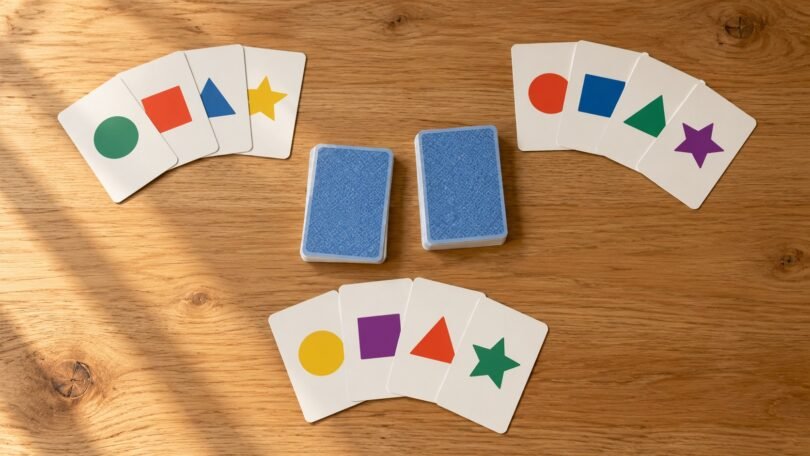

The best card games for kids fit the players at your table: how many are joining, whether they read independently, and whether they enjoy a race or prefer time to think. UNO Junior is a useful starting point for animal matching; Guess Who? Card Game suits two players who like questions; and Sushi Go! is a step toward choosing combinations and keeping score. A standard deck also gives you Go Fish without buying a dedicated game.
Use the age labels below as the publishers’ recommendations, then check the demands of the rules. A picture-based game can still require quick reactions, spoken answers or adult help. The choices here are based on the named editions and their published rules.
Compare card games by age, players and play style
Times are publisher estimates where stated, not a promise for a first game. “Not specified” means the linked instructions do not give a fixed duration; leave extra time to explain and deal the cards.
| Game and edition | Stated age | Players | Listed time | What players need to do |
|---|---|---|---|---|
| UNO Junior, GKF04 rules | 3+ | 2–4 | Not specified | Match animals or colors; learn action symbols at later levels |
| Guess Who? Card Game, E7588 | 5+ | 2 | Not specified | Ask and answer yes-or-no questions; identify character names |
| Spot It! Classic, Eco Sleeve SPR105ML | 6+ | 2–8 | 15 minutes or less | Find and call out matching pictures under time pressure |
| BLINK, HJC90 tin edition | 7+ | 2 in the standard game | Not specified | Quickly match color, shape or symbol count |
| Sleeping Queens, original #230 | 8+ | 2–5 | 20 minutes | Recognize numbers and card powers; use addition and count points |
| Sushi Go!, original #249 | 8+ | 2–5 | 15 minutes | Choose sets, follow scoring reminders and total points |
| Go Fish, standard 52-card deck | 4+ on Bicycle’s guide | 2–5 for the deal described below | Not specified | Recognize card ranks, ask for them and collect four of a kind |
1. UNO Junior: a starting point for animal matching
Choose it for: a child within the 3+ age guidance who can match pictures but is still learning numbers. The GKF04 game uses animal illustrations as another way to match, so numeral recognition is not essential at the beginner level.
Each player starts with five cards and tries to empty their hand by matching the top discard. Begin with all action cards removed. The intermediate level adds Reverse, Skip and Wild cards; the advanced level brings in Draw One and Draw Two. Mattel also suggests leaving beginners’ hands face up so an adult can help. See the official GKF04 instructions.
Edition check: that rule sheet lists 56 cards. Some Mattel regional product pages list 45, so confirm the actual box contents and enclosed rules before buying. Do not assume every game called UNO Junior has an identical deck.
Tradeoff: the later levels introduce missed turns and extra draws. Keep the beginner rules until everyone understands the turn order, and choose a different game if those penalties spoil the fun.
2. Guess Who? Card Game: questions for two players
Choose it for: two players who want a turn-based game with no speed race. This is Hasbro’s E7588 card edition, containing 40 Face cards, 20 Mystery cards and instructions. It is a separate format from the familiar plastic-board versions. Hasbro lists ages 5+ and exactly two players.
Each player lays out 20 faces in a four-by-five grid and keeps one Mystery card hidden. Ask a yes-or-no question, then turn over faces the answer rules out. Guessing the character takes a turn; a wrong guess loses the game. The Hasbro product page and downloadable rules explain the setup.
Reading and adult help: players do not need to read long instructions on each turn, but the characters have printed names. An adult may need to help identify a name or clarify a question without revealing the answer.
Tradeoff: a small box still needs room for two card grids. It works better on a steady table than in a cramped moving-car seat. The rule sheet separately carries a small-parts choking warning for children under three; its recommended playing age remains 5+.
3. Spot It! Classic: a picture-matching race
Choose it for: a group that enjoys everyone looking and responding at once. The current Zygomatic Classic Eco Sleeve edition, SPR105ML, lists ages 6+, two to eight players and a play time of 15 minutes or less. Its package contains 55 cards, a tin and a rulebook, with rules in English, Spanish and French.
The central challenge is finding the shared symbol between cards and calling it out. Five game variants change what happens to the cards. No sentences need to be read during that matching task, but agreeing on names for unfamiliar pictures before starting helps avoid disputes.
Tradeoff: picture recognition and speed are different demands. A child who understands the matching rule may still dislike competing against a much faster player. Use an untimed practice round before deciding whether this style suits the group. Check for the Classic edition; themed and junior versions can have different specifications.
4. BLINK: fast matching for two
Choose it for: a head-to-head race without a large hand of cards. The HJC90 tin edition is listed for ages 7+. Its rules describe 60 symbol cards and a standard two-player game.
Players hold up to three cards, replenishing from their own draw piles. Both play simultaneously onto two center piles. A card must match at least one feature of the card it covers: color, shape or number of symbols. Empty both your hand and draw pile to win. There is no reading-heavy card text to interpret, but players need to recognize valid matches quickly. The HJC90 instructions also provide a three-player variation.
Tradeoff: a large speed difference can make repeated rounds frustrating. The rules suggest giving the faster player more cards for balance. For a child who prefers to pause before choosing, try Guess Who? instead.
5. Sleeping Queens: card powers and simple addition
Choose it for: children who enjoy a small hand of cards, different character powers and a little arithmetic. Gamewright’s original #230 edition has 79 cards and rules, with a stated age of 8+, two to five players and a 20-minute play time.
Kings awaken queens, while other cards can steal a queen or put one back to sleep. Dragons and wands provide defenses. On a discard turn, players can exchange a single card, a matching pair of numbers or a group that forms an addition equation. For example, 2, 3 and 5 can go together because 2 + 3 = 5. Players refill their hands to five cards.
With two or three players, the target is five queens or at least 50 queen points; with four or five, it is four queens or at least 40 points. The original rules cover the special cases and the alternative ending when all queens are awake.
Tradeoff: losing a collected queen is part of play. Choose this when that interaction appeals to the child, and allow adult help with sums and card powers. Look for the original 79-card game when matching these specifications, rather than a sequel or deluxe edition.
6. Sushi Go!: choosing combinations as hands move around
Choose it for: children ready to weigh several scoring options. Original Sushi Go!, #249, contains 108 cards and rules. Gamewright lists ages 8+, two to five players and 15 minutes. You also need paper and a pencil for scoring.
Everyone chooses one card from their hand, reveals it together, then passes the remaining cards to the next player. Different foods score in different ways: for example, a pair of tempura scores five points, while sashimi needs a set of three. The game runs for three rounds, with pudding scored at the end. The original rulebook explains each combination.
Reading and adult help: the illustrations make food types recognizable, but the scoring reminders include words and numbers. A confident reader can explain those reminders and keep score while a newer player concentrates on choosing cards.
Tradeoff: the selection step is simple; comparing the value of different sets is more involved. Start by explaining the scoring options before dealing. This guide covers the original 108-card format; check the contents and rules of other Sushi Go! versions separately.
Already have playing cards? Try Go Fish
Use a standard 52-card deck without jokers. Bicycle’s Go Fish rules list age 4+, but beginners may need help naming card ranks. Collect four-card books in this version.
- Deal seven cards each for two or three players, five for four or five. The remaining cards form the face-down stock.
- Starting left of the dealer, ask an opponent for a rank you hold. They give you all matching cards; if they have none, draw one from stock.
- Receiving the requested rank from either place lets you ask again. Show a successful draw; otherwise pass left. Lay completed groups of four face up.
- With an empty hand, draw on your turn and ask for that rank. If the stock is empty, you are out.
- When all 13 books have been collected, the player with the most wins.
Picture decks that collect pairs have different rules; follow their instructions.
How to choose a game that gets played
Separate the age label from the help a child needs
Check the exact edition’s age recommendation and any separate small-parts or other safety warnings. Then consider the play task: matching two pictures, remembering a symbol’s effect, reading a short instruction or adding a score. Adult help with the rules does not override a product’s safety labeling.
For a child who does not read independently, start by looking at the cards themselves. Picture matching can work well, but a game may still depend on spoken names, number recognition or reacting before another player. An older child who dislikes racing may prefer a slower turn-based game over a simpler-looking speed game.
Count the actual players and the available table space
Choose a two-player game when that is how it will usually be used. A large advertised player range is only helpful if the normal group fits it. Also check the setup: a card grid, a spread of collected cards and a single discard pile need very different amounts of space. A pocket-sized box does not necessarily mean a tray-sized game.
Match the type of competition to the group
Decide whether the children enjoy racing, losing a collected card, missing a turn or waiting while someone considers a move. These are preferences, not tests of ability. Show one example of the game’s most frustrating interaction before committing to a full session. If a practice rule changes the published game, explain that change to everyone first.
Check the package before comparing prices
Match the full name and item number, card count, language and included storage to the edition you want. A tin, junior version, themed deck, expansion and full game can appear under closely related names. For a used copy, count the cards and check the rules and any other listed components. Missing cards can change how a game works.
Read the box’s contents instead of assuming accessories pictured beside it are included. With the games above, the practical extra to plan for is Sushi Go!’s paper and pencil. A card holder may be convenient for some players, but it is an optional accessory to assess separately.
Make the first round easier to follow
- Explain the goal first. Say whether players are emptying a hand, collecting cards, identifying a character or earning points.
- Demonstrate one turn. Show one legal move and what happens when no move is available.
- Point out the exception. Introduce the action cards, scoring rule or wrong-guess consequence that could otherwise surprise someone.
- Play a short practice. Keep the rules nearby and allow questions. Choose another round only if the group wants one.
For a small game collection, choose different experiences: one straightforward matching game and one game with time to make decisions. That gives children a choice of pace without buying several decks that all ask them to do the same thing.


