
For a cat with diagnosed asthma, discuss an unscented, low-dust litter with your veterinarian rather than looking for a product that promises to treat asthma. A paper-pellet option, an unscented corn-based clumping litter, and an unscented clay litter can offer different practical tradeoffs. None of the products below has been established here as the best or safest litter for every asthmatic cat.
If your cat is struggling to breathe, breathing with an open mouth, or rapidly worsening, seek urgent veterinary care. Changing litter is not an emergency treatment. Cats Protection’s asthma guidance explains why breathing problems need veterinary assessment; similar signs can have other causes.
Research checked October 4, 2026. This is a product-attribute comparison informed by veterinary guidance, not a medical treatment plan or hands-on dust test. Manufacturer dust percentages are reported as claims, not independently verified measurements. We have not verified prices or stock.
Why dust and fragrance are the starting point
The Cornell Feline Health Center identifies dusty litter among possible respiratory irritants and emphasizes reducing relevant exposures. The practical goal is to reduce an avoidable source of irritation while keeping a litter box the cat will use. It does not follow that one material or brand will work for every cat.
Cats Protection’s litter-selection guidance says low dust is especially important for cats with respiratory conditions. It also notes that texture preferences differ: a low-dust pellet can still be rejected by a cat accustomed to fine granules. Ask your vet how to make a suitable change without disrupting the prescribed asthma plan.
Three litter options to discuss with your vet
| Exact product | Material and cleanup | Reason to consider | Important limitation |
|---|---|---|---|
| Fresh News Original Cat Litter | Recycled-paper pellets; non-clumping | An alternative to fine granular litter | Different texture and waste-removal routine; avoid confusing it with scented Multi-Cat |
| World’s Best Low Tracking & Dust Control | Whole-kernel corn; clumping | Unscented larger-granule option | The manufacturer’s dust claim is not a clinical asthma result |
| Dr. Elsey’s Ultra | Natural clay; clumping | Unscented familiar granular format | Check actual dust in use; a low-dust label does not guarantee zero airborne particles |
1. Fresh News Original: if paper pellets suit your cat
Fresh News lists its original cat litter as non-clumping recycled-paper pellets and makes a 99% dust-free claim. Its ingredient FAQ lists recycled paper, baking soda and zeolite. Wet pellets expand and darken, so cleanup differs from lifting a firm clay clump.
Why consider it: it provides a clearly different texture and material to discuss when fine litter is problematic. Limit: not every cat accepts pellets. Buy the exact original cat-litter formula after checking the label: the separate Multi-Cat product explicitly adds a Fresh Linen scent. We do not treat the brand’s broad non-allergenic wording as a guarantee for an individual animal.
2. World’s Best Low Tracking & Dust Control: unscented clumping corn
The exact Low Tracking & Dust Control formula uses whole-kernel corn and larger granules. The manufacturer states that it has no added scent and is 99.9% dust-free. This makes it a candidate for someone who prefers clumping cleanup while comparing alternatives to clay.
Why consider it: it retains a scoopable clumping routine with a different base material. Limit: larger granules may feel different under the cat’s paws. A percentage on the label does not show that the product prevents attacks, and it is not directly comparable with another brand’s number without equivalent test methods.
3. Dr. Elsey’s Ultra: if a familiar clay format matters
Ultra is an unscented, clumping natural-clay product. The current manufacturer page says 99% dust-free and identifies the formula as free of perfumes and deodorants. Keep the exact name in view: Ultra, Ultra+ and Respiratory Relief are separate listings.
Why consider it: the familiar granular texture may be worth discussing when a cat refuses pellets. Limit: this is not a reason to persist with a visibly dusty bag or a product associated with worsening symptoms. Its clumping performance and dust label do not establish medical suitability.
Checks before you switch
- Confirm the care plan. Tell your vet what litter and box you use and whether symptoms appear around box use. Do not stop prescribed treatment because you changed a household product.
- Check the exact formula. “Natural,” “multi-cat” and “odor control” do not establish that a product is fragrance-free. Check ingredient and scent information on the package.
- Start with a manageable amount. Avoid committing to a bulk supply before you know whether the cat accepts the texture and the actual bag is acceptably low in dust.
- Plan the transition. Ask your vet about timing if the existing litter is suspected to be an irritant. Do not force prolonged exposure solely to follow a generic gradual-change schedule.
- Keep useful observations. Record the exact product, date of the change, box avoidance or respiratory symptoms to discuss with the vet. Do not deliberately expose the cat to a suspected trigger to test a theory.
Frequently asked questions
Can litter cure feline asthma?
No. Litter selection is an environmental-management discussion, not a substitute for veterinary diagnosis and treatment. Continue the plan your veterinarian prescribes.
Does 99.9% dust-free prove a litter is safer than 99%?
Not from the label alone. We did not find a shared clinical comparison of these exact products, and the percentages are manufacturer claims. Watch the actual product and discuss concerns with your vet.
Should I automatically choose a product named Respiratory Relief?
No. A name is not proof of suitability. Read the ingredients and fragrance information, and have the vet assess the exact product for your cat.
What if my cat stops using the new litter?
Take avoidance seriously and contact your vet for a suitable alternative and transition plan. A theoretically attractive material is not useful if the cat will not use the tray.
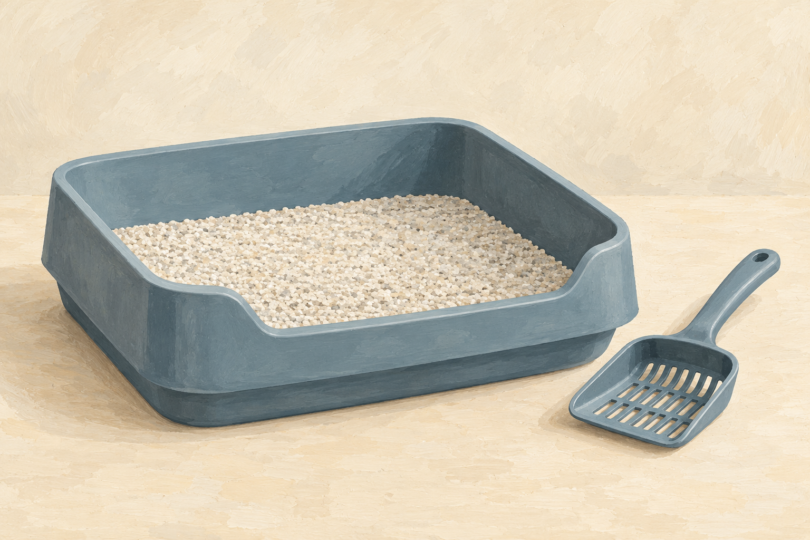
Image note: Generic editorial illustration of cat litter supplies; the image does not demonstrate or verify a dust-free performance claim.