

For caulking a sound, leak-free toilet base, GE Advanced Silicone 2 Kitchen & Bath is a sensible first option when the toilet and floor manufacturers permit silicone. DAP KWIK SEAL ULTRA offers water-based cleanup, while DAP KWIK SEAL PLUS is the paintable alternative. The right choice depends on your floor finish, the fixture instructions and how long you can keep the joint dry.
These products seal the exposed joint between the toilet and floor. They do not repair a failed wax ring or wax-free waste seal, a damaged flange, loose mounting hardware or a cracked toilet. Water appearing during a flush, persistent dampness or rocking calls for diagnosis before new caulk.
This is a comparison of manufacturer documentation, not a hands-on adhesion, leak or mold-resistance test. Prices and stock have not been verified.
Three caulks to consider for a toilet base
| Product | Why consider it | Water exposure guidance | Paintable? |
|---|---|---|---|
| GE Advanced Silicone 2 Kitchen & Bath, white 10.1 fl oz, item 2812565 | 100% silicone for a compatible, unpainted bathroom joint | 30 minutes only under the specified conditions below | No |
| DAP KWIK SEAL ULTRA, white 10.1 fl oz, code 18897 | Water-based formula with water cleanup | At least 4 hours; longer in cool or humid conditions | No, according to the linked white/biscuit technical sheet |
| DAP KWIK SEAL PLUS, white 5.5 fl oz, code 18526 | Paintable squeeze-tube option | 18 hours in the linked white-product technical sheet | Yes; follow label drying requirements |
Compare the exact package and color against its current label. Similar names do not mean identical chemistry, drying schedules or cleanup methods. In particular, KWIK SEAL ULTRA and KWIK SEAL PLUS have different painting instructions.
1. GE Advanced Silicone 2: for a compatible unpainted joint
This is the most straightforward starting point when you want a 100% silicone bathroom sealant and do not need paint over the bead. GE lists porcelain and ceramic tile among the compatible surfaces and offers both cartridges and small squeeze tubes. White suits a deliberately visible finishing line; clear is worth considering when you prefer the floor color to show through.
The technical sheet identifies white 10.1 fl oz as item 2812565 and white 2.8 fl oz as 2812566. Its fast water-exposure claim requires a bead no larger than 3/16 inch, at least 65°F and at least 50% humidity. Otherwise, it specifies an eight-hour wait. It also says not to touch or clean the sealant for 24 hours or until fully cured.
Main limitation: it is not paintable. Check substrate compatibility, especially on treated stone, specialty coatings or unfamiliar flooring. A bathroom-use label is not a blanket approval for every floor finish.
Listing to compare: GE Advanced Silicone 2 Kitchen & Bath, white 10.1 fl oz cartridge, item 2812565.

GE Advanced Silicone Caulk for Kitchen & Bathroom, White, 10 fl oz Cartridge, 1 Pack - 100% Waterproof Silicone Sealant, 5X Stronger Adhesion, Shrink & Crack Proof
As an Amazon Associate we earn from qualifying purchases.
2. DAP KWIK SEAL ULTRA: for water-based cleanup
ULTRA is an alternative when easier wet-material cleanup matters. DAP describes it as an interior, water-based kitchen-and-bath sealant suitable for surfaces including granite and marble when used as directed. The selected cartridge is the white 10.1 fl oz version, code 18897.
The white/biscuit technical sheet distinguishes four-hour water readiness from a typical 24-hour full dry-through. It explicitly lists the product as non-paintable. Do not buy it on the assumption that all water-based caulks can be painted.
Main limitation: the early water-exposure time is conditional, with additional drying needed in cool or humid conditions. Choose it for its documented application characteristics, not because its name sounds like a guaranteed performance upgrade over every silicone.
Listing to compare: DAP KWIK SEAL ULTRA, white 10.1 fl oz cartridge, code 18897.

3. DAP KWIK SEAL PLUS: when paintability matters
PLUS is a siliconized latex adhesive sealant, rather than a 100% silicone product. The white 5.5 fl oz squeeze tube, code 18526, is a convenient format for someone who does not own a caulking gun. DAP also lists a white 10.1 fl oz cartridge, code 18510.
Its white-product technical sheet permits painting and calls for 18 hours before water exposure. That is a different schedule from ULTRA. Use the current package directions if the product you buy has revised instructions.
Main limitation: it needs a longer protected drying window than the faster water-ready options above. It is not intended for continuous underwater use. Paintability is useful only if the surrounding finish actually needs it; painting a toilet-base bead is not automatically necessary.
Check the toilet before choosing the tube
Start with the source of any water. Kohler’s installation guide treats the waste seal, mounting and leak test as separate tasks from the final caulk bead. An exterior sealant cannot substitute for the internal connection that carries wastewater into the drain.
If the toilet moves, the base is wet, the floor feels soft or the joint repeatedly opens, have a plumber check the installation. Covering the symptom can make the next inspection harder. Once the fixture is stable and leaks have been ruled out, consult the instructions for that toilet model and your installer’s applicable local requirements.
Buying and preparation checklist
- Identify both surfaces. Record the toilet material and exact floor finish. Ask the sealant or flooring manufacturer about uncertain compatibility before applying anything.
- Choose a workable format. A squeeze tube avoids buying a gun; a cartridge may make sense for several bathroom joints. Compare usable quantity rather than multipack count.
- Check age and condition. Buy an intact package within its stated shelf life or use-by date. An old, partly cured tube is a poor starting point.
- Plan drying time. Keep cleaning water and accidental splashes away for the full period required by the product and conditions.
- Prepare the joint. GE’s recaulking guide emphasizes removing failed old material and preparing a clean, dry surface. Do not cover dirt or dampness with a fresh bead.
- Follow the specific handling directions. Use compatible cleaners and the label’s ventilation, protective-equipment and tooling instructions. Cleanup advice for an acrylic product should not be transferred to silicone.
Frequently asked questions
Will caulk stop water leaking from beneath the toilet?
It will not repair the underlying cause. Stop using a toilet that is leaking wastewater and arrange appropriate repair. After the leak is fixed and the area is dry, the perimeter joint can be finished as required.
Should I leave a gap at the back?
Do not treat internet advice about a rear gap as a universal installation rule. Ask the installer how the specific toilet instructions and local requirements apply, and how future leaks will be detected. A gap is not a substitute for checking the waste seal.
Does mold-resistant mean I never need to clean it?
No. GE’s technical sheet explains that residue can support secondary mold growth even on a resistant cured sealant. Follow the product’s cleaning guidance and investigate recurring moisture.
Is silicone grease, plumber’s tape or caulk tape equivalent?
No. Those are different product categories. Do not substitute them for a specified bathroom joint sealant or for the toilet’s waste seal.
How we selected these options
We compared identifiable US variants, linked manufacturer product and technical pages, and prioritized material compatibility, paintability and water-exposure limits. These three choices cover different practical needs; their order is not a laboratory ranking or a prediction of service life in your bathroom.
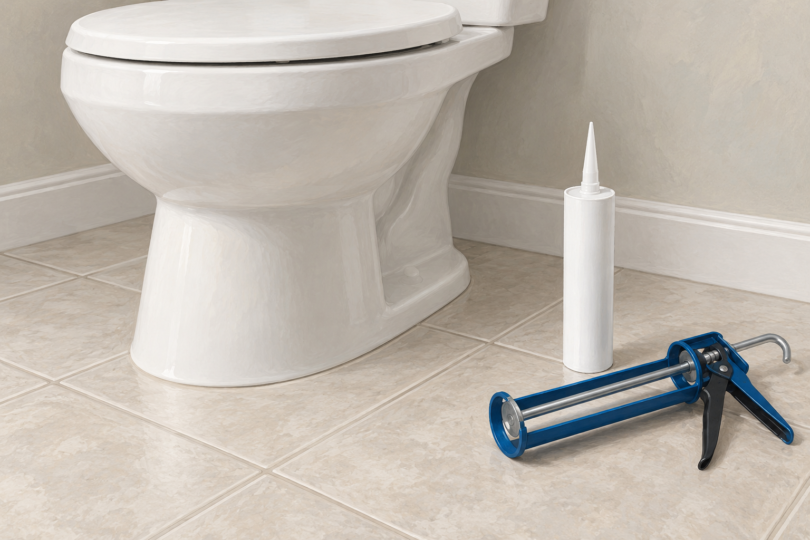
Image note: Generic editorial illustration of toilet-base caulking supplies; it does not demonstrate installation or repair of a leak.

