
The best automobile ramps for oil changes are the ones whose load rating, tire-width limit and approach geometry all suit your particular vehicle. Compare the Pittsburgh 63956 for a compact 6-inch-lift option with a narrow published tire limit, the Race Ramps RR-56 for an 8-inch lift and shallower approach, and the standard RR-XT for a 10-inch lift and wider tires.
There is no universal winner here. A large weight number cannot compensate for an incompatible tire or a bumper that hits the incline. These are specification-based comparisons, not results of load tests or an authorization to work underneath a vehicle.
Manufacturer information checked October 4, 2026. Ratings below apply to the exact versions identified. Follow the label and instructions supplied with your ramps and the vehicle manufacturer’s service requirements.
Three car ramp sets compared
| Exact ramp set | Published load limit | Published tire-width limit | Lift / approach / length | Main limitation |
|---|---|---|---|---|
| Pittsburgh 63956, 2-piece set | 6,500 lb per pair; 3,250 lb per ramp. Seller separately lists 13,000 lb GVWR | 7-1/4 in. | 6 in. lift; 17° approach; 35-1/2 in. long | Narrow tire allowance and steeper approach |
| Race Ramps RR-56, one-piece ramps | 1,500 lb per ramp; 3,000 lb maximum supported axle | 10 in. | 8 in. lift; 10.8° approach; 56 in. long | Axle load remains limited even if total vehicle weight seems acceptable |
| Race Ramps RR-XT, standard one-piece ramps | 1,500 lb per ramp; 3,000 lb maximum supported axle | 12 in. | 10 in. lift; 10.8° approach; 67 in. long | Larger footprint; the extra lift does not increase capacity |
The Race Ramps axle limits come from the RR-56 manual and RR-XT manual. Other versions, including two-piece and heavy-duty models, have their own instructions. A similar family name is not enough to transfer a rating.
GVW, GVWR and pair capacity are not interchangeable
A vehicle-weight headline describes the vehicle as a whole. The pair capacity describes the load allowed on the two ramps; a per-ramp figure limits each individual support. A vehicle’s weight is not necessarily divided equally between its front and rear axles or between individual wheels.
The two ratings shown for the Pittsburgh are deliberately separated in the table. Race Ramps likewise advertises the RR-56 for vehicles up to 6,000 lb, while its manual caps the supported axle at 3,000 lb. A vehicle-weight headline does not authorize placing that full load onto a ramp pair.
Do not estimate suitability by dividing a vehicle’s advertised curb weight by two or four. Have the ramp manufacturer or a qualified mechanic verify the applicable vehicle, axle and individual-ramp requirements if the loading information is unclear. Passengers, cargo and modifications also make a brochure comparison incomplete.
Which set is worth considering?
Pittsburgh 63956: compact, with a restrictive tire limit
The 63956 specification sheet gives it a 12-inch overall body width. Do not mistake that for its much narrower tire allowance. Its shorter length may suit a small garage, but check the incline against your bodywork.
Consider it when: your verified load, tire and clearance measurements fit. Choose something else when: you would need to ignore a listed limit to make it work.
Race Ramps RR-56: a shallower approach with an 8-inch lift
The RR-56 uses a longer incline than the Pittsburgh and has a lower published approach angle. Its stated lift is 8 inches; overall ramp height is 10 inches. Those numbers describe different dimensions.
Consider it when: a 10-inch tire limit and 3,000 lb axle limit fit your car, and your clearance check supports its approach. Trade-off: two 56-inch ramps take substantial storage space. The standard one-piece version does not have the removable approach section of the RR-56-2.
Race Ramps RR-XT: more lift and tire width, same standard load limit
The standard RR-XT provides two more inches of lift than the RR-56 and accepts tires up to 12 inches wide. Its overall body is 14 inches wide and its length is 67 inches.
Consider it when: the wider tire allowance or additional lift matters and the vehicle meets every load and geometry requirement. Trade-off: it needs more space, and its standard 3,000 lb supported-axle limit is unchanged. Do not assume a standard XT has the separate heavy-duty version’s rating.
What to check before spending money
Clearance means more than ground clearance
The lowest front or rear overhang, splitter, air dam and the distance between that point and the tire all affect ramp compatibility. A “low profile” label does not prove fit. Use the ramp maker’s clearance-check method and confirm the exact vehicle configuration, including aftermarket bodywork. Race Ramps includes a vehicle approach-angle calculator on its product pages.
Match the allowed tire width, rather than the outside width of the ramp. If the maker’s width measurement is unclear for your tire, ask before purchasing. Race Ramps’ FAQ additionally excludes heavy-lug mud tires and extra-narrow tires from the applications it describes.
Check space and the intended job
Account for ramp length, room around the vehicle, storage and any drain equipment required by the service procedure. Lift height is not a measurement of the final usable gap everywhere beneath the car.
Vehicle service requirements still apply. For example, Kia’s oil-level instructions require level ground. A pair of ramps raising one end does not make the car level. Consult the correct manual for your vehicle rather than using this shopping comparison as an oil-change procedure.
Safety limits that should affect your purchase
Working beneath a vehicle can cause fatal crushing injuries if the vehicle or its supports move or fail. If you cannot verify the setup or follow the complete manufacturer instructions, use a qualified service facility.
The linked Race Ramps manuals require undamaged ramps, dry, hard, level ground and full contact between the ramp base and the ground. They require chocks for tires remaining on the ground and specify the parking-brake and transmission precautions. Read the complete manual for the exact product; a short buying guide cannot replace it.
The same manuals prohibit using two ramps along one side of a vehicle and prohibit disconnecting wheels, brakes or specified drivetrain components while supported on these ramps. This makes them a different tool from equipment used for wheel-off repairs. Choose professional service when the job falls outside the ramps’ intended use.
Do not improvise extensions, stack supports or use a ramp to bridge a gap. Race Ramps’ published guidance warns against combining its products with wood, metal or other materials. Any extension must be the manufacturer’s compatible part and used according to its own instructions. We do not adopt broad marketing claims that ramps cannot slip on any surface.
Frequently asked questions
Does a 13,000 lb vehicle rating mean 13,000 lb can rest on the pair?
No. Read the separately stated pair and individual-ramp limits. A headline about the whole vehicle does not change those working-load limits.
Will the taller ramp work with every low car?
No. Lift height, approach angle and body overhang describe different constraints. Measure the vehicle and use the manufacturer’s fit-check method before deciding.
Are these suitable for removing wheels?
The Race Ramps instructions expressly prohibit disconnecting wheels while the vehicle is on these ramps. Wheel-off work requires a different approved support arrangement and appropriate expertise.
Are wheel chocks included?
Do not assume so. Harbor Freight explicitly lists additional chocks as separately sold. Check the exact package and allow for the compatible restraint equipment required by its instructions.
How we made this comparison
We reviewed current primary product specifications and the manufacturer manuals linked above. Selection focuses on three distinct lift and tire-fit combinations, with both per-ramp and supported-axle limits made visible. We did not drive onto these ramps, inspect individual units, test load capacity or compare long-term durability. Prices, stock and retailer review scores are not used as evidence of safety. Read the supplied instructions and inspect the actual rating labels before use.
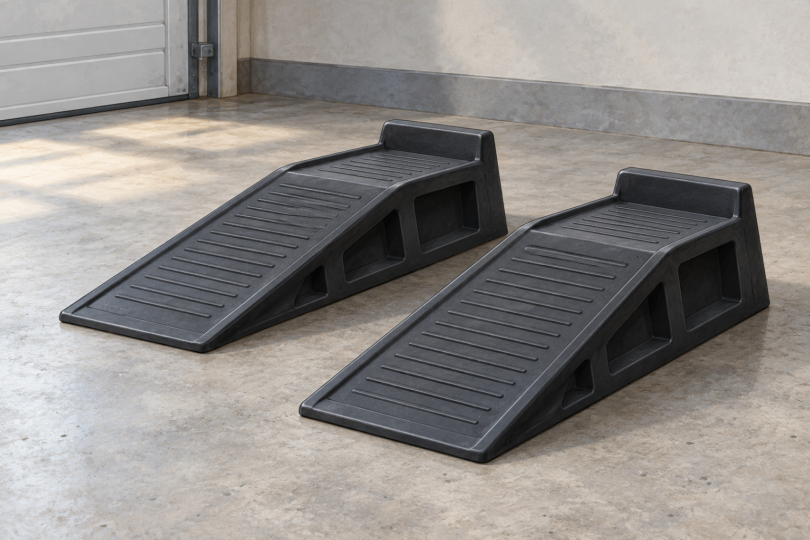
Image note: Generic editorial illustration of empty vehicle ramps; it does not demonstrate installation, loading, vehicle compatibility or a safe working setup.