
For a stock Jeep Wrangler’s emergency tire change, first check the correct factory jack and tools for your VIN. For a modified Jeep, compare a properly matched high-reach floor jack or bottle-jack system only after verifying the lifting point, collapsed height, required reach, and load capacity. Tire size or a “3-ton” label alone cannot establish fit.
A TJ, JK, JL, 4xe, or other Wrangler configuration can have different equipment and requirements. Use the owner’s manual for the exact model year and powertrain, plus the jack manufacturer’s instructions. This is a buying guide, not a substitute for those lifting procedures.
Research disclosure: We reviewed manufacturer product specifications and Jeep/Mopar safety information on October 4, 2026. We have not lift-tested these jacks, checked a particular owner’s Jeep, or verified current prices and stock.
Three candidates to compare
| Option | Use to investigate | Documented feature | Main buying check |
|---|---|---|---|
| VIN-matched Mopar factory jack | Emergency tire changes on the approved vehicle configuration | Vehicle-specific jack, tools, and stowage parts | Correct year/variant and any tire or suspension changes |
| Pro Eagle 3-ton Kratos | A rolling jack where extra reach and transport space are available | 6-inch minimum; 28-inch maximum with supplied extension | Lift-point access, saddle compatibility, capacity, and size |
| Safe Jack 6-ton “The General” kit | A bottle-jack system with matched adapters and extensions | Jack, lift pads, extensions, base plate, and chocks | Minimum clearance with a flat tire and approved component combination |
1. Mopar factory jack: the starting point for a stock vehicle
The official Mopar jack-stowage catalog shows the scissors jack and associated tools for one example, a 2025 Wrangler Sport 2.0L. That listing is not a part-number recommendation for every Wrangler. Have Mopar or a dealer match the assembly and missing tools to your VIN.
Why consider it: It is the logical first comparison when replacing missing original equipment and retaining the factory tire-change arrangement. Check that the handle pieces, lug wrench, storage hardware, and any wheel-lock key are present.
Limits: Jeep describes its supplied jack as a tire-changing tool, not a service lift. Larger tires, modified suspension, or changed lift-point access require a fresh assessment. Do not assume the original jack still has adequate reach simply because it fits the storage compartment.
2. Pro Eagle Kratos: reach with a substantial storage penalty
The 3-ton Kratos, SKU ORJ3B4X, has large non-pneumatic wheels and a full-length skid plate. Pro Eagle lists a 6-inch minimum height without the extension and a 28-inch maximum with the supplied 8-inch extension. The advertised 35-inch maximum requires the optional 15-inch extension.
Why consider it: This gives a Wrangler owner a specific high-reach rolling-jack option to evaluate with a qualified shop. The manufacturer lists its weight as 68 pounds and its footprint as 31 by 14.5 inches, so measure the intended storage space and consider how you will load and secure it.
Limits: Extra height and big wheels do not make every surface suitable for lifting. The jack must still be used within the vehicle and jack instructions. Pro Eagle’s extension documentation also identifies brand-specific compatibility; do not transfer extensions to an unrelated jack or improvise a taller saddle.
3. Safe Jack “The General”: assess the minimum height carefully
The 6-ton General kit, SKU 37M-GENERAL, combines a bottle jack with an extension collar, fixed and adjustable extensions, flat and round lift pads, a base plate, wheel chocks, and a storage can. It is a useful package to investigate when you want a matched component system instead of separately sourced adapters.
Buying checks: The linked 6-ton jack listing gives the bare jack a height range of 8.30–16.30 inches. A pad or adapter changes the required starting clearance. Have the supplier verify the exact kit contents and configuration against your approved lift point and flat-tire clearance.
Limits: Extension height and hydraulic travel are different. A tall assembled setup may reach the vehicle but still be unsuitable for the required lift. Use only the manufacturer’s permitted combinations and instructions. A base plate is not permission to work on unstable ground.
Take these measurements and details to the supplier
- Vehicle identity: Supply the year, generation, two- or four-door configuration, powertrain, and modifications. Include 4xe or special-edition details where relevant.
- Loaded vehicle: Account for accessories and carried equipment. Ask the manufacturer or qualified shop to confirm capacity for the intended lift; do not simply divide curb weight by four.
- Approved lifting point: Verify it in the exact vehicle instructions. Check saddle shape and access around suspension, skid plates, brakes, and other equipment.
- Collapsed clearance: Ask the shop to evaluate clearance in a flat-tire scenario, not only with all tires inflated.
- Required lift: Confirm usable reach and stroke for that lifting point and tire size. Suspension droop and the lift method affect the answer.
- Storage and maintenance: Plan secure retention, safe handling, periodic inspection, and access to replacement parts. Include approved accessories in the total quote.
Safety requirements come before convenience
The 2024 Wrangler manual requires a firm, level surface and the specified lifting locations. It warns against going beneath a vehicle supported by its jack and directs owners needing underbody access to a service center with a lift. Follow your own year’s manual for wheel chocking and the complete tire-change procedure.
Never crawl under a Jeep supported only by a jack. Maintenance requires an appropriate professional lift or correctly rated stands positioned and used under the applicable service instructions by someone competent to do so. If the roadside position or ground is unsafe, call roadside assistance rather than attempting the lift.
Frequently asked questions
Is a Hi-Lift the best jack for every Wrangler?
No. The Hi-Lift manual warns about slipping from unsuitable curved or tubular bumpers and about rapid handle movement. Factory plastic bumpers, steps, and unverified rock rails are not universal lifting points. Confirm an approved interface and obtain proper training before considering this type of jack.
Will a 3-ton jack definitely work?
Capacity is only one check. It must also fit beneath the approved point, have sufficient usable lift, make proper contact, and suit the manufacturer’s permitted operating conditions.
Can I add blocks to make a short jack reach?
Do not improvise stacked blocks or homemade extensions. Ask for a compatible, manufacturer-approved lifting system and use roadside or professional help when the available equipment cannot perform the job safely.
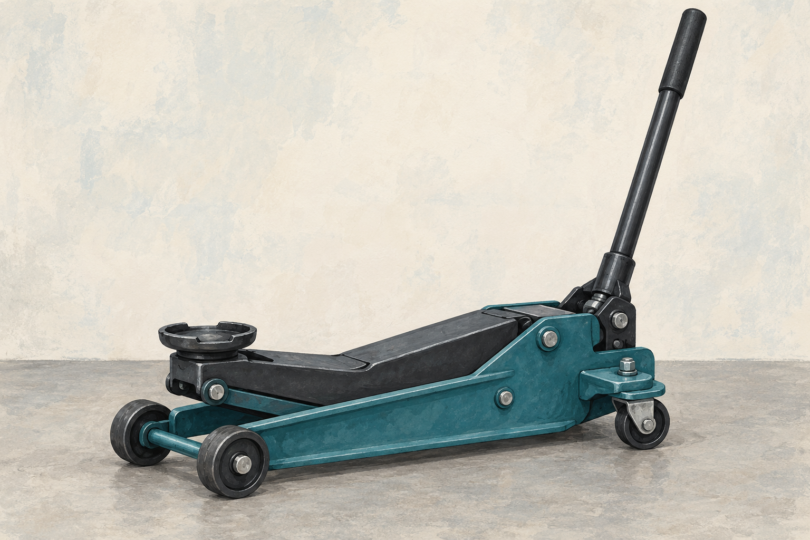
Image note: Generic editorial illustration of an unused floor jack; no Jeep fitment, load capacity, lift point or safe support setup is demonstrated.