
If you are shopping for a heat torch for ordinary heat-shrink tubing, start by checking a controllable electric heat gun instead. The useful features are a suitable temperature range, manageable airflow and an approved nozzle for the job. A hotter flame is not automatically a better heat source.
Use an open-flame torch only when the exact tubing or cable-accessory manufacturer explicitly permits it for that product and the work environment allows it. A method intended for a specialist cable system should not be copied onto small electronic wiring.
Research checked October 4, 2026. We reviewed manufacturer product pages, tubing data and safety instructions. We did not test shrink quality, temperature accuracy or tool durability. Prices, stock and kit contents beyond the cited manufacturer information are not independently verified.
Two heat guns worth comparing
| Model | Published controls | Potential fit | Check before purchase |
|---|---|---|---|
| Wagner FURNO 500 | 12 temperature settings, 150–1200°F; two fan settings | Occasional tubing work alongside other permitted heat-gun jobs | Preset temperatures, airflow and nozzle arrangement suit the tubing |
| STEINEL HL 2020 E, item 110025597 | Adjustable 120–1150°F range; LCD; staged airflow | Work where adjustable settings and heat warnings are useful | Exact regional model, accessories and required process controls |
Neither model is a universal recommendation for every sleeve, connector or cable kit. The tubing’s installation requirements remain the deciding specification.
1. Wagner FURNO 500: a general-purpose option
Wagner explicitly lists electric heat-shrink tubing among the FURNO 500’s applications. The product page documents 12 temperature settings, two fan settings, a cool-down mode and an integrated stand. It identifies a glass-protector nozzle and flare nozzle as included accessories.
Consider it if its preset choices fit your tubing and you also need a general-purpose heat tool. Controls offer a more deliberate selection process than choosing a flame by appearance.
Limits: the preset temperatures are not infinitely variable. Do not assume a tubing reflector comes in the box, or that every setting is appropriate for wiring. Confirm nozzle compatibility and the complete kit before buying. A cool-down mode does not guarantee that the metal nozzle is safe to touch immediately.
2. STEINEL HL 2020 E: compare for adjustable control
The US HL 2020 E, item 110025597, is documented for shrinking tubes and sleeves onto cables. STEINEL lists 120–1150°F adjustment, an LCD, a residual-heat indicator and a heat-build-up warning. The page specifies 120 VAC, 60 Hz and 1600 watts.
Its published airflow stages are 4, 4–8 and 6–13 CFM. Consider this model when its control range and compatible accessories fit the work better than a simpler preset tool.
Limits: those are manufacturer’s specifications, not our measurements at a workpiece. Confirm which nozzles are included versus optional. Match the exact item number and local electrical supply; a similarly named overseas model may have different specifications.
Choose the tubing before the heating tool
Identify the sleeve by manufacturer and part number. “Heat shrink” can describe different materials, wall thicknesses and adhesive systems. Check the installation instructions, supplied and recovered internal diameter, permitted substrate, environmental rating and required temperature conditions.
For example, the 3M FP-301 data sheet describes flexible polyolefin tubing with a 2:1 shrink ratio and a minimum shrink temperature of 100°C/212°F. That is information about this tubing family, not a universal heat-gun setting. Its operating-temperature rating is also a different specification from the heat needed during installation.
A 2:1 designation describes recovery from the supplied diameter; it does not mean an arbitrarily oversized piece will seal every joint. Check the actual diameter range, recovered wall and longitudinal change in the applicable data sheet.
TE Connectivity’s tubing range includes both single-wall and dual-wall products for different protection and sealing tasks. If environmental sealing is required, specify a product and complete connection system documented for that purpose. A visibly tight sleeve alone does not establish a waterproof or electrically compliant joint.
Gun temperature is not tubing temperature
The number selected on a heat gun does not directly state the temperature reached by the sleeve, nearby connector or insulation. Airflow, nozzle geometry, workpiece shape and the manufacturer’s required application method all matter. Treat the tool’s maximum temperature as a capability limit, not the preferred operating point.
For repeat production or sensitive assemblies, ask the tubing supplier about validated processing equipment and verification. TE provides a dedicated Raychem heat-shrink application-tooling catalog. A general-purpose handheld gun may not provide the process control the assembly requires.
When should a torch be considered?
Only after the exact product instructions specify an acceptable flame-heating method and equipment. Specialist energy accessories have their own installation documentation; TE’s energy installation library is organized around specific products and applications.
Without that authorization, do not substitute a lighter, culinary torch or generic propane torch for a controlled heating tool. “Flame retardant” describes a material property under defined conditions; it is not permission to expose any tubing to an open flame. For mains or high-voltage systems, use a qualified installer and the complete approved procedure.
Fire and electrical safety are essential
A heat gun can ignite materials even though it has no exposed flame. The FURNO 500 manual warns about flammable liquids and gases, hidden combustible material, hot nozzles and electrical shock. Keep the work environment consistent with the tool’s instructions, allow safe cooling and never leave a powered heat tool unattended.
Do not apply heat to energized wiring. Have the circuit made safe and verified by a qualified person when necessary. Damaged insulation, uncertain connections or concealed wiring need assessment; heat-shrink tubing is not an automatic repair for every electrical defect.
Frequently asked questions
Will a hair dryer work?
Do not assume its output can satisfy the tubing’s documented recovery requirements. Select equipment supported by the tubing instructions.
Is the highest-wattage gun best?
No. Suitable controls, airflow, accessories and the material’s process requirements matter more than a single power rating.
Does adhesive-lined tubing always make a waterproof joint?
No universal claim is justified. Check the exact tubing, connector, cable and installation requirements for the intended environment.
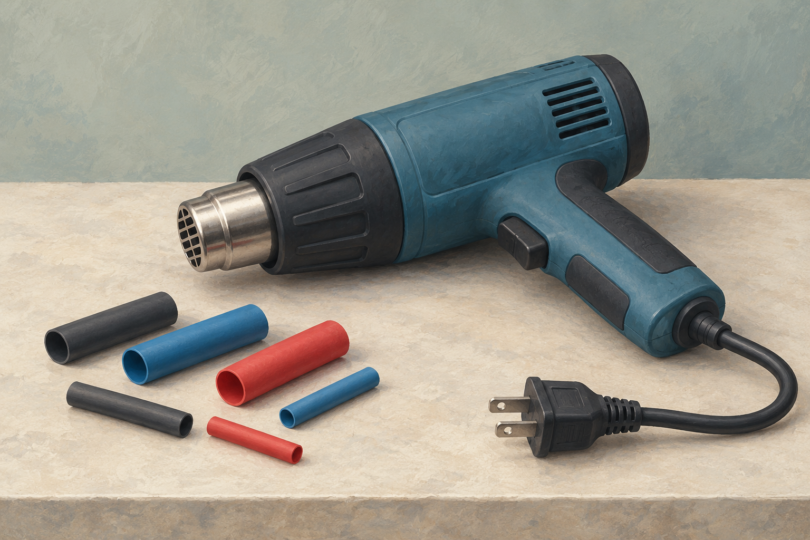
Image note: Generic editorial illustration of heat-shrink supplies; the heat gun is unused and no heating or electrical procedure is demonstrated.