
For irrigation winterization, choose the method and verify the system before choosing an air compressor. Required airflow and permitted air pressure are separate constraints. A compressor that reaches a high pressure is not necessarily capable of clearing the system, and increasing pressure to compensate for insufficient airflow can cause injury and damage.
For most homeowners doing this once a year, a qualified irrigation contractor is the first option to compare with equipment rental or ownership. The right choice depends on the installed pipes, zones, valves, backflow assembly and other components, not simply the lawn’s size.
Research checked October 4, 2026 using manufacturer winterization documents. We have not tested compressors on irrigation systems or verified local service prices, rental availability or equipment stock. This is an equipment-selection guide, not a blowout procedure.
Three practical recommendations
| Option | When to consider it | What to verify |
|---|---|---|
| Qualified irrigation winterization service | Annual household maintenance, unfamiliar systems or sensitive components | Experience with your installation and the exact work included |
| Professionally specified rental compressor | A documented system with a qualified operator and occasional equipment need | Delivered airflow at the permitted pressure, controls, hoses and training |
| A matched compressor purchase | Repeated work or useful year-round shop demand | Written sizing assessment, duty requirements and the complete ownership cost |
1. Professional service: the sensible starting point
Both Rain Bird and Hunter direct homeowners toward professional help because winterization can be hazardous. This is particularly useful when you do not know the pipe material, system layout or condition of the backflow equipment.
Ask the contractor whether the quote includes every irrigation zone, separate drip circuits, pumps or specialty components, and any spring visit. Request an explanation of how they identify the applicable component limits. A company arriving with a large compressor does not, by itself, establish a suitable service.
Trade-off: service is a recurring expense and requires scheduling. Compare an actual written quote with the entire equipment alternative, including transport, accessories, maintenance and your time. No universal payback period is claimed here.
2. Rental: useful when the equipment need is occasional
A rental can avoid storing and maintaining a compressor for a short annual job. However, the rental counter needs more information than the number of sprinkler heads. Have an irrigation professional establish the required delivered airflow, maximum permitted pressure and suitable connection arrangement first.
Rain Bird’s winterization guide illustrates why airflow matters: its described application calls for substantial air volume at limited pressure and warns that small shop compressors may be inadequate. That document is not a sizing guarantee for every installation.
Trade-off: the machine, controls and accessories must be compatible as a complete setup. Ask who verifies the regulator’s suitability and operating range, the hose and fittings, safe transport and operator instruction. If those questions remain unresolved, choose professional service instead.
3. Buying: justify the complete installation
Ownership makes more sense when there are other verified uses for the compressor or frequent professionally managed winterization work. Get the required performance documented before choosing a model.
For perspective, Ingersoll Rand’s SS5L5 specification lists 18.1 CFM at 90 PSI, a 60-gallon receiver and a 230-volt single-phase supply. Those facts describe a compressor; they do not prove irrigation suitability or authorize applying 90 PSI to your system. Its output at the intended operating conditions, controls and installation would still need verification.
Trade-off: include power, space, transport, servicing and pressure-control equipment in the decision. A larger receiver cannot turn insufficient sustained airflow into a properly sized system. Do not buy an oversized high-pressure machine simply because a listing calls it a “sprinkler compressor.”
Airflow and pressure must be evaluated separately
Airflow, commonly expressed in CFM, describes delivered air volume over time. Pressure, expressed in PSI, must remain within the limits established for the actual irrigation assembly. A tank’s maximum rating is neither an irrigation setting nor evidence of adequate flow.
Published manufacturer guidance is not interchangeable. Rain Bird’s homeowner winterization guide sets a 50-PSI ceiling for its described procedure. Hunter’s guidance distinguishes pipe materials and requires staying below the lowest-rated component in the zone. A mixed system can contain components more restrictive than the pipe.
Do not pick the highest number from competing guides. Ask the system manufacturer or qualified contractor to resolve the requirements for your installation. Likewise, a quoted general-purpose CFM range or online sizing formula is a starting question for that assessment, not a guarantee of safe results.
Special components can change the answer
- Backflow prevention: Hunter warns against blowing compressed air through a backflow device. The FEBCO 765 freeze-protection instructions also show that the assembly itself needs model-specific attention. Clearing sprinkler lines is not proof that the backflow assembly is protected.
- Drip irrigation: identify its tubing, filters, regulators and emitters separately. Rain Bird provides a dedicated drip winterization guide; do not transfer a rotor-zone pressure assumption to delicate drip components.
- Pumps and sensors: obtain the specific winterization instructions and include them in the service scope. Their needs may differ from those of the buried pipe.
- Drainage design: some systems use manual or automatic drains. Confirm the installed design before assuming a compressor is required.
Safety checks that affect the purchase
Compressed air stores energy and can propel broken parts. Follow the manufacturer’s eye-protection and exclusion-area guidance. Never try to solve inadequate airflow by releasing a fully charged tank into the irrigation line. Hunter explicitly warns against this practice. Avoid prolonged airflow through dry components, and leave unfamiliar equipment to a qualified operator.
Frequently asked questions
Can I use a pancake compressor?
Do not assume so. Its ability to reach pressure or fill a tank says little about sustained output. Have its documented performance checked against the specific installation.
Is more PSI better?
No. Pressure is limited by the system and its components. It is not a substitute for adequate airflow.
Which compressor is best for every irrigation system?
There is no defensible universal choice. Obtain the system requirements first, then compare suitable equipment or a professional service quote.
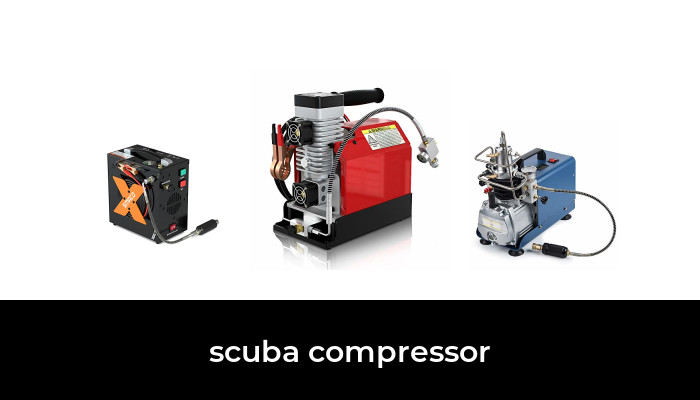
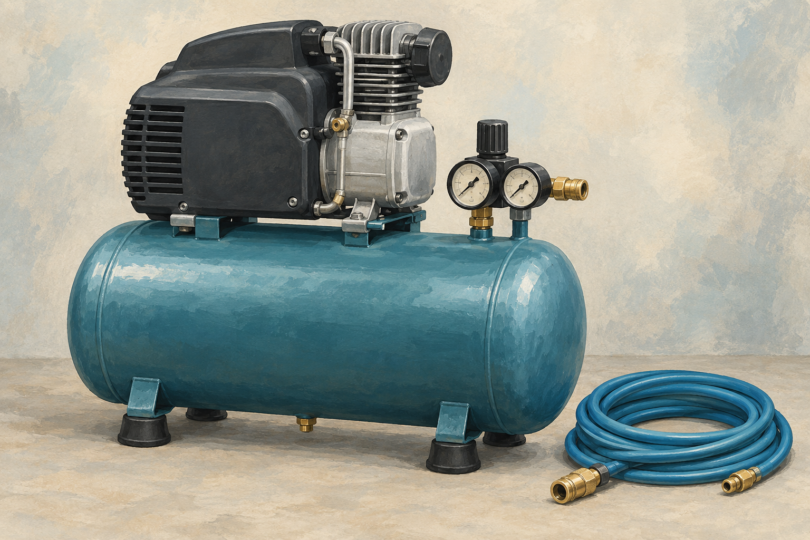
Image note: Generic editorial illustration of an unused air compressor; no model, capacity, spraying setup or irrigation pressure is specified.