
For most small wooden signs, start with a compact router and a compatible plunge base. The Makita RT0701CX7 is a practical corded combination; the Bosch 1617EVSPK suits buyers who also need 1/2-inch-shank bits and broader woodworking capability; the DEWALT DCW600B is a cordless option for existing 20V MAX owners, with its plunge base purchased separately.
Choose the router together with the lettering system, bits and dust extraction. A powerful motor does not guarantee that a template bushing fits, or that a particular cutting bit is safe for the tool.
Research checked October 4, 2026. Recommendations are based on manufacturer specifications, manuals and accessory documentation, not our own cutting, noise or endurance tests. Prices and stock are not verified. Model and package details below refer to the cited US products.
Three routers compared for sign making
| Model | Power and speed | Collet / bases | Good fit | Main limitation |
|---|---|---|---|---|
| Makita RT0701CX7 | Corded, 6.5A; 10,000–30,000 rpm | 1/4-inch; trim and plunge bases included | Compact setup for small signs | No included 1/2-inch collet |
| Bosch 1617EVSPK | Corded, 12A; 8,000–25,000 rpm | 1/4- and 1/2-inch; fixed and plunge bases included | Signs plus broader workshop use | Larger base and greater bulk |
| DEWALT DCW600B | 20V MAX cordless; 16,000–25,500 rpm | 1/4-inch; fixed base included, DNP612 plunge base optional | Cord-free movement around a sign | Battery, charger and plunge base cost extra |
1. Makita RT0701CX7: a compact corded starting point
The RT0701CX7 kit includes the RT0701C motor, trimmer base, plunge base, straight guide and 1/4-inch collet. Makita specifies soft start, electronic speed control and a 1-3/8-inch plunge capacity. The kit suffix matters: a motor-only or different-base package is not an equivalent purchase.
Choose it when: you want a relatively compact setup for lettering and modest edge profiles, with a plunge base already included. You avoid adding a battery platform simply to make occasional signs.
Limitations: do not buy 1/2-inch-shank bits for the supplied collet. Check the sign jig’s fit separately. In particular, the Milescraft compact-router chart lists the RT0701C only with its plunge base. Makita’s general template-guide compatibility language does not establish that every aftermarket plate fits every base.
2. Bosch 1617EVSPK: for signs and a wider range of woodworking
The Bosch combination kit supplies RA1161 fixed and RA1166 plunge bases plus both 1/4- and 1/2-inch collets. Bosch lists a 2-1/4-inch plunge depth and a 6-11/16-inch plunge-base diameter. This larger two-handle setup deserves consideration when the router must do more than lettering.
Choose it when: your approved bit selection includes 1/2-inch shanks, or you want a workshop router for several kinds of joinery and shaping. Its wider accessory scope is the reason for the recommendation; we have not measured faster cutting or better finish against the compact models.
Limitations: the bulkier base may be less convenient on small sign blanks. Budget for the appropriate dust hood and template-guide hardware. Bosch lists the RA1129 adapter set as optional; do not assume it is in the case. Check the base opening, bit dimensions and jig instructions even when the collet fits.
3. DEWALT DCW600B: for an existing cordless setup
The DCW600B tool-only package includes a fixed base and wrench, with battery and charger sold separately. It has dual LEDs, soft start and an electronic brake. DEWALT explicitly identifies the optional DNP612 plunge base for this router.
Choose it when: you already own compatible batteries and want to avoid managing a power cord around templates. Include the battery in your handling assessment; tool-only weight does not describe the working setup.
Limitations: its manual specifies 1/4-inch-shank cutters and prohibits router-table use. It also limits cutter diameter to 1-3/8 inches. An electronic brake does not make a moving cutter safe to touch or set down.
Plunge, trim or larger router?
A plunge base provides controlled vertical movement into the work and is the configuration to investigate for letters that begin inside a board. A fixed trim base is useful for suitable edge work, with depth established beforehand. Choose the base required by the intended cut and template system rather than trying to improvise an entry method.
A larger router offers different bit and accessory possibilities, but more motor capacity alone does not make delicate lettering easier. Base support, visibility, comfortable control and a secure jig matter. Plunge travel also is not a recommendation for cutting that deep in one pass.
Check bits, bushings and templates together
- Match the shank exactly. Cutting diameter and shank diameter are different measurements. A 1/4-inch shank is not interchangeable with a 6mm shank.
- Choose the intended lettering profile. V-groove and round-bottom lettering need different cutters. Follow the jig maker’s specified bit and guide combination.
- Verify the complete interface. Check router model, base, mounting pattern, guide-bushing diameter and bit clearance. The Milescraft SignPRO, for example, uses its own baseplate system and supplied 5/8- and 7/16-inch guide bushings.
- Compare full setup costs. Include cutters, guides, suitable clamps, collection fittings and any needed batteries. A lower tool-only price may leave important parts missing.
Dust control and workholding belong in the purchase
Plan to secure both the sign blank and template to a stable support, with clearance for the base and cutter. Read the tool and jig manuals before work. Disconnect power or remove the battery before accessory changes, and use the specified eye, hearing and respiratory protection. Follow the bit manufacturer’s speed limits.
OSHA’s wood-dust guidance identifies collection at or near the source as a primary control. Check the exact base’s dust attachment and hose fit; a chip shield is not a dust extractor. No router on this list is presented as dust-free or as establishing workplace compliance by itself.
Frequently asked questions
Can a trim router make wooden signs?
Yes, with an appropriate bit, supported base and compatible guiding system. For interior lettering, investigate a compatible plunge setup first.
Does every “universal” sign jig fit?
No. Check the manufacturer’s model-and-base chart. A router motor can fit one baseplate configuration and fail to fit another.
Should I buy the highest-horsepower model?
Choose around the actual cuts and accessories. Small lettering alone does not justify a heavy full-size router, and marketing horsepower figures do not establish lettering quality.
Can I mount the DEWALT DCW600B in a router table?
No. Its cited manual says not to use it in a router table. Choose a tool and mounting system explicitly documented for that use.
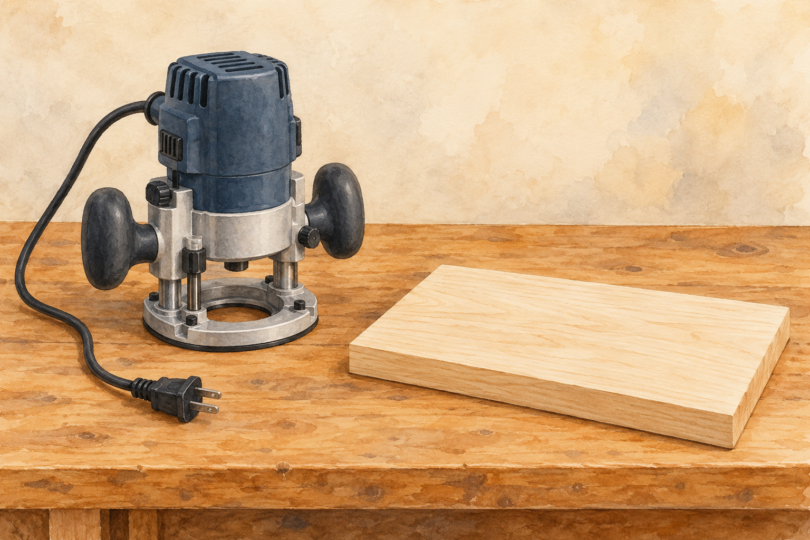
Image note: Generic editorial illustration of a stationary unplugged router and an unused wood blank; no specific product, cutting method or safe-use procedure is demonstrated.